
HDTree: Generative Modeling of Cellular Hierarchies for Robust Lineage Inference
Abstract
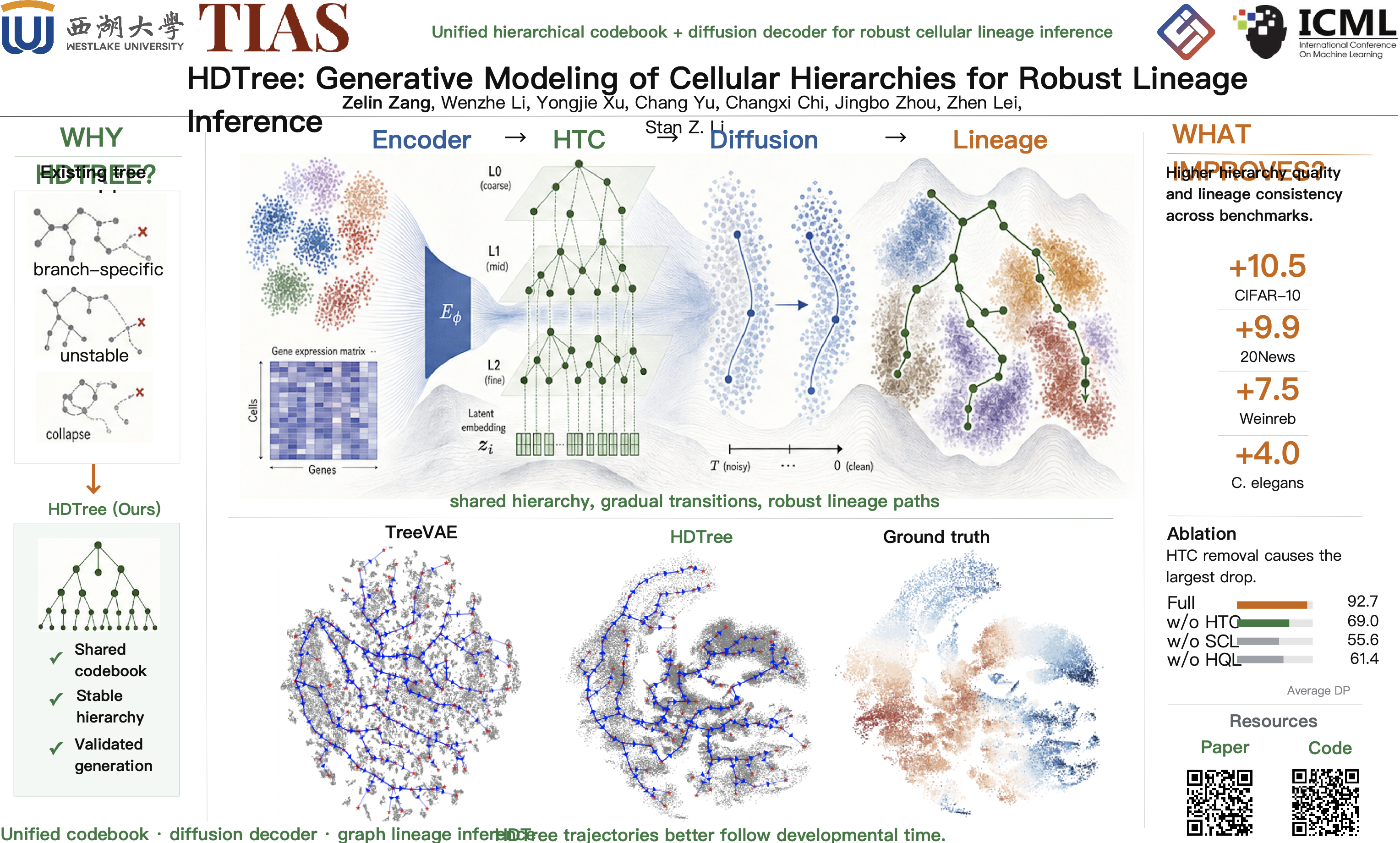
In single-cell research, tracing and analyzing high-throughput single-cell differentiation trajectories is crucial for understanding biological processes. Key to this is the robust modeling of hierarchical structures that govern cellular development. Traditional methods face limitations in computational cost, performance, and stability. VAE-based approaches have made strides but still require branch-specific network modules, limiting their scalability and stability, while often suffering from posterior collapse.To overcome these challenges, we introduce HDTree, a generative modeling framework designed for robust lineage inference. HDTree captures tree relationships within a hierarchical latent space using a unified hierarchical codebook and employs a quantized diffusion process to model continuous cell state transitions. By aligning the generative process with the Waddington landscape, this method not only improves stability and scalability but also enhances the biological plausibility of inferred lineages. HDTree's effectiveness is demonstrated through comparisons on both general-purpose and single-cell datasets, where it outperforms existing methods in lineage inference accuracy, reconstruction quality, and hierarchical consistency. These contributions enable accurate and efficient modeling of cellular differentiation paths, offering reliable insights for biological discovery.
Lay Summary
Just like a single seed grows into a complex tree with many different branches, a basic cell in the body develops into many highly specialized cell types over time. Mapping this "family tree" of cell development is critical for understanding biology and disease. However, existing computer programs often struggle to track these paths accurately and efficiently, especially as the branching becomes more complex. To solve this, we created a new AI tool called HDTree. Instead of using clunky, pieced-together methods like previous models, HDTree uses a single, streamlined framework to smoothly and reliably map out how cells mature and change states. By designing our AI to mimic the natural, continuous way cells develop in real life, HDTree avoids the crashing and mapping errors common in older systems. When tested against current state-of-the-art tools, HDTree proved significantly better at accurately rebuilding these cellular family trees. Ultimately, this tool provides scientists with a faster, more reliable way to track cellular development, paving the way for new biological discoveries.