
PINNfluence: Interpreting PINNs through Influence Functions
Abstract
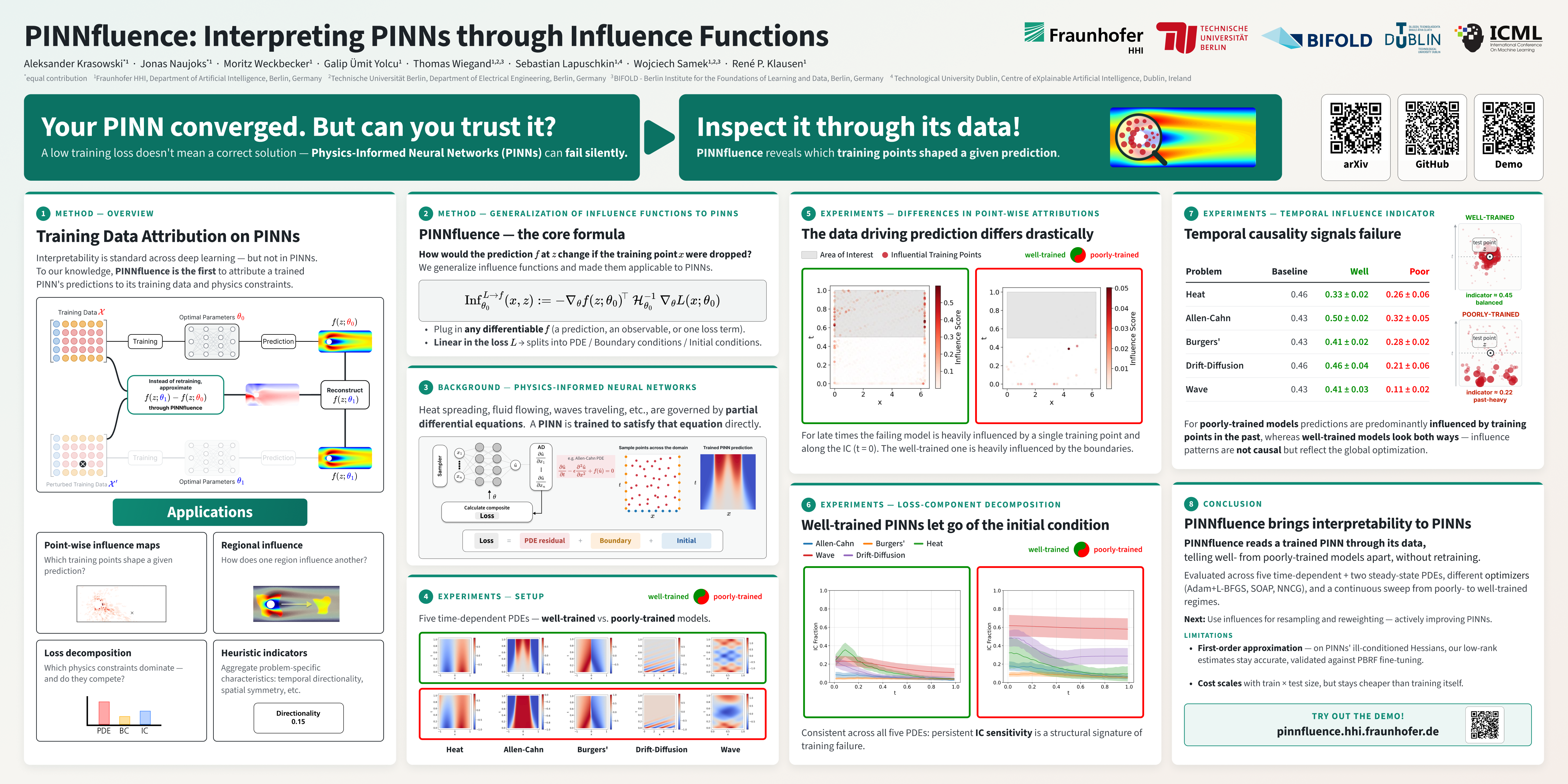
Physics-informed neural networks (PINNs) have emerged as a powerful deep learning approach for solving partial differential equations (PDEs) in the physical sciences, yet their behavior remains largely opaque and is typically understood through failure mode analyses rather than explicit interpretability. To address this issue, we introduce PINNfluence, a training data attribution framework for interpreting PINNs based on influence functions. By extending influence functions to composite physics-informed training objectives, we enable fine-grained attribution between predictions, loss components, and training data points. Through benchmark experiments across various PDEs, we demonstrate that influence patterns provide granular diagnostics that distinguish structural characteristics across well-trained and poorly-trained PINNs. PINNfluence thus opens a new avenue for understanding and improving the reliability of PINNs through the lens of their data.
Lay Summary
Scientists increasingly use a kind of AI that learns to simulate physical processes -- how heat spreads, fluids flow, or waves travel -- by building the underlying physical laws into its training. But these models can fail quietly: they sometimes look like they have solved the problem while actually getting it wrong, and it is hard to see why. We built a method that traces a model's predictions back to the training points and physical rules that shaped them, without retraining it. This shows what the model is actually relying on. Poorly-trained models, it turns out, cling to their starting conditions, while well-trained ones draw on the whole problem. That difference gives researchers a new way to tell a trustworthy physics model from a broken one, and ultimately to make them more reliable.