
Metric—Phase Fields: Decoupling Distance and Sign for Thin-Structure Reconstruction from Unoriented Point Clouds
Abstract
Lay Summary
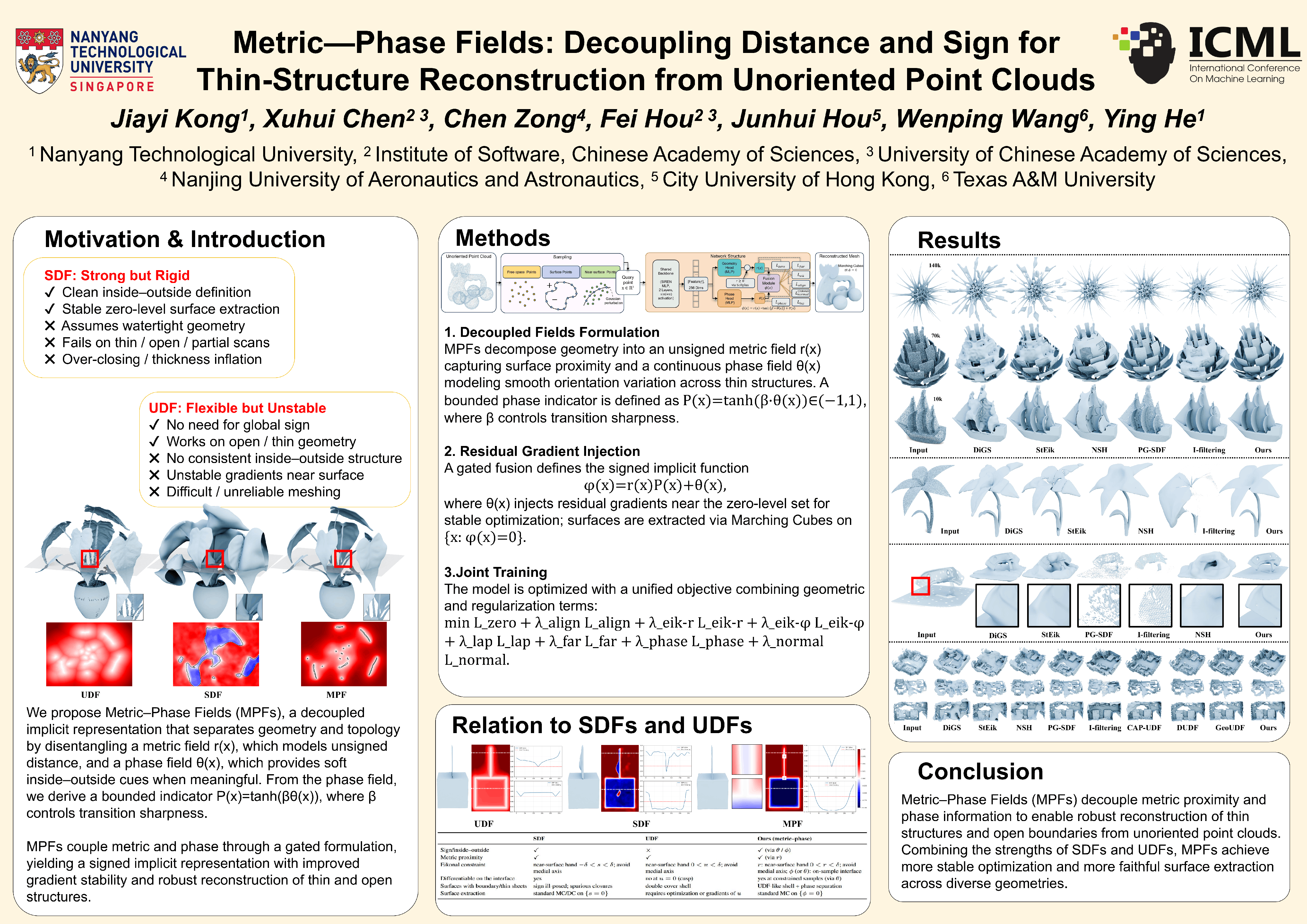
Existing neural 3D reconstruction methods often struggle with thin structures such as shells, plates, and layered surfaces. Methods based on signed distance fields usually produce smooth closed surfaces but have difficulty handling thin or open geometries, while unsigned distance field methods are more flexible but can become unstable during training and surface extraction. We introduce Metric—Phase Fields (MPFs), a new representation that separates geometric distance from structural phase information when reconstructing shapes from unoriented point clouds. By learning these two components independently and combining them in a smooth and adaptive way, MPFs produce more stable surface representations with reliable near-surface behavior. Experiments on both synthetic and real scanned data show that our method reconstructs thin and layered structures more faithfully than recent approaches, while also improving training stability and surface extraction robustness.