
Video-o3: Native Interleaved Clue Seeking for Long Video Multi-Hop Reasoning
Abstract
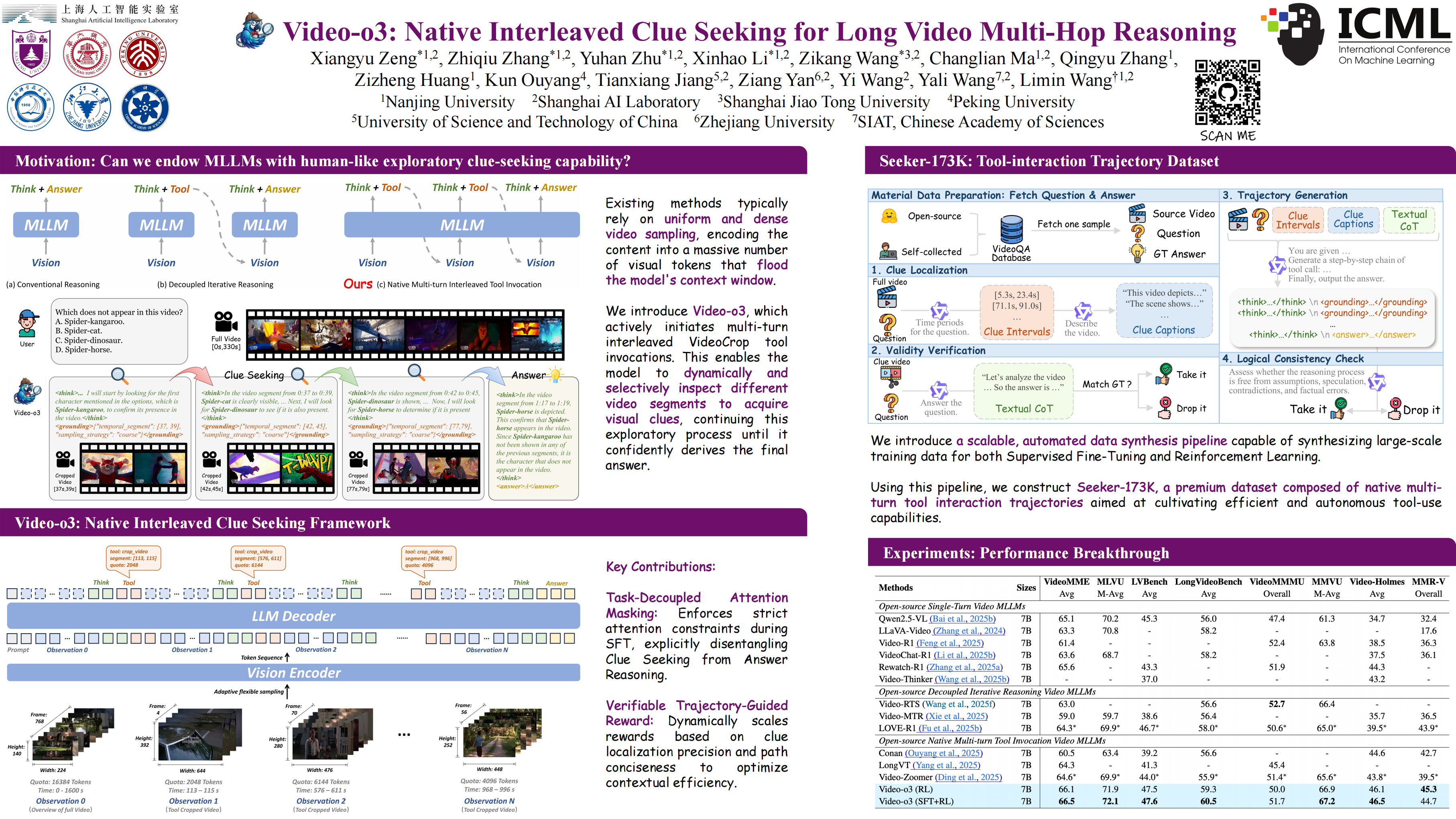
Existing multimodal large language models for long-video understanding predominantly rely on uniform sampling and single-turn inference, limiting their ability to identify sparse yet critical evidence amid extensive redundancy. We introduce Video-o3, a novel framework that supports iterative discovery of salient visual clues, fine-grained inspection of key segments, and adaptive termination once sufficient evidence is acquired. Technically, we address two core challenges in interleaved tool invocation. First, to mitigate attention dispersion induced by the heterogeneity of reasoning and tool-calling, we propose Task-Decoupled Attention Masking, which isolates per-step concentration while preserving shared global context. Second, to control context length growth in multi-turn interactions, we introduce a Verifiable Trajectory-Guided Reward that balances exploration coverage with reasoning efficiency. To support training at scale, we further develop a data synthesis pipeline and construct Seeker-173K, comprising 173K high-quality tool-interaction trajectories for effective supervised and reinforcement learning. Extensive experiments show that Video-o3 substantially outperforms state-of-the-art methods, achieving 72.1% accuracy on MLVU and 46.5% on Video-Holmes. These results demonstrate Video-o3's strong multi-hop evidence-seeking and reasoning capabilities, and validate the effectiveness of native tool invocation in long-video scenarios.
Lay Summary
People often ask AI systems to answer questions about long videos, such as lectures, movies, or recorded events. This is hard because the answer may depend on a few brief moments hidden inside many irrelevant frames. Most current video AI systems look at the video in a fixed way and try to answer in one step, which can waste computation and miss important clues. We built Video-o3, a system that watches long videos more like a person: it first scans the whole video, then repeatedly zooms in on the segments that seem most useful, and stops when it has enough evidence. To train this behavior, we separate the model’s “searching for clues” from its “reasoning about the answer,” and we reward it for finding accurate evidence without making unnecessary searches. We also built a large training set of video question-answering examples that show the model when to search and when to stop. Across several standard tests, Video-o3 answers more accurately while keeping the search process efficient. This work can help future AI systems navigate long videos more reliably for tasks such as education, digital archives, and video assistants, while also highlighting the need for responsible privacy safeguards.