
Once-for-All: Scalable Simultaneous Forecasting via Equilibrium State Estimation
Abstract
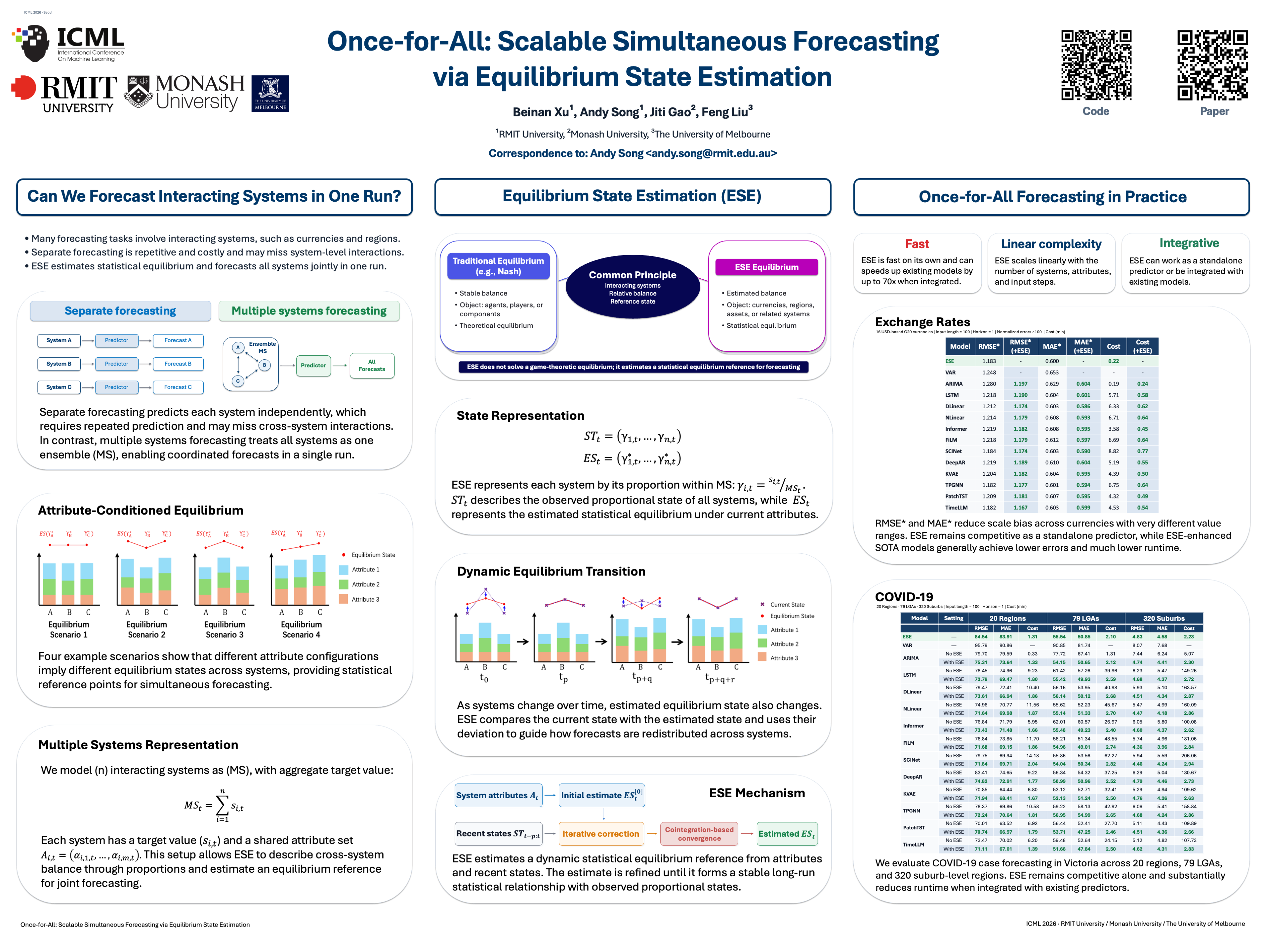
We introduce Equilibrium State Estimation (ESE), a novel paradigm for simultaneous prediction, where multiple interacting systems require separate yet coordinated forecasts. Such scenarios often arise in real-world such as economics and healthcare modeling. Unlike existing approaches that predict one system at a time, ESE forecasts all systems in a single pass. It first estimates the equilibrium state across systems, then generates holistic forecasts based on the difference between the current state and the estimated equilibrium. Extensive experiments on synthetic and real-world datasets, including currency exchange and COVID-19 spread modeling, demonstrate that ESE is at least as accurate as state-of-the-art (SOTA) methods while being significantly faster. In addition, ESE integrates seamlessly with conventional predictors, combining their accuracy with its exceptional efficiency and delivering a 10–70× speedup. With linear-time complexity, ESE scales far better than SOTA methods as the number of systems increases. Moreover, it remains accurate under diverse perturbations, establishing ESE as a fast, generalizable, robust, and scalable multi-prediction method.
Lay Summary
Many real-world forecasting problems involve predicting many related systems at the same time. For example, exchange rates across countries or COVID-19 cases across regions do not change independently, because each system may be connected to the others. However, many existing machine learning forecasting methods either predict each system separately, which can be slow, or combine them in ways that may not fully capture these relationships. This paper introduces Equilibrium State Estimation (ESE), a new approach that predicts all related systems in a single run. The method first estimates a balanced overall state among the systems and then uses the difference between the current state and this estimated balanced state to forecast future values. Experiments on synthetic data, currency exchange rates, and COVID-19 data show that ESE can make accurate predictions while greatly reducing the time and computing resources needed for forecasting.