
Efficient Learning of Deep State Space Models via Importance Smoothing
Abstract
Lay Summary
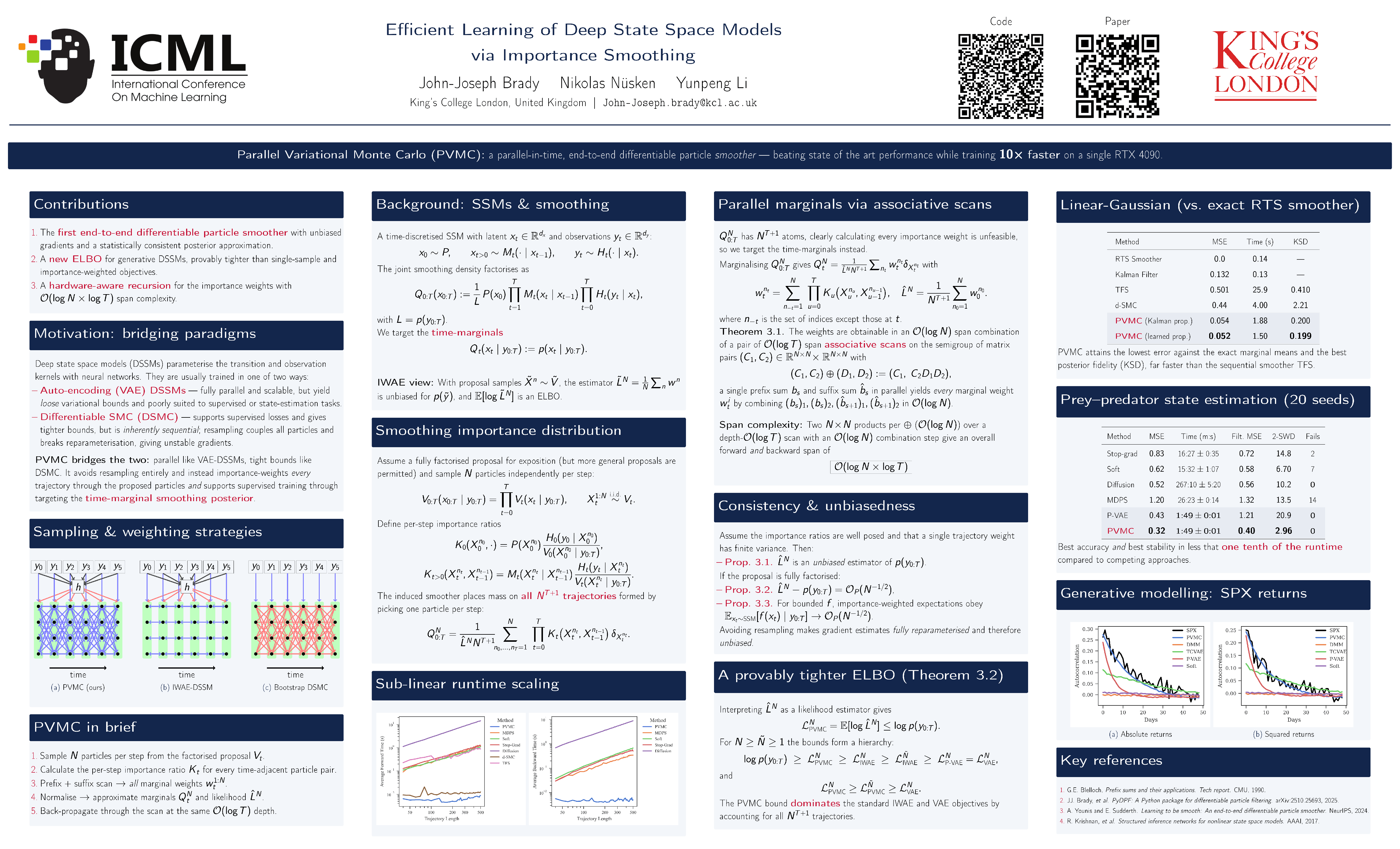
State space models are a powerful tool for modelling systems that evolve in time. They express the behaviour of a system that is under study over a length of time with two separate models. A model for the evolution of the system's internal properties, and a model for how the internal properties are expressed in the measurements that we take. This naturally mimics the structure of many models employed across science and finance. There are two broad types of goals in modelling such systems, generative and discriminative. Discriminative modelers try to estimate the system properties from a set of measurements. Generative modellers try to design their model so that it can be used to generate fake measurements that appear as if they had come from the actual system. Previous work in learning state space models in a deep learning context are either fast but only capable at generative modelling or slow. Our method makes use of modern parallel computation to learn discriminative models 10 times faster than previous approaches. We also show it has benefits over previous approaches in generative tasks whilst maintaining a good run time.