
On the Coordination of Value-Maximizing Bidders
Abstract
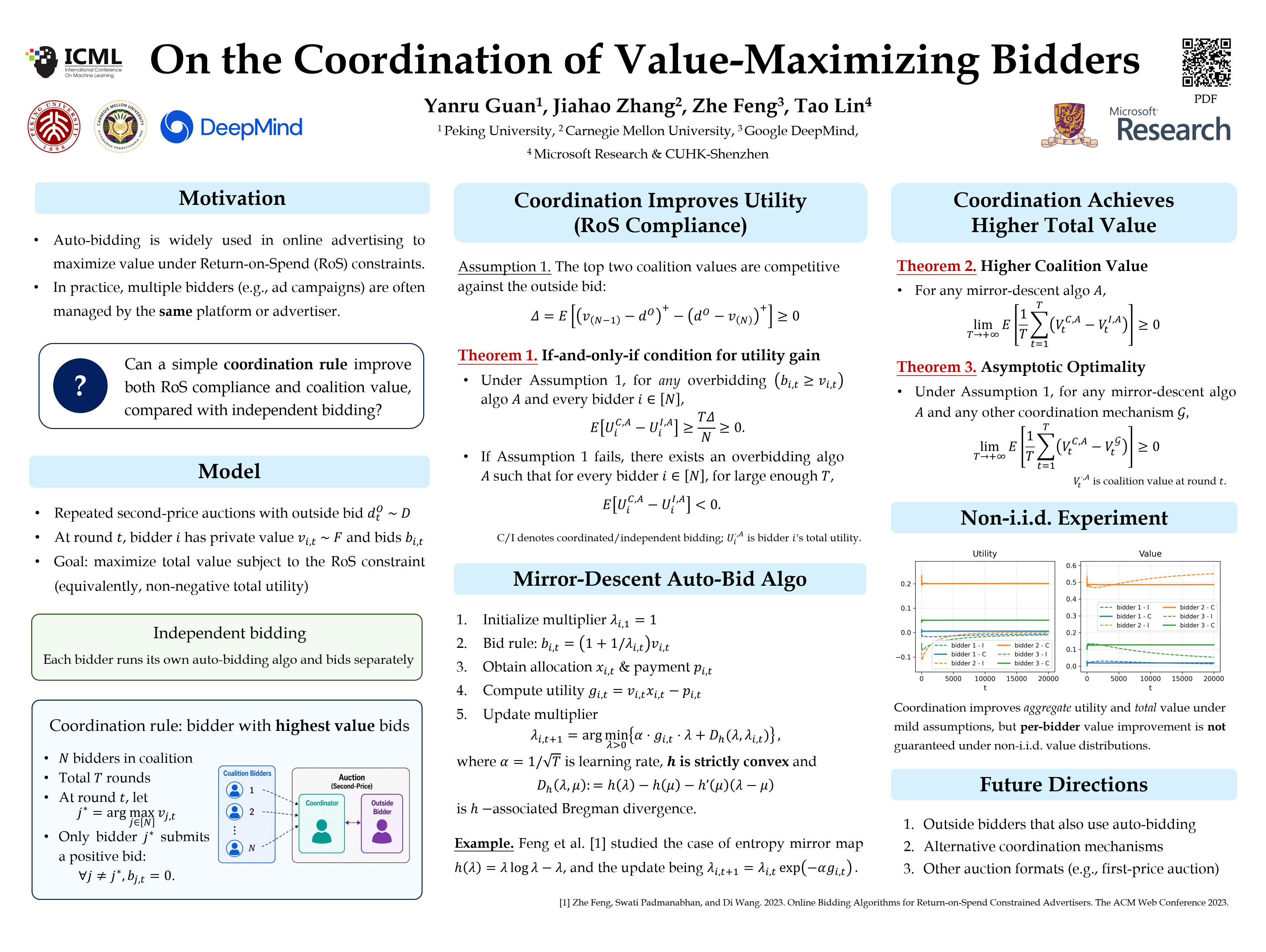
While the auto-bidding literature predominantly considers independent bidding, we investigate the coordination problem among multiple auto-bidders in online advertising platforms. Two motivating scenarios are: collaborative bidding among multiple bidders managed by a third-party bidding agent, and strategic bid selection for multiple ad campaigns managed by a single advertiser. We formalize this coordination problem as a theoretical model and investigate the coordination mechanism where only the highest-value bidder competes with outside bidders, while other coordinated bidders refrain from competing. We demonstrate that such a coordination mechanism dominates independent bidding, improving both Return-on-Spend (RoS) compliance and the total value accrued for the participating auto-bidders or ad campaigns, for a broad class of auto-bidding algorithms. Additionally, our simulations on synthetic and real-world datasets support the theoretical result that coordination outperforms independent bidding. These findings highlight both the theoretical potential and the practical robustness of coordinated auto-bidding in online auctions.
Lay Summary
Online advertising platforms increasingly rely on automated bidding systems to decide which ads are shown and how much advertisers spend. This paper studies what happens when several related auto-bidders - such as campaigns owned by one advertiser or bidders managed by one agent - coordinate rather than bid independently. We analyze a simple rule: in each auction, only the bidder in the group that values the ad opportunity most places a bid, while the others stay out. This reduces unnecessary competition within the group, and we prove that it can help the group obtain more value while keeping spending worthwhile. Experiments on synthetic and real-world ad-auction data support these gains.