
Quantifying the noise sensitivity of the Wasserstein metric for images
Abstract
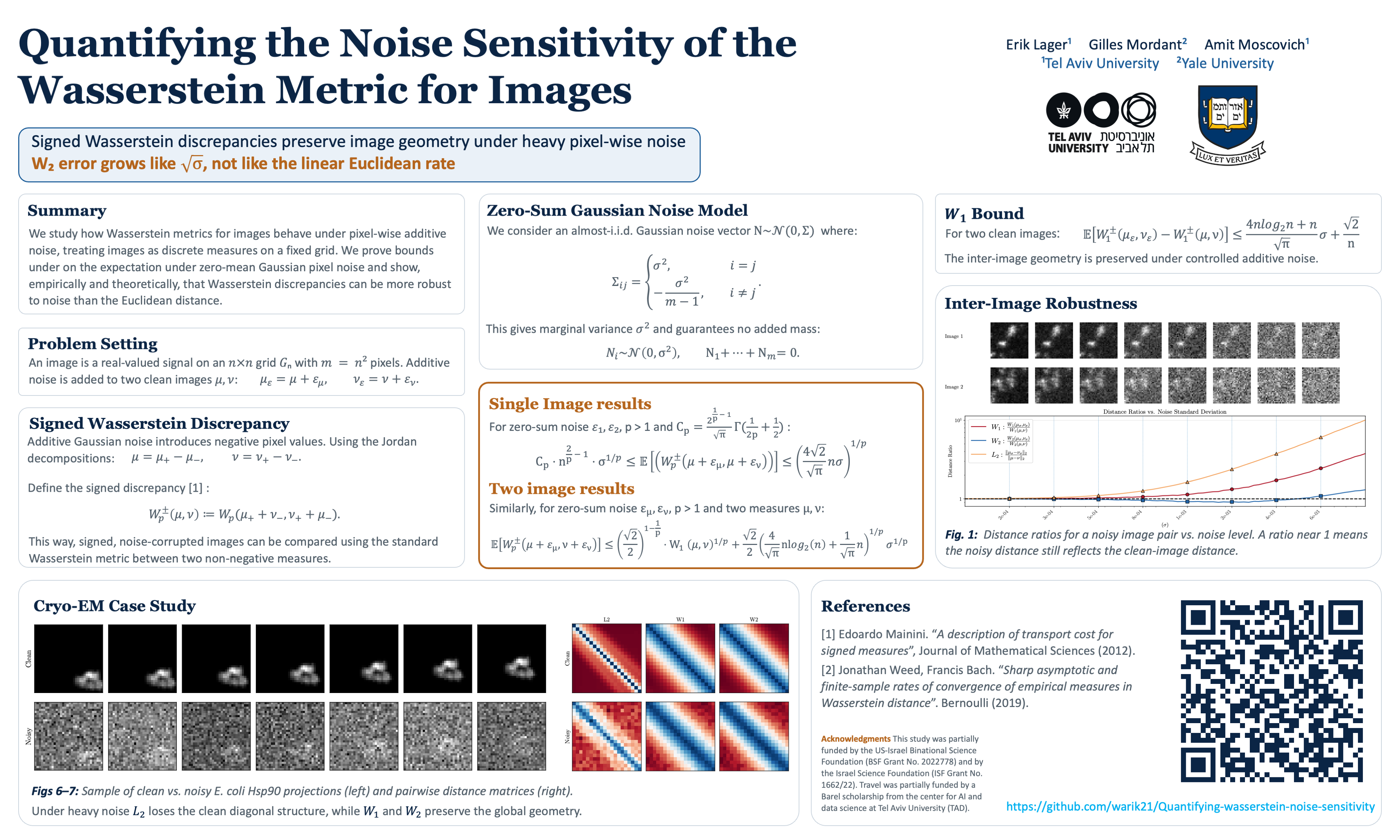
Wasserstein metrics are increasingly adopted as similarity scores for images. We consider the sensitivity of Wasserstein metrics with respect to pixel-wise additive noise when the images are treated as discrete measures on the pixel grid. We derive finite-sample expectation bounds for a Gaussian noise model. Among other results, we prove that the error in the signed 2-Wasserstein distance scales with the square root of the noise standard deviation. This is favorable compared to the Euclidean metric that scales linearly, and thus provides a theoretical basis for the benefits of optimal transport distances in noisy settings. We present experiments that support our theoretical findings and point to a peculiar phenomenon where increasing the level of noise can decrease the Wasserstein distance. A case study on cryo-electron microscopy images demonstrates that the Wasserstein metric can capture the geometry of the data manifold in high noise settings even when the Euclidean metric fails.
Lay Summary
Several recent works have demonstrated that notions of distance from the field of optimal transport work well in extremely noisy settings. We provide a rigorous explanation for these empirical findings by proving upper and lower bounds on the impact of pixel-wise noise.