
No More, No Less: Least-Privilege Language Models
Abstract
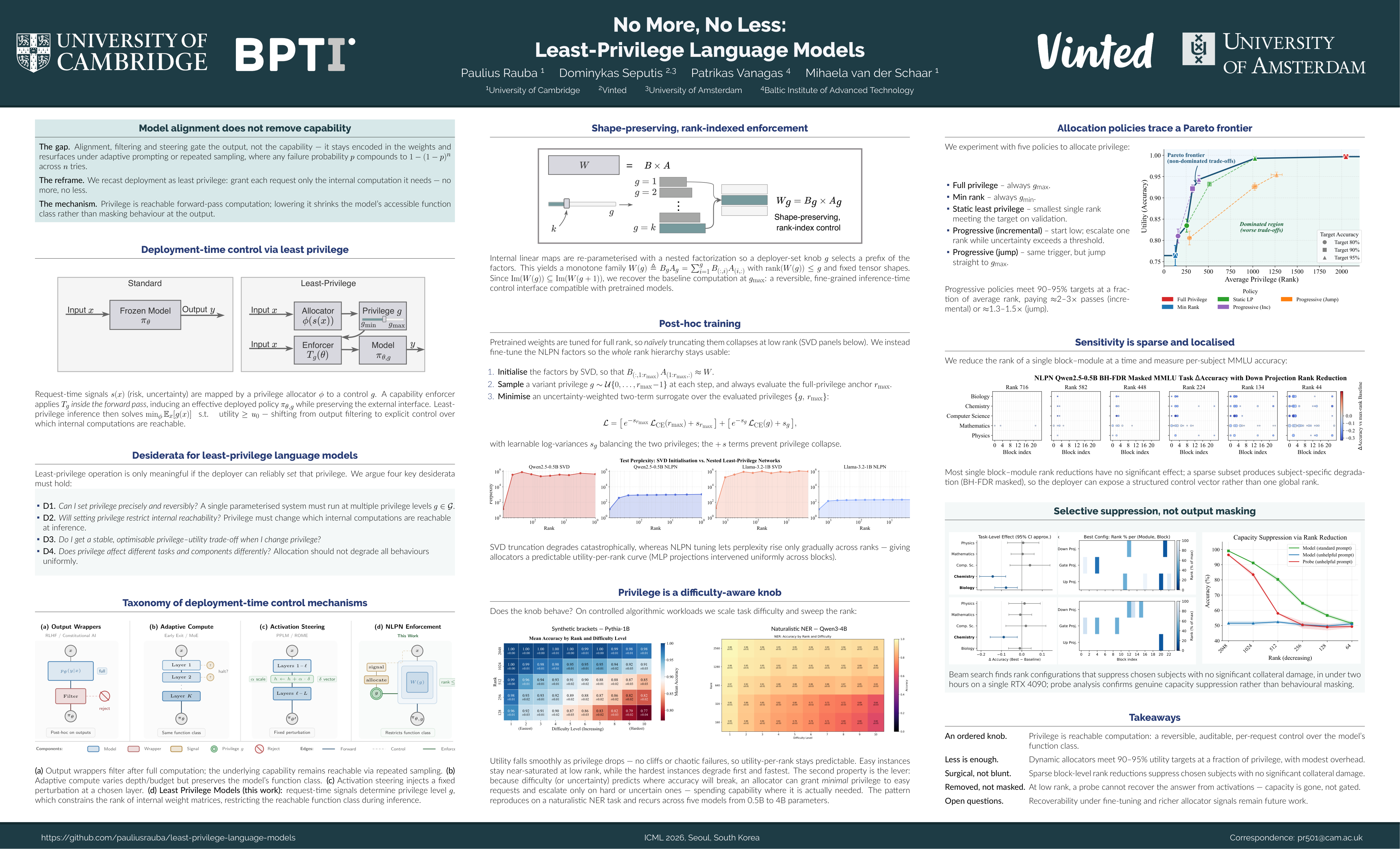
Least privilege is a core security principle: grant each request only the minimum access needed to achieve its goal. Deployed language models almost never follow it, instead being exposed through a single API endpoint that serves all users and requests. This gap exists not because least privilege would be unhelpful—deployments would benefit greatly from reducing unnecessary capability exposure. The real obstacle is definitional and mechanistic: what does "access" mean inside a language model, and how can we enforce it without retraining or deploying multiple models? We take inspiration from least privilege in computer systems and define a class of models called least-privilege language models, where privilege is reachable internal computation during the forward pass. In this view, lowering privilege literally shrinks the model's accessible function class (as opposed to denying access via learned policies). We formalize deployment-time control as a monitor--allocator--enforcer stack, separating (i) request-time signals, (ii) a decision rule that allocates privilege, and (iii) an inference-time mechanism that selects privilege. We then propose Nested Least-Privilege Networks, a shape-preserving, rank-indexed intervention that provides a smooth, reversible control knob. We show that this knob yields policy-usable privilege--utility frontiers and enables selective suppression of targeted capabilities with limited collateral degradation across various policies. Most importantly, we see this as a defense of a completely new deployment paradigm which challenges the premise that we can only have output-level control of language models.
Lay Summary
This paper proposes a framework and a concrete method to allow a single language model expose only a subset of its capabilities/knowledge to various users. An example of a real-world impliaction of this work is limiting dangerous or plausibly harmful knowledge to individuals within a language model while still exposing such knowledge to people who might need it.