
AlgoVeri: An Aligned Benchmark for Verified Code Generation on Classical Algorithms
Haoyu Zhao ⋅ Ziran Yang ⋅ Jiawei Li ⋅ Deyuan Mike He ⋅ Zenan Li ⋅ Chi Jin ⋅ Venugopal Veeravalli ⋅ Aarti Gupta ⋅ Sanjeev Arora
Abstract
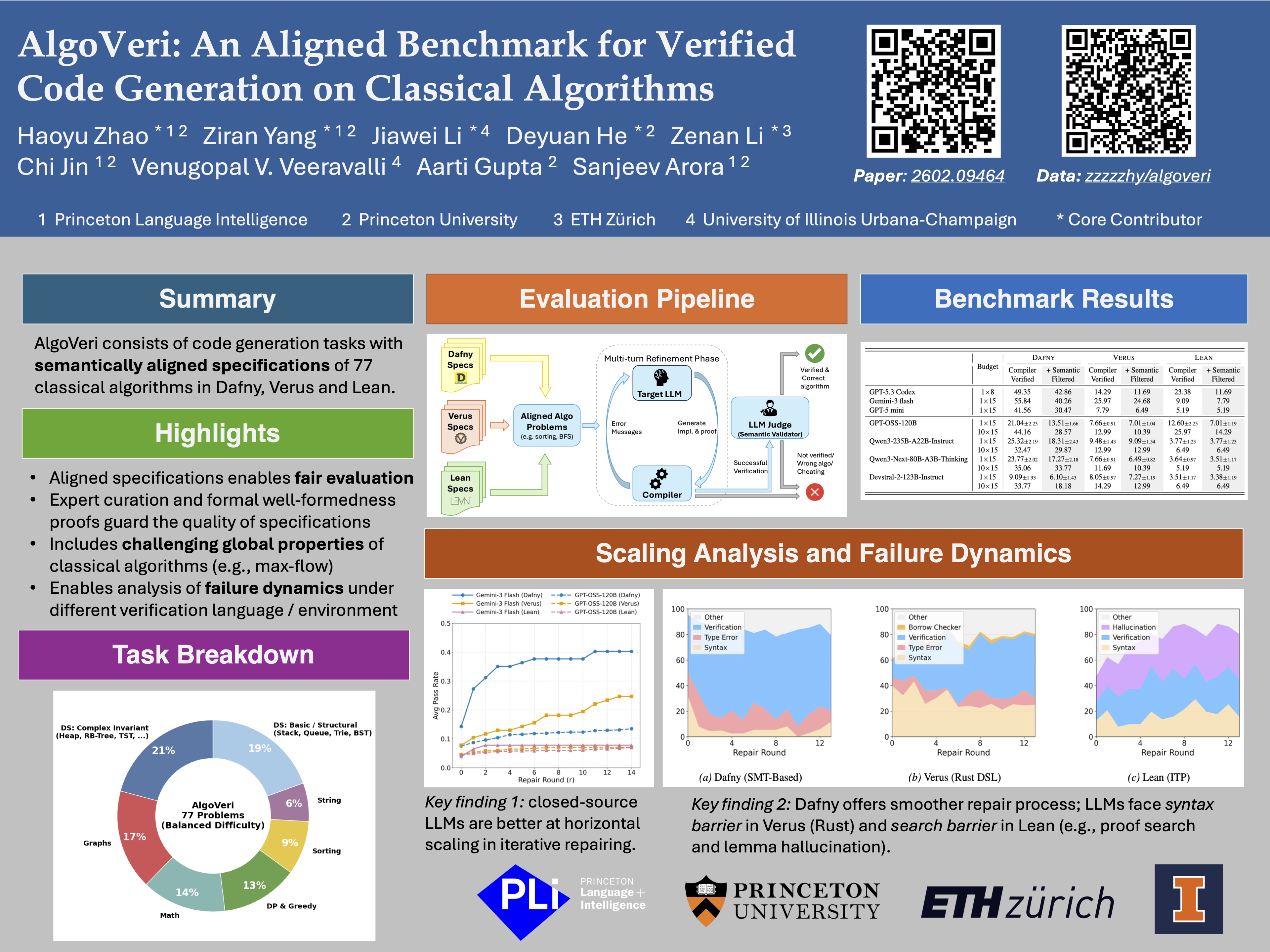
Vericoding refers to the generation of formally verified code from rigorous specifications. Recent AI models show promise in vericoding, but a unified methodology for cross-paradigm evaluation is lacking. Existing benchmarks test only an individual language/tool (e.g., Dafny, Verus, and Lean) and each covers very different tasks, so the performance numbers are not directly comparable. We address this gap with AlgoVeri, a benchmark that evaluates vericoding of $77$ classical algorithms in each of Dafny, Verus, and Lean. By enforcing identical functional contracts, AlgoVeri reveals critical capability gaps in current models. While frontier models achieve tractable success in Dafny ($40.3$\% for Gemini-3 Flash), where high-level abstractions and SMT automation simplify the workflow, performance collapses under the systems-level memory constraints of Verus ($24.7$\%) and the explicit proof construction required by Lean (7.8\%). Beyond aggregate metrics, we uncover a sharp divergence in test-time compute dynamics: Gemini-3 effectively utilizes iterative repair to boost performance (e.g., tripling pass rates in Dafny), whereas GPT-OSS saturates early. Finally, our error analysis shows that language design affects the refinement trajectory: while Dafny allows models to focus on logical correctness, Verus and Lean trap models in persistent syntactic and semantic barriers.
Video
Chat is not available.
Successful Page Load