
Networked Information Aggregation for Binary Classification
Abstract
Lay Summary
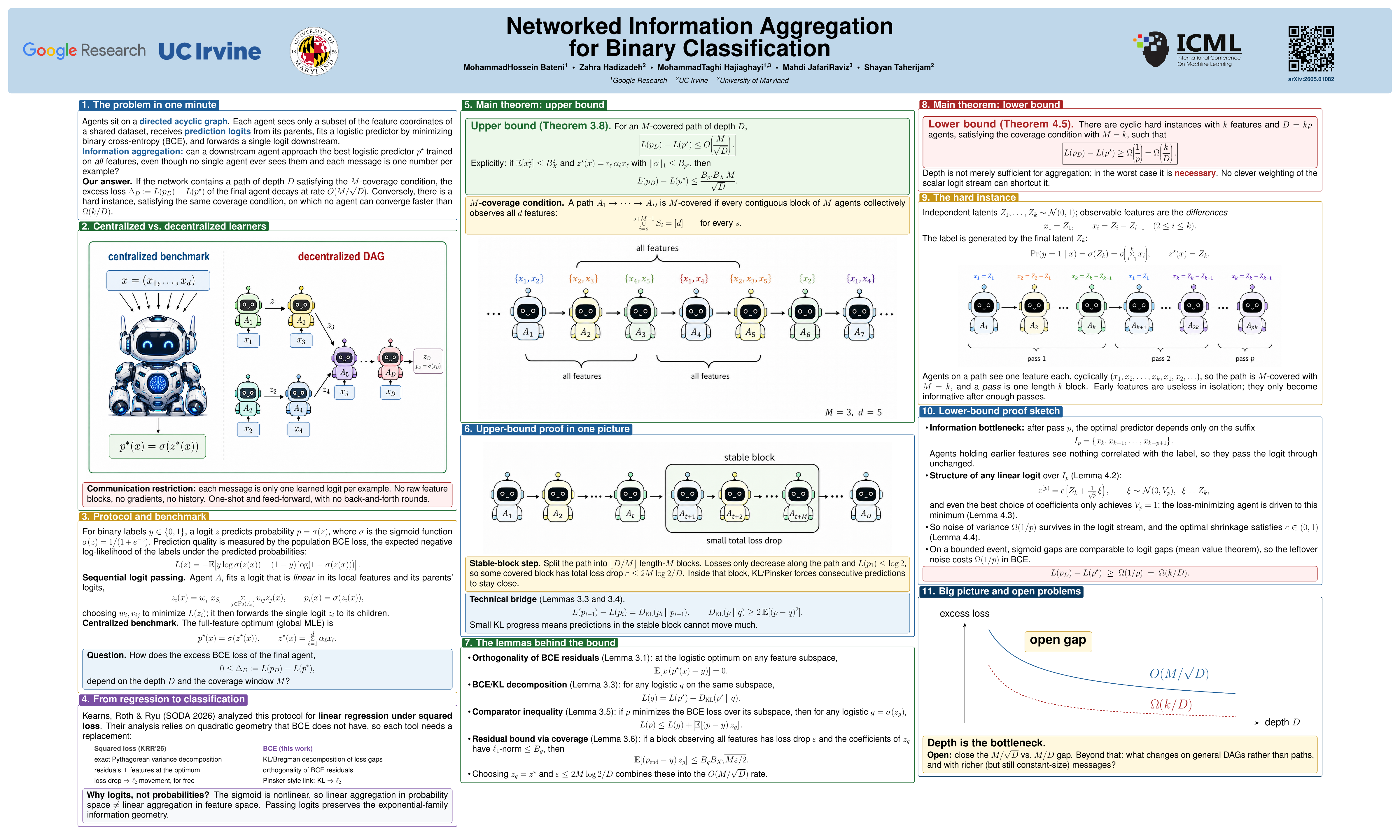
Many learning problems involve binary classification, where the goal is to predict one of two possible outcomes, such as whether an event will happen or not. In some settings, the useful information is spread across many agents, and each agent can see only part of the input features. This paper studies how such agents can combine their information when they are connected in a network and are only allowed to pass simple prediction messages to downstream agents. We analyze a protocol where each agent uses its own features together with the prediction messages it receives, trains a logistic classifier, and passes its learned logit to the next agents. Our results show that, under a coverage condition on the network, enough network depth allows the final agent to approach the performance of a centralized classifier that sees all features. We also construct examples showing that this depth is genuinely necessary: if the network is too shallow, some information cannot be fully aggregated. This helps clarify how communication structure limits distributed binary classification.