
Diff-MN: Diffusion Parameterized MoE-NCDE for Continuous Time Series Generation with Irregular Observations
Abstract
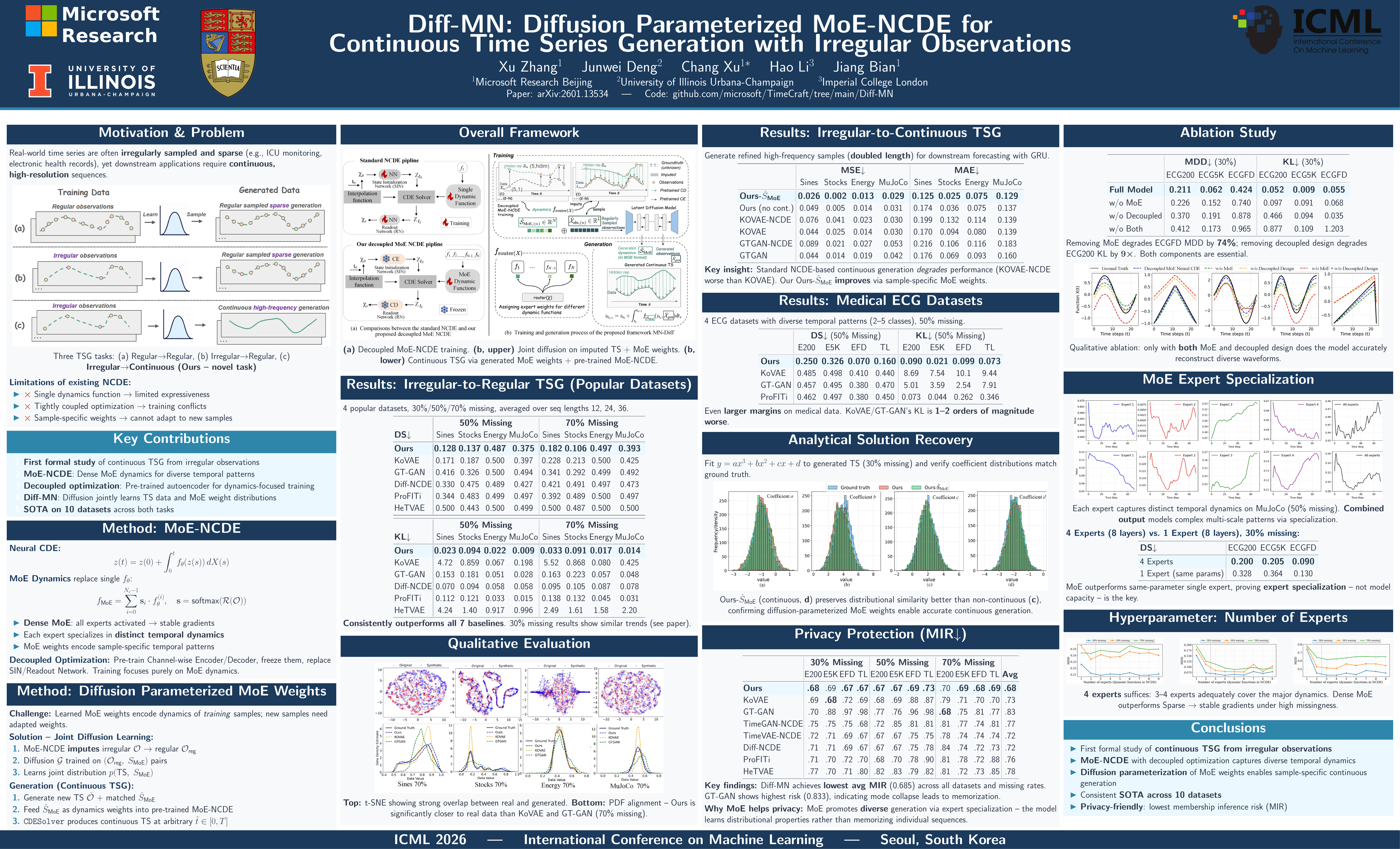
Time series generation (TSG) is widely used across domains, yet most existing methods assume regular sampling and fixed output resolutions. These assumptions are often violated in practice, where observations are irregular and sparse, while downstream applications require continuous and high-resolution TS. Although Neural Controlled Differential Equation (NCDE) is promising for modeling irregular TS, it is constrained by a single dynamics function, tightly coupled optimization, and limited ability to adapt learned dynamics to newly generated samples from the generative model. We propose Diff-MN, a continuous TSG framework that enhances NCDE with a Mixture-of-Experts (MoE) dynamics function and a decoupled architectural design for dynamics-focused training. To further enable NCDE to generalize to newly generated samples, Diff-MN employs a diffusion model to parameterize the NCDE temporal dynamics parameters (MoE weights), i.e., jointly learn the distribution of TS data and MoE weights. This design allows sample-specific NCDE parameters to be generated for continuous TS generation. Experiments on ten public and synthetic datasets demonstrate that Diff-MN consistently outperforms strong baselines on both irregular-to-regular and irregular-to-continuous TSG tasks. The code is available at the link \url{https://github.com/microsoft/TimeCraft/tree/main/Diff-MN}.
Lay Summary
Time series data, such as temperature measurements, medical signals, or financial trends, are widely used in many real-world applications. However, these data are often recorded irregularly, sparsely, and are incomplete, while many applications require smooth, dense (high-frequency), and continuous signals. In this work, we study how to generate continuous and dense (high-frequency) time series from such irregular and sparse observations. Existing methods often rely on fixed modeling assumptions and have limited flexibility when handling new data. We propose a new approach that improves flexibility by allowing the model to use multiple learned patterns to describe how time series evolve. More importantly, we introduce a diffusion-based mechanism that generates the internal dynamics settings of the model for each individual time series. This allows the model to adapt its behavior to different samples, leading to better generalization when producing new time series. Experiments on multiple datasets show that our method consistently outperforms existing approaches in generating accurate and dense (high-frequency) continuous time series.