
On the Spectral Unreachability of Brain Graph Learning
Abstract
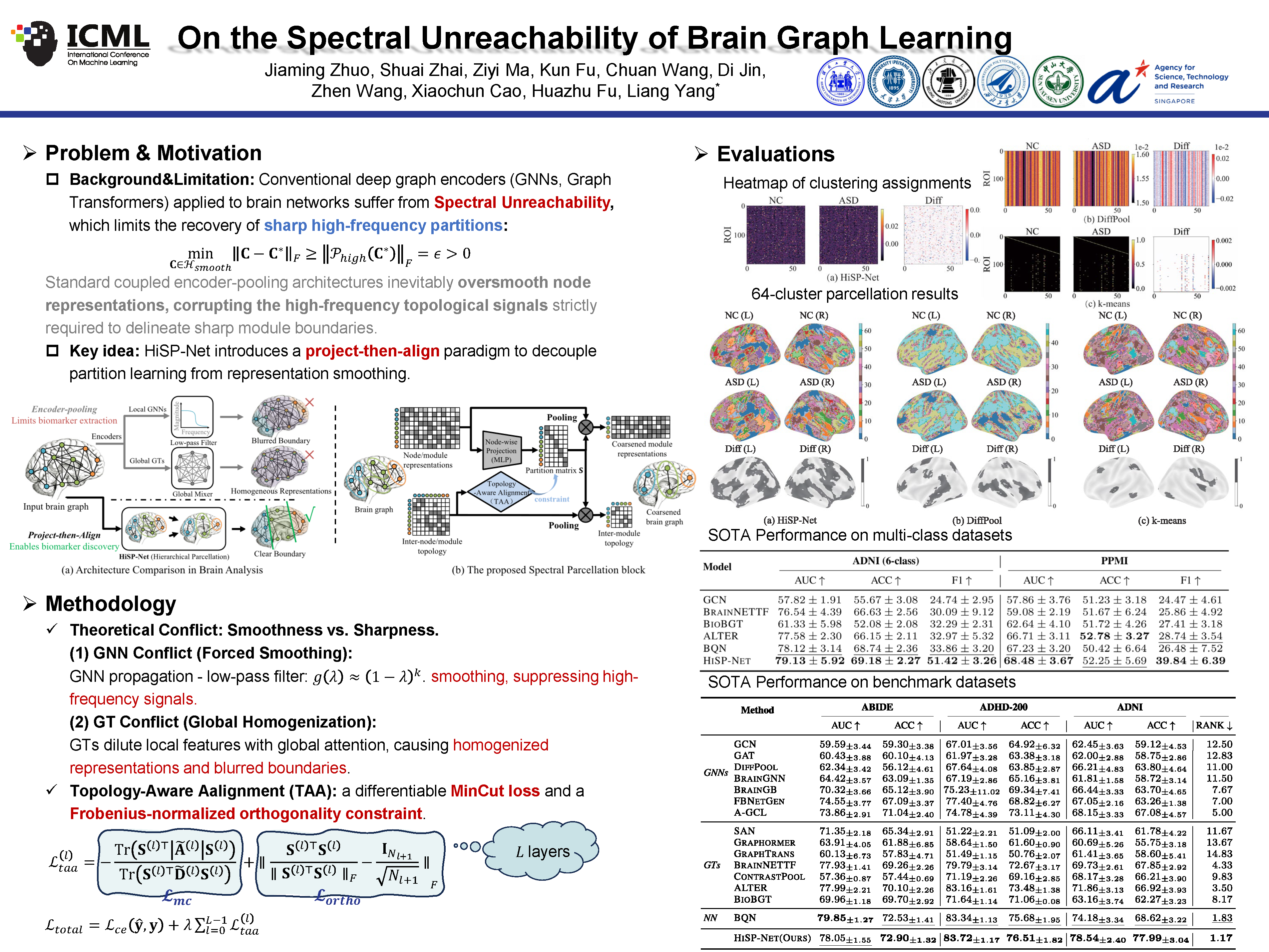
Brain network classification is pivotal for diagnosing neurological disorders, yet identifying interpretable functional biomarkers fundamentally relies on precise parcellation. Unfortunately, conventional deep graph encoders applied to brain networks suffer from a critical theoretical limitation termed Spectral Unreachability. Through graph spectral analysis, this paper demonstrates that standard coupled encoder-pooling architectures inevitably oversmooth node representations, corrupting the high-frequency topological signals strictly required to delineate sharp module boundaries. To provide a structural remedy, the Hierarchical Spectral Parcellation Network (HiSP-Net) is proposed, which structurally decouples partition learning from feature smoothing via a project-then-align paradigm. Specifically, HiSP-Net maps representations directly into a partition space using a topology-agnostic projection block to preserve all-frequency details, while a Topology-Aware Alignment regularizer subsequently enforces spatial coherence. Extensive evaluations demonstrate that HiSP-Net consistently outperforms state-of-the-art baselines in classification, while successfully extracting stable and structurally coherent functional biomarkers. Source code is available at https://github.com/Kevin-916/HiSP-Net-demo/.
Lay Summary
Brain network analysis can help diagnose neurological disorders, but reliable diagnosis requires brain regions that are both accurate and interpretable. Existing deep learning methods often smooth brain network signals too much, which can blur important boundaries between functional brain regions and make disease-related biomarkers harder to understand. In this work, we study this limitation and propose HiSP-Net, a new framework that preserves fine-grained brain organization while encouraging spatially coherent partitions. By separating partition learning from excessive feature smoothing, HiSP-Net can better identify meaningful functional brain modules. Experiments show that HiSP-Net improves brain disorder classification and extracts more stable and interpretable biomarkers, which may support more reliable brain network analysis in neurological disorder studies.