
Swift-SVD: Theoretical Optimality Meets Practical Efficiency in Low-Rank LLM Compression
Abstract
Lay Summary
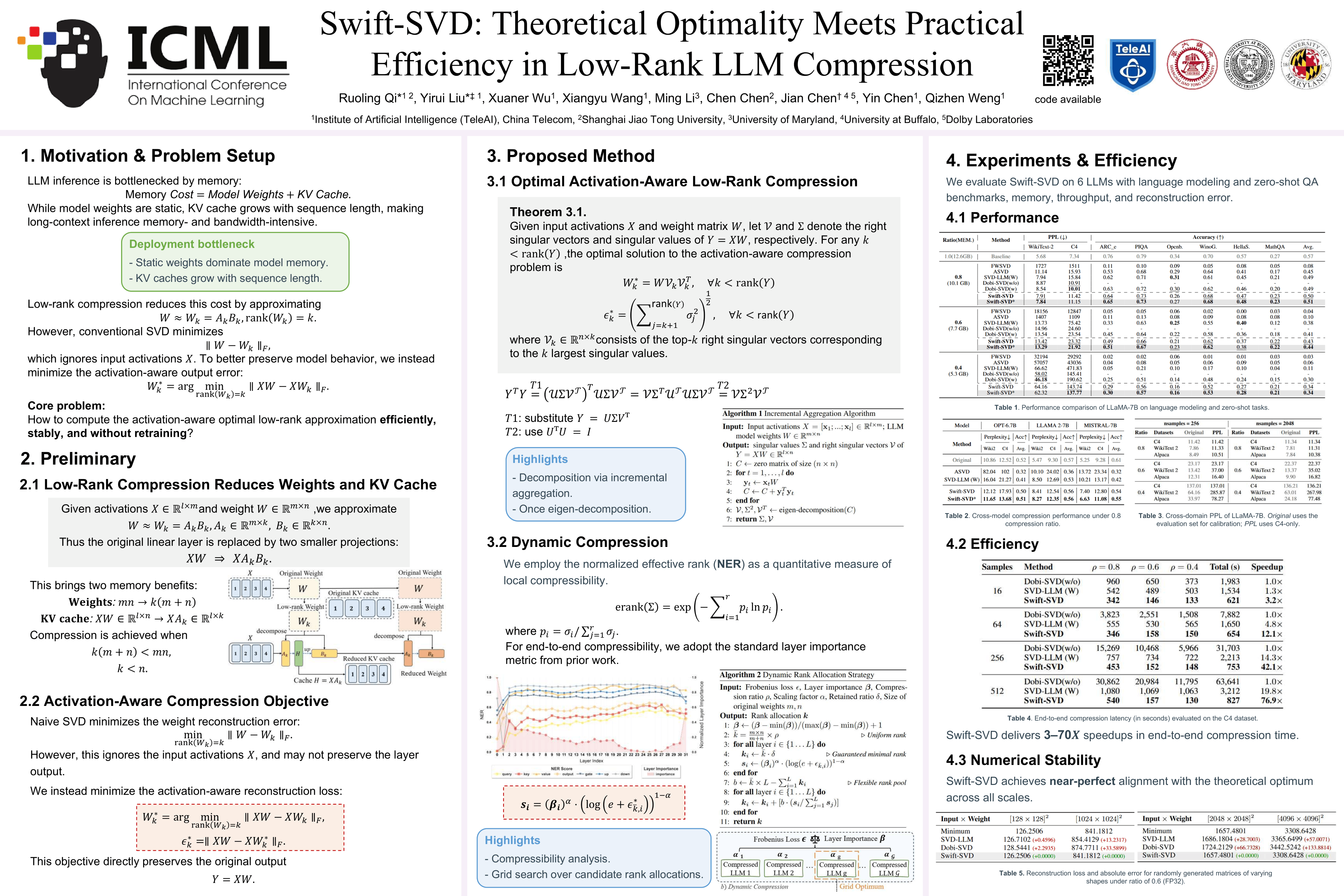
Why This Matters AI assistants have become part of daily life—but running them is surprisingly expensive. These models contain billions of numerical parameters, and every time a user sends a message, the system must load and process enormous amounts of data at high speed. This makes deploying AI costly in both money and energy, limiting who can afford to build and use these systems. A Smarter Way to Slim Down AI One promising solution is compression: mathematically simplifying the model so it runs on less memory without losing much capability—similar to how image formats like JPEG reduce file size while preserving visual quality. We developed Swift-SVD, a new compression method with two advantages over prior approaches. First, it is theoretically optimal: using a mathematical technique called matrix decomposition, it finds the best possible simplified representation of each part of the model in a single pass over data, rather than requiring slow, repeated optimization. Second, it is smart about where to compress: not all parts of an AI model are equally important or equally compressible. Swift-SVD automatically gives more compression to redundant parts and protects the parts the model relies on most—like a careful editor who cuts filler paragraphs but preserves the core argument. What We Found Testing across six AI models and eight tasks, Swift-SVD consistently produced more accurate compressed models than existing methods—and compresses a model up to 70 times faster than prior approaches. This brings practical, efficient AI compression closer to real-world deployment—helping reduce the cost and energy footprint of large AI systems.