
Origo: Interpretable Multi-physics PDE Foundation Model through Neural Operator Splitting
Abstract
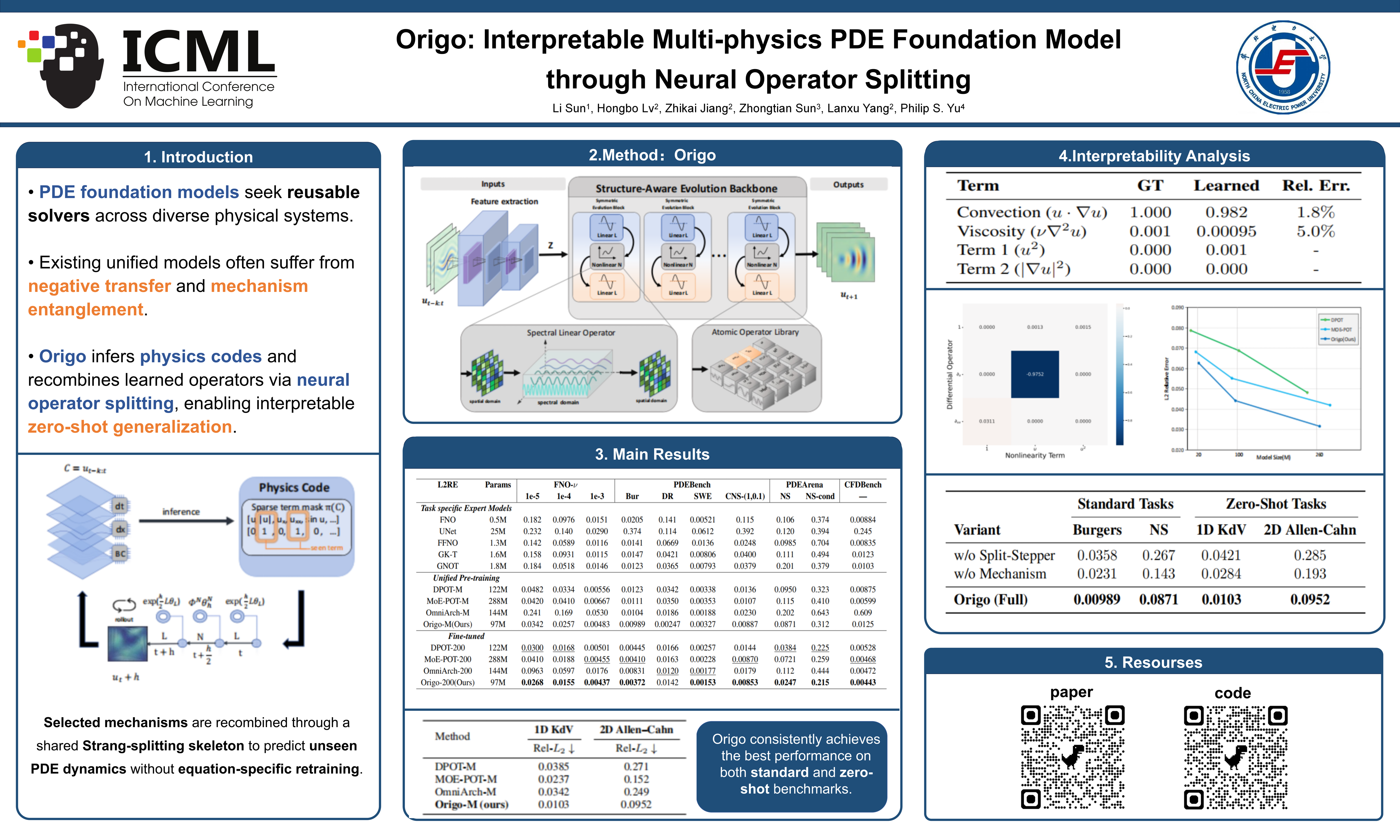
Partial Differential Equations (PDEs) play a fundamental role in scientific computing, and recent efforts have sought to extend the success of foundation models to PDE solving. However, multi-physics PDE pre-training faces the unique challenge of disentangling dynamic heterogeneity to learn universal, elementary patterns that generalize to new PDEs. Additionally, cross-physics transfer lacks a theoretical framework for interpretability—specifically, understanding which pre-trained operator knowledge is effectively transferred to target PDEs. To bridge these gaps, we introduce the theory of neural operator splitting, which decomposes PDE evolution into a modulated global spectral operator and sparse local constitutive mechanisms. A key innovation is Origo, which provides a neural operator bank that enables the identification of operator-level generalization patterns. Extensive experiments demonstrate strong zero-shot generalization and mechanism-level interpretability on unseen PDEs.
Lay Summary
Predicting physical systems, like weather or heat, usually requires solving complex equations. While AI speeds up these predictions, most models act as uninterpretable black boxes. They tangle different physical rules together, making it difficult for scientists to understand their decisions or trust them in new scenarios. To solve this, we introduce Origo, a transparent AI framework. Origo automatically breaks down complex physical processes into simpler pieces, separating broad global movements from specific local interactions. By analyzing past data, it infers underlying rules and selects the right tools from a built-in library to predict future behavior. Consequently, Origo adapts to unseen physical systems and allows scientists to clearly read the exact physical laws the AI applies, providing a trustworthy tool for scientific discovery.