
Looking Locally: Object-Centric Vision Transformers as Foundation Models for Efficient Segmentation
Abstract
Lay Summary
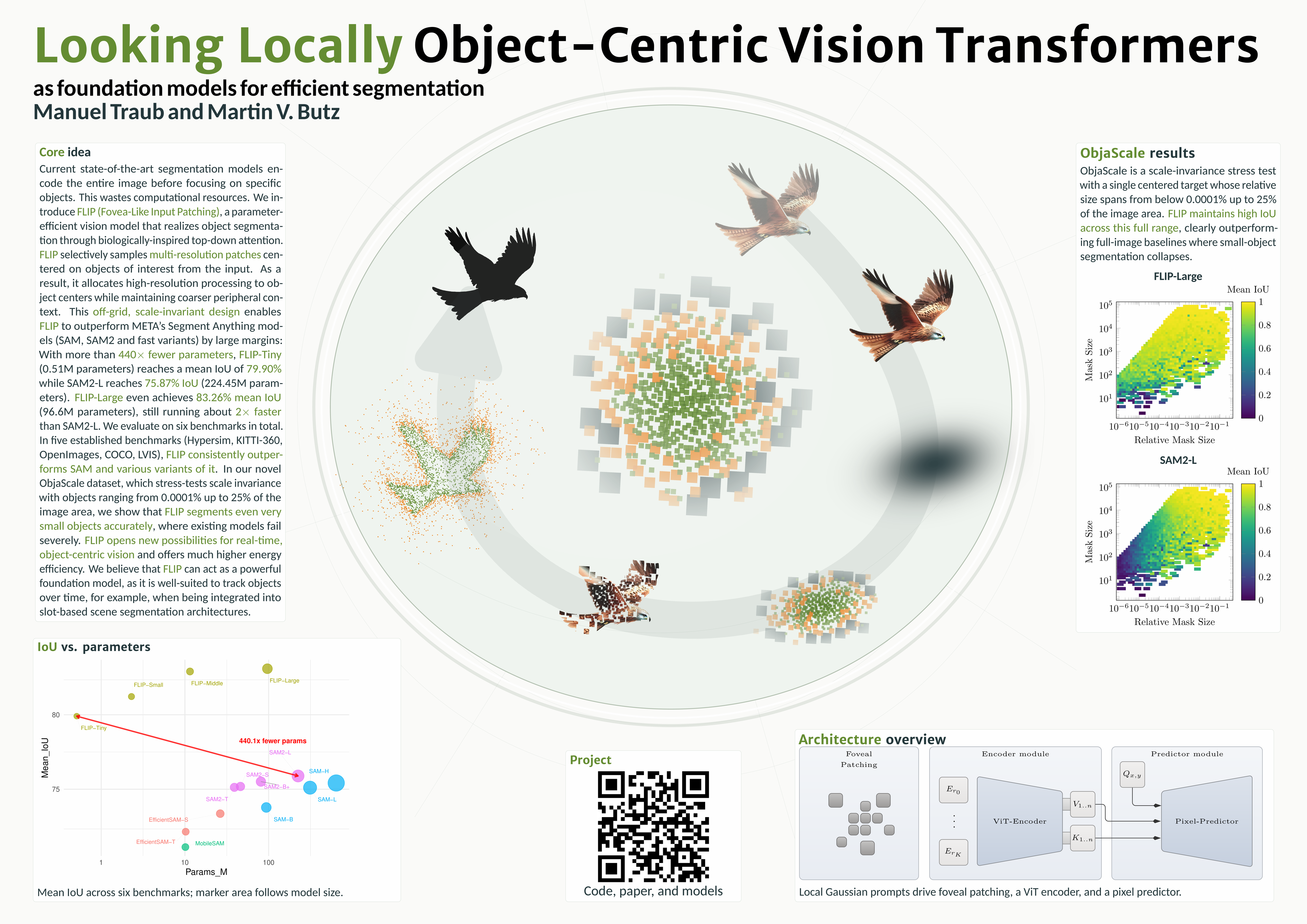
Many image-analysis systems first inspect every part of a picture before drawing the exact outline of a chosen object, which can consume unnecessary computational resources when the object is small or the image is very large. This paper introduces Fovea-Like Input Patching (FLIP), a model inspired by human vision: it looks in high detail at the target object and uses lower detail for the surrounding context. Instead of processing a whole image at one fixed level of detail, it samples small image pieces around an object the user points to and predicts which pixels belong to that object. The authors test the method on six image collections, including street scenes, indoor scenes, natural images, and a new stress test with objects ranging from tiny specks to large foreground items. Across these tests, it matches or improves on Segment Anything models while being much smaller, which helps it run faster and reduces hardware demands, with especially strong results for very small objects. This could make accurate object boundary computation more practical for real-time vision systems, though the current method still depends on a reliable cue that tells it where to look.