
TabMGP: Martingale Posterior with TabPFN
Abstract
Lay Summary
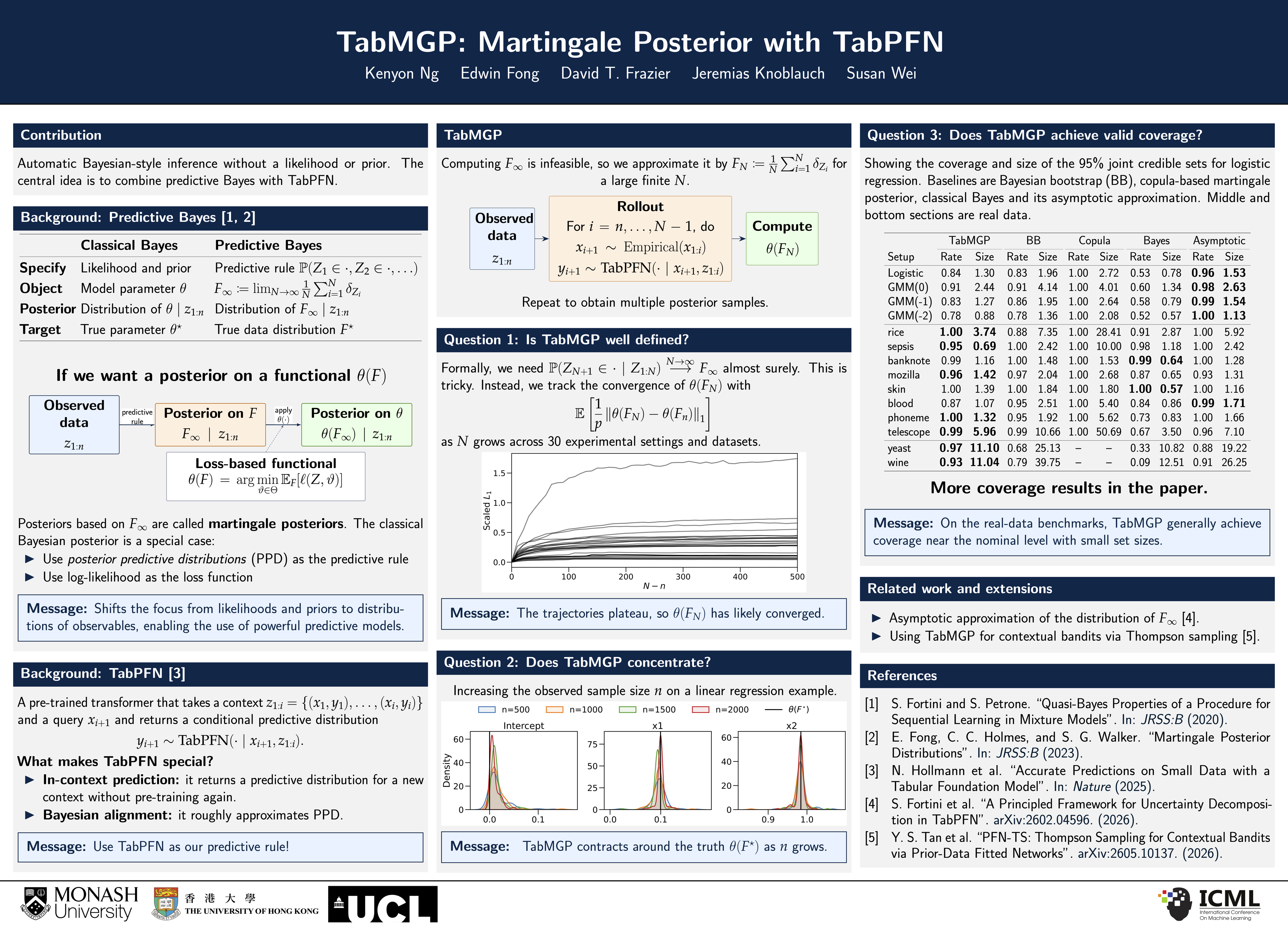
Machine-learning tools can make strong predictions, but scientists often also need to know how uncertain they should be about a quantity of interest. Traditional statistical methods can provide this uncertainty, but they often require users to choose a full probability model, a choice that can be difficult, fragile, or expensive. We introduce TabMGP, a way to turn TabPFN, a pretrained transformer model for tabular prediction, into a tool for uncertainty quantification. TabMGP asks TabPFN to predict plausible continuations of the observed dataset, computes the scientific quantity of interest on each completed dataset, and uses the resulting variation as an uncertainty estimate. This gives users a set of plausible values for the quantity of interest without the laborious work of hand-designing a full probability model. Across synthetic and real-world tabular datasets, TabMGP usually produced reliable and meaningful uncertainty estimates. Overall, TabMGP shows how pretrained tabular models can support not only prediction, but also practical scientific uncertainty quantification.