
Particles Don’t Care About Z: Towards Scaling Entropy Estimation of Unnormalized Densities
Abstract
Lay Summary
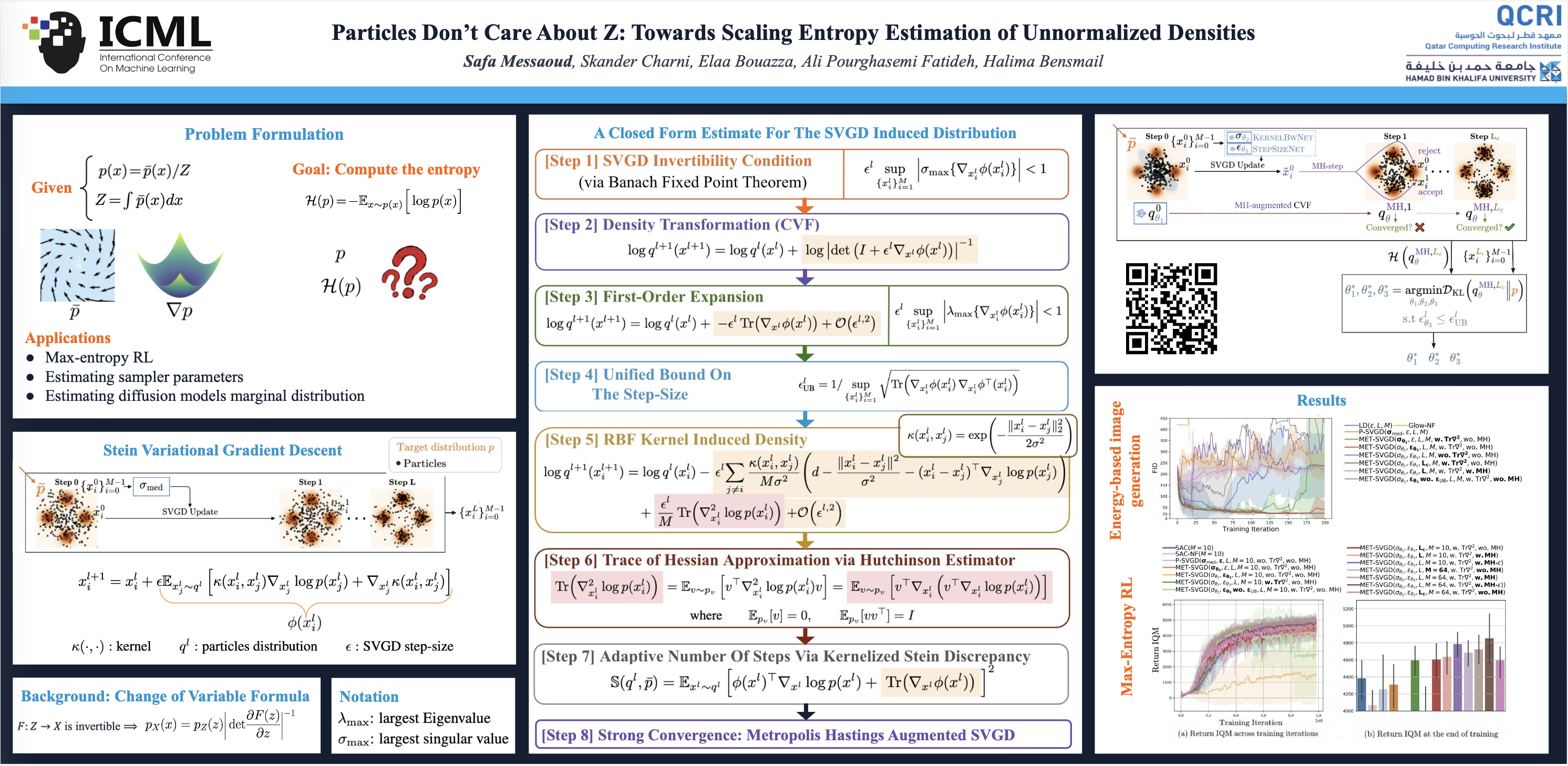
Many modern AI systems rely on estimating uncertainty and randomness in complex probability distributions, including applications in image generation, reinforcement learning, and scientific modeling. In many real-world problems, however, these distributions are only known approximately and cannot be computed exactly, making entropy estimation particularly difficult. Existing scalable methods often become unstable or inaccurate as the dimensionality of the problem grows. In this work, we identify several fundamental issues in a recent entropy estimation method called P-SVGD that prevent it from scaling reliably to high-dimensional problems. We then introduce MET-SVGD, a more stable and principled approach that fixes these issues while preserving computational efficiency. Our method provides stronger theoretical guarantees and significantly improves robustness in practice. Across a range of experiments, MET-SVGD substantially improves entropy estimation accuracy, produces more stable image generation models, and improves performance in reinforcement learning tasks. These results suggest that the proposed approach can make scalable probabilistic modeling more reliable for future AI systems.