
An In-Depth Study on Deep Learning Model Cloning
Abstract
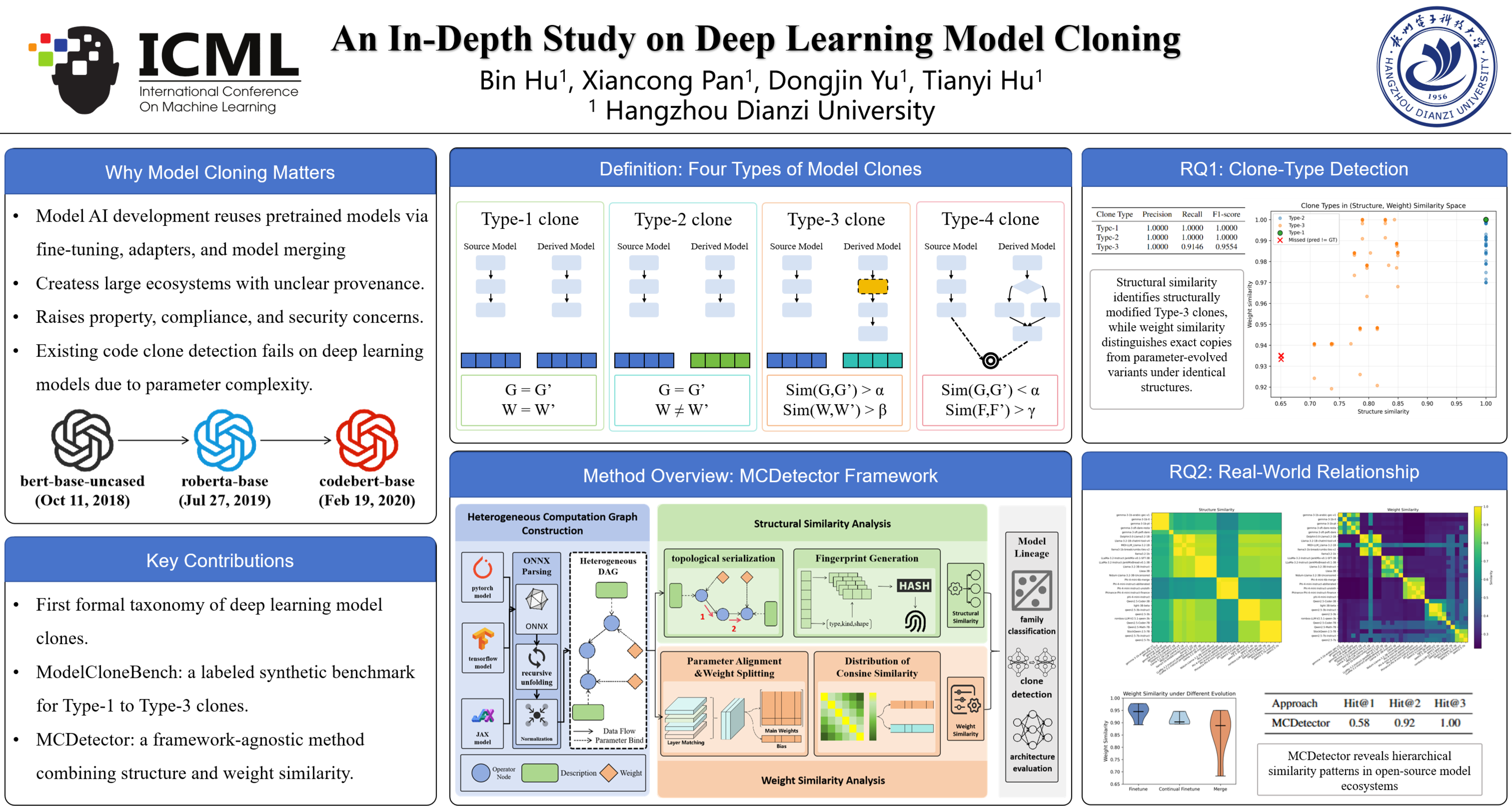
Artificial intelligence has achieved remarkable breakthroughs in fields such as text, image, and video analysis, with deep learning serving as the mainstream paradigm. Trained deep learning models can be integrated into various applications either through fine-tuning or without any modification. While this practice promotes the advancement of artificial intelligence, it also raises concerns regarding intellectual property protection and information security risks. Therefore, it is necessary to propose relevant methods to measure the similarity between models. Existing code clone detection techniques are insufficient to address this issue. In this paper, we provide the first definition of model cloning and design a method for model similarity detection. The framework characterizes model topology at the structural level based on normalized computational graphs, and at the weight level, it employs a method that does not require explicit parameter alignment to measure the statistical similarity of weight parameters. Experiments on a synthetic model clone benchmark dataset and real-world open-source models demonstrate that the proposed method can accurately detect similar models. This method provides a unified and extensible quantitative foundation for model lineage analysis, model retrieval, and intellectual property protection of models.
Lay Summary
Currently, many artificial intelligence models are not developed and trained entirely from scratch. Instead, they are often released after being modified from existing models. This practice can reduce development time and cost, while also facilitating the broader adoption of AI technologies. However, when license information is not clearly specified, it becomes difficult to determine whether a model is original or derived from another model. This paper investigates how to identify model clones, namely models that are highly similar to each other. First, we provide a systematic definition of model cloning, including Type-1 clones, which are identical models; Type-2 clones, which share the same structure but have fine-tuned parameters; and Type-3 clones, which are partially modified in structure while remaining similar to the original model. We then propose MCDetector, a method that detects model similarity from two dimensions: structure and parameters.Experimental results show that MCDetector can identify similar models in both manually constructed benchmark models and real-world open-source models. This study can help researchers, developers, and platforms detect potential model reuse and mitigate intellectual property risks.