
Learning to Reconfigure: Configuration-Control Co-optimization of Reconfigurable Robots for Heterogeneous Locomotion
Abstract
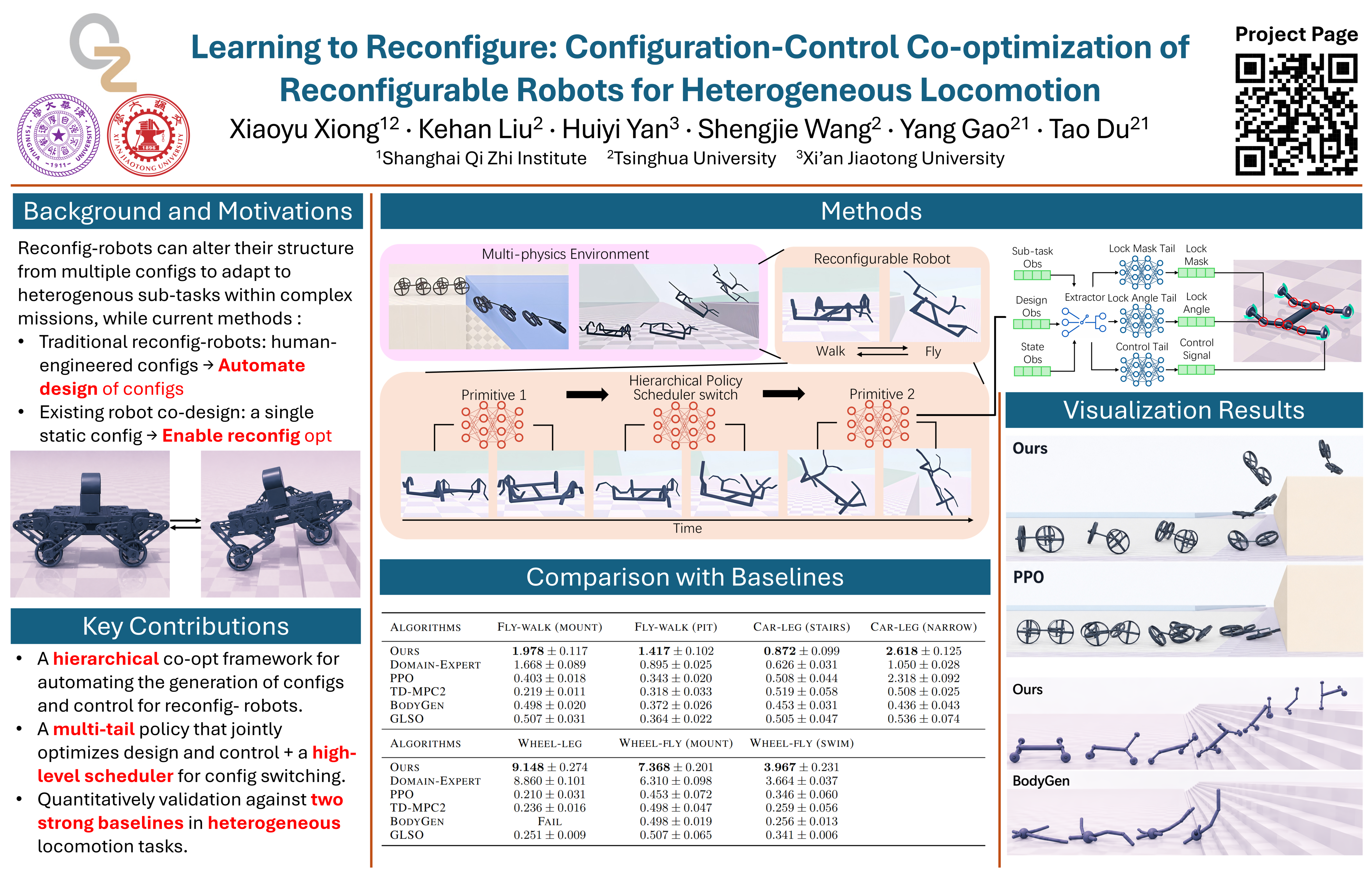
Traditional robot co-design approaches typically converge to one configuration, which do not explore the flexibility from reconfiguration on heterogeneous environments. On the other hand, existing designs for reconfigurable robots require human-designed configurations. We present Learning to Reconfigure, a holistic pipeline for configuration-control co-optimization of reconfigurable robots in heterogeneous locomotion tasks consisting of several sub-tasks. Our pipeline proposes low-level specialized primitives with a high-level scheduler. To jointly optimize configuration design and control, our primitives employ a multi-tail architecture that disentangles these distinct objectives. Building on this, the scheduler learns to dynamically switch configurations based on global task progress. We evaluate our pipeline on locomotion tasks across walking, flying, and swimming, and compare with the state-of-the-art baselines, including single-robot control and multi-morphology co-optimization algorithms. Quantitative results based on traversal progress show that our pipeline outperforms single-robot baselines by 5.95x average progress. Compared with the reconfiguration-free design given by the co-design algorithms, our robots also exhibit 9.81x progress on average. These results highlight the critical role of configuration adaptation in achieving versatile robotic autonomy in complex worlds.
Lay Summary
Robots often need to move through very different environments in a single mission, such as tunnels, stairs, air, and water. A fixed robot body is usually not well suited to all of these situations, while existing reconfigurable robots often rely on hand-designed configurations. We propose Learning to Reconfigure, a method that automatically learns both useful robot configurations and how to control them. It also learns when to switch between configurations during a long task. In simulated multi-environment locomotion tasks, our method substantially outperforms fixed-control and reconfiguration-free robot co-design baselines. These results show that learning when and how to reconfigure can make robots more adaptable in complex worlds.