
Planar Symmetric Pattern Generation
Abstract
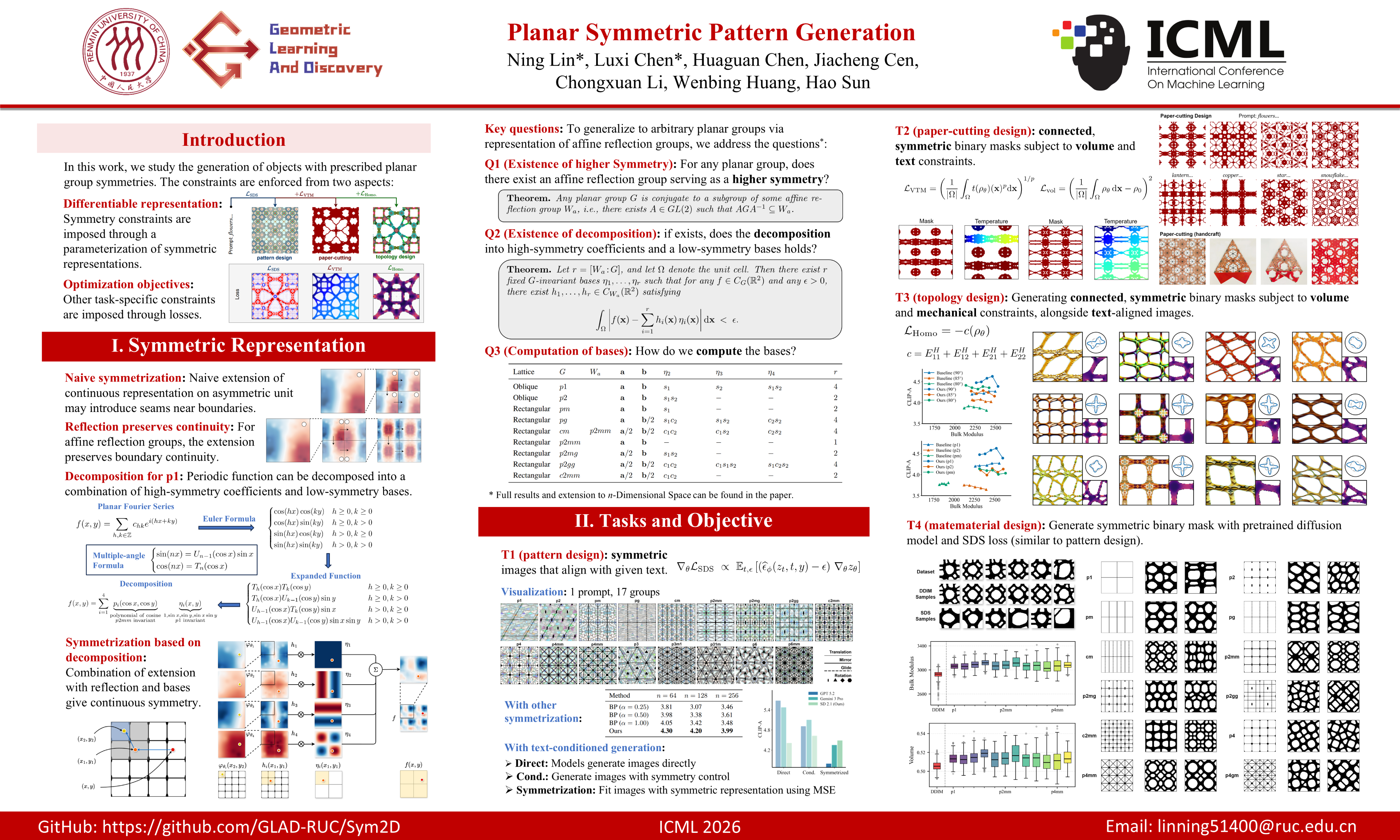
Generating objects with specific symmetries is essential in various real-world scenarios. However, adapting existing 2D continuous representations to enforce planar group symmetry remains a challenge, as the transformation of non-reflective group elements may disrupt continuity. To overcome this limitation, we propose a symmetrization framework for arbitrary planar groups. Our method transforms any 2D continuous representation into a symmetric one while preserving continuity. We provide the mathematical formulation of this representation, demonstrate its approximation capability for symmetric functions, and detail the construction methodology. We validate our approach through three visual design tasks (pattern design, paper-cutting design and stylized topology design) and one material design task. Experiments confirm that our representation enables effective symmetry control and demonstrate its broader applicability.
Lay Summary
Symmetry is a common and important property in both natural and human-made designs, such as patterns, paper-cut artworks, architectural ornaments, and engineered materials. Being able to generate objects with prescribed symmetries can therefore benefit many visual and physical design applications. However, existing methods based on continuous 2D representations often have difficulty enforcing general planar symmetries, because some symmetry transformations may introduce discontinuities or visible artifacts. In this work, we propose a general symmetrization framework that can convert any continuous 2D representation into a symmetry-preserving one. The resulting representation maintains continuity while allowing users to control the desired planar symmetry group. We provide the mathematical formulation of the method, show that it can approximate symmetric functions, and describe how to construct such representations in practice. We further demonstrate the usefulness of our approach on several applications, including pattern design, paper-cutting design, stylized topology design, and material design. The results show that our method provides an effective and flexible way to generate symmetric designs across different domains.