
Know Thyself, Know Thy User: Intrinsic Dual-Perspective Reasoning for Role-Playing LLMs
Abstract
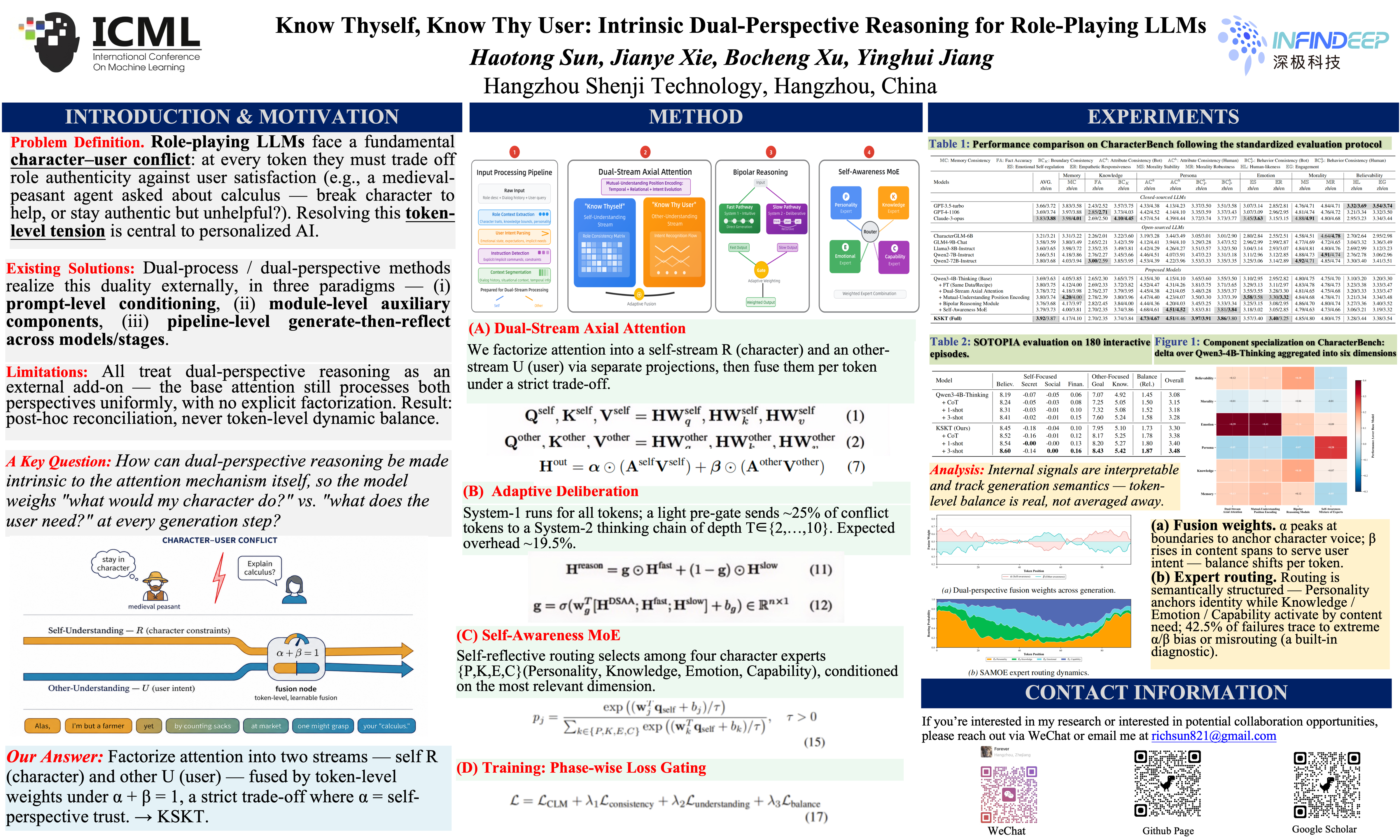
As role-playing Large Language Models (LLMs) become central to personalized AI, they face a fundamental challenge: balancing character authenticity with user satisfaction. Prior dual-process and dual-perspective approaches address this through prompt-level conditioning, auxiliary modules, or inference-time reflection---realizing duality externally rather than within the core attention mechanism. We introduce the KnowSelf-KnowOther Transformer (KSKT), which embeds dual-perspective reasoning directly into the generation process via dual-stream factorized attention that processes self-understanding and other-understanding through separate streams. This intrinsic integration enables token-level dynamic balance rather than post-hoc reconciliation. On CharacterBench, KSKT achieves 6.2% overall improvement over Qwen3-4B-Thinking. On SOTOPIA, KSKT improves Relationship by 19.3% over the base model---the dimension requiring explicit self-other coordination. These results establish intrinsic dual-perspective reasoning as an effective architectural principle for role-playing systems.
Lay Summary
Imagine asking an AI that is playing a medieval peasant to explain calculus. It faces an impossible choice. It can stay true to character and admit it knows nothing, leaving you unhelped, or it can break character to recite a textbook answer that shatters the illusion. Today's role-playing AIs tend to lurch to one extreme, because they have no built-in way to weigh "staying in character" against "actually helping this person." We redesigned the part of the AI that produces each word so that it holds both questions in mind at once, "what would my character do?" and "what does this person need?", and blends the two answers afresh for every single word, leaning toward character in some moments and toward helpfulness in others. The result keeps characters believable while making them genuinely useful, and our compact model matches role-playing systems many times its size. More broadly, the idea of balancing competing goals from the inside, rather than bolting on a fix afterward, could help AI navigate other hard trade-offs, such as being both helpful and honest at the same time.