
VideoGPA: Distilling Geometry Priors for 3D-Consistent Video Generation
Abstract
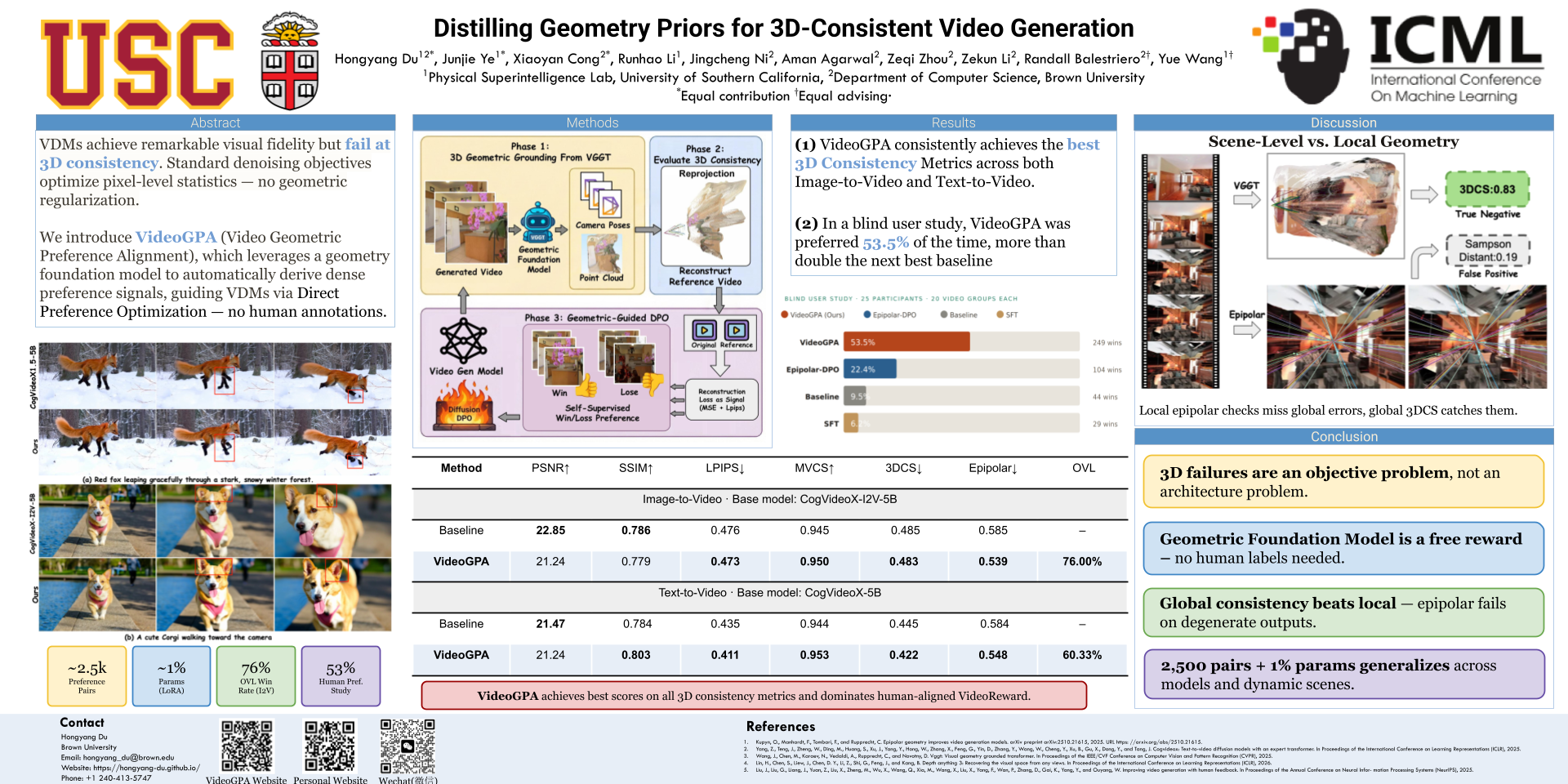
While recent video diffusion models (VDMs) produce visually impressive results, they fundamentally struggle to maintain 3D structural consistency, often resulting in object deformation or spatial drift. We hypothesize that these failures arise because standard denoising objectives lack explicit incentives for geometric coherence. To address this, we introduce VideoGPA (Video Geometric Preference Alignment), a data-efficient self-supervised framework that leverages a geometry foundation model to automatically derive dense preference signals that guide VDMs via Direct Preference Optimization (DPO). This approach effectively steers the generative distribution toward inherent 3D consistency without requiring human annotations. VideoGPA significantly enhances temporal stability, geometric plausibility, and motion coherence using minimal preference pairs, consistently outperforming state-of-the-art baselines in extensive experiments.
Lay Summary
AI video generators can create strikingly realistic footage, but they often fail in subtle ways: objects warp as the camera moves, backgrounds drift, and scenes lose their physical coherence over time. These failures happen not because the models are too small or undertrained, but because they are never explicitly taught to respect the laws of 3D space — they learn to make videos look plausible frame by frame, without any guarantee that the underlying geometry is consistent. We introduce VideoGPA, a lightweight method that teaches existing video generators to "think in 3D." The key idea is to use a separate geometry model — one that can reconstruct a 3D scene from a video — as an automatic quality inspector. If a generated video is geometrically correct, the inspector should be able to reconstruct it accurately; if not, the reconstruction error is high. We use this error as a free signal to rank generated videos from best to worst, and then train the video model to prefer the geometrically better ones. No human labeling is required. The result is a video generator that produces more stable, physically plausible videos — with fewer floating objects, fewer warping backgrounds, and better motion coherence — using only a small amount of additional training. Improvements also transfer to dynamic scenes the model was never explicitly trained on, suggesting that learning 3D consistency teaches a general physical intuition rather than a narrow trick.