
Optimal Fair Aggregation of Crowdsourced Noisy Labels using Demographic Parity Constraints
Abstract
Lay Summary
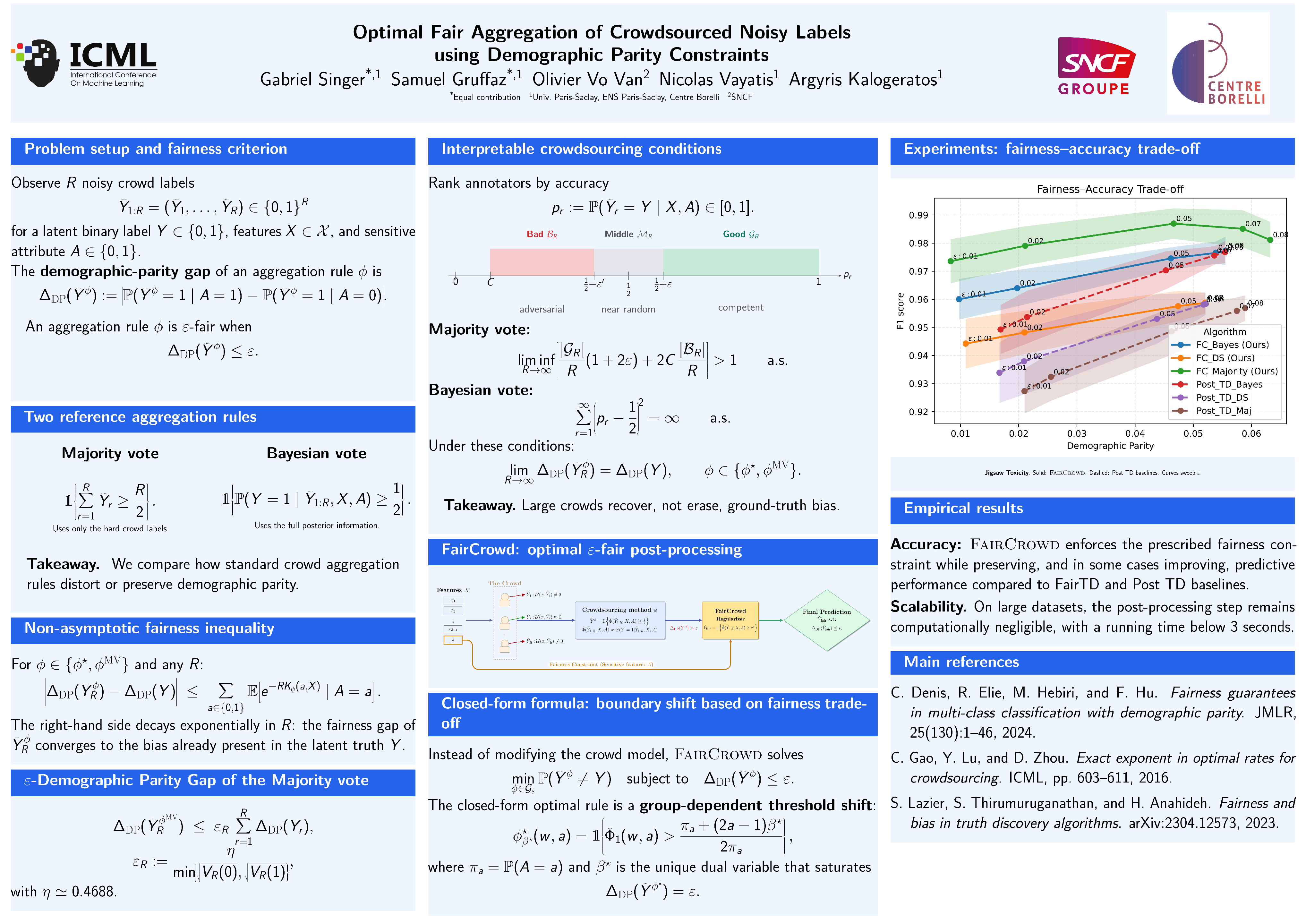
Crowdsourced datasets are often built by asking many people to label the same examples, but human annotators can make systematic errors that depend on sensitive attributes such as race, gender, or whether a text mentions a protected group. Standard aggregation rules such as majority vote may preserve or even amplify these biases, especially when only a small number of annotators label each item. We study when common crowdsourcing methods are fair and show theoretically how their demographic-parity gap behaves as the number and quality of annotators changes. We then introduce FairCrowd, a post-processing method that can be applied on top of any label aggregation rule to enforce a user-specified fairness constraint. Unlike previous approaches, FairCrowd is designed for discrete crowdsourced labels and comes with formal guarantees. Experiments on synthetic data, Crowd Judgment, and Jigsaw Toxicity show that FairCrowd improves the fairness–accuracy trade-off compared with existing fair truth-discovery methods. The method is also computationally efficient, making it practical for real crowdsourcing pipelines.