
TelecomTS: A Multi-Modal Observability Dataset for Time Series and Language Analysis
Abstract
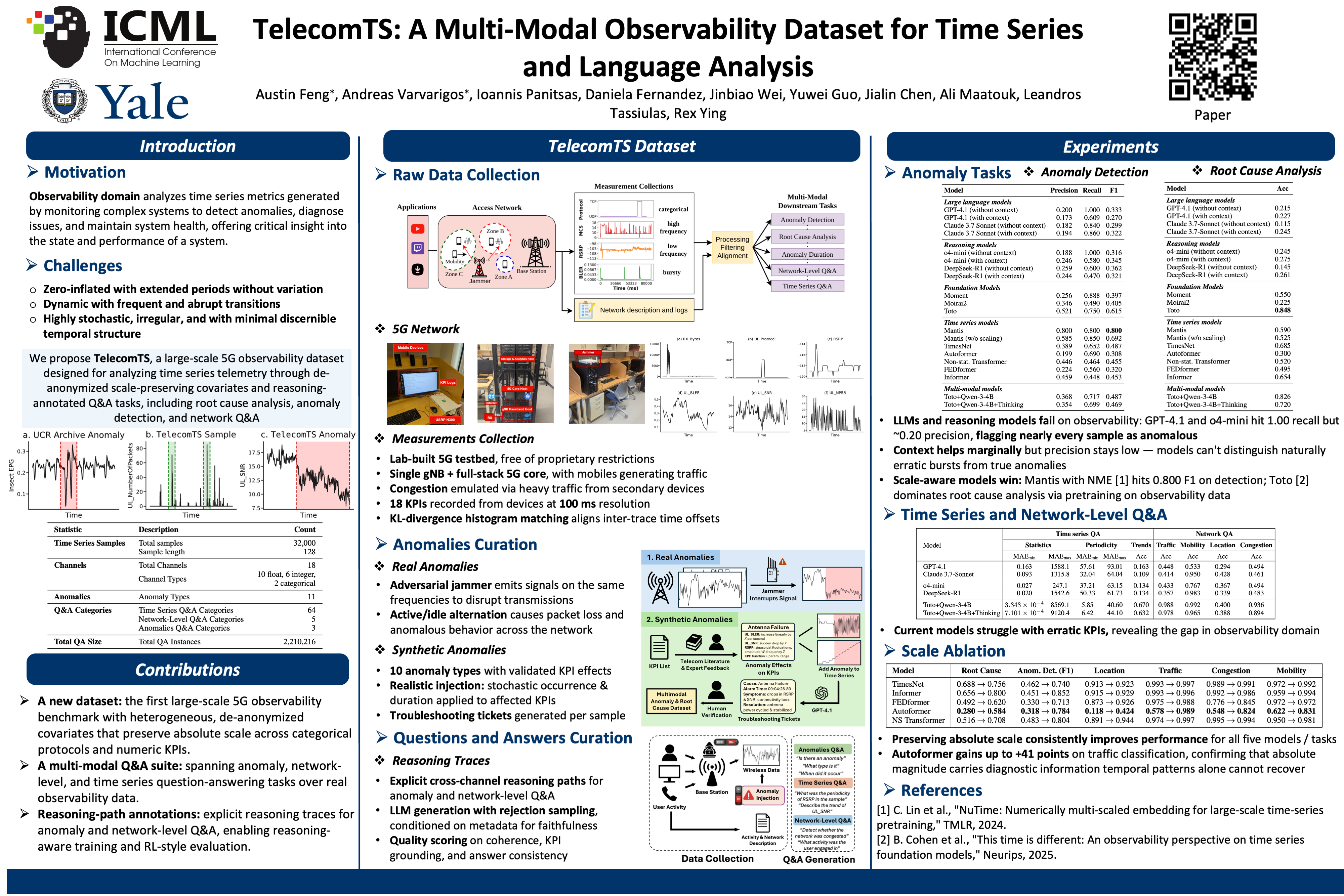
Modern enterprises generate vast streams of time series metrics when monitoring complex systems, known as observability data. Unlike conventional time series from domains such as climate, observability data are zero-inflated, highly stochastic, and exhibit minimal temporal structure. Despite their importance, observability datasets remain underrepresented in public benchmarks due to proprietary restrictions and privacy concerns. Existing datasets are often anonymized and normalized, removing scale information and limiting their use for tasks such as anomaly detection, root cause analysis, and multi-modal reasoning. To address this gap, we introduce TelecomTS, a large-scale observability dataset derived from a 5G telecommunications network. TelecomTS features heterogeneous, de-anonymized covariates with explicit absolute scale information and provides a diverse suite of downstream tasks, including anomaly detection, root cause analysis, and multi-modal question-answering. Benchmarking state-of-the-art time series, language, reasoning, and multi-modal foundation models reveals that existing approaches struggle with the abrupt, noisy, and high-variance dynamics characteristic of observability data. Our experiments further underscore the importance of preserving covariates’ absolute scale, emphasizing the need for foundation time series models that natively leverage scale information for practical real-world observability applications. The code is available at: \url{https://github.com/Ali-maatouk/TelecomTS}.
Lay Summary
Modern companies rely on constant streams of data to monitor whether their systems are running smoothly: this is called “observability data.” Unlike weather measurements or stock prices, this type of data is messy. It is often zero for long stretches, then suddenly spikes unpredictably, with little of the regular patterns that make other data easier to analyze. A major obstacle for researchers studying this problem is that real-world observability data is rarely shared publicly due to privacy and business concerns. Existing public datasets have been anonymized and stripped of important context, making them less useful for practical tasks such as spotting anomalies or diagnosing their root causes. To fill this gap, we created TelecomTS, a large, realistic dataset drawn from a telecommunications network. It preserves the original scale and context of the data and includes a range of benchmark tasks. We found that today’s best AI models struggle significantly with this type of data, highlighting the need for new approaches built with the characteristics of this data in mind.