
ANCHOR: Abductive Network Construction with Hierarchical Orchestration for Reliable Probability Inference in Large Language Models
Abstract
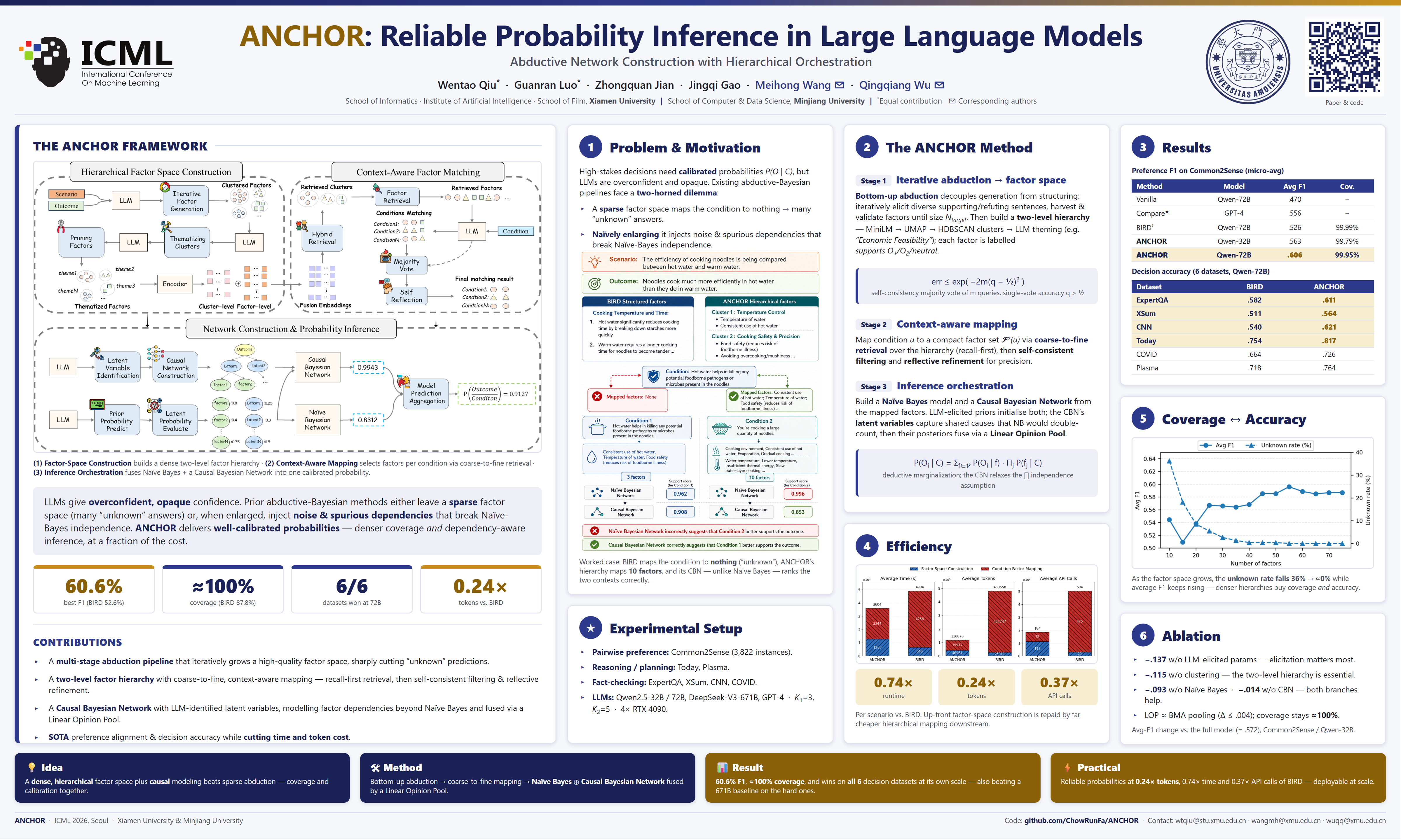
A central challenge in large-scale decision-making under incomplete information is estimating reliable probabilities. Recent approaches use Large Language Models (LLMs) to generate explanatory factors and coarse-grained probability estimates, which are then refined by a Naïve Bayes model over factor combinations. However, sparse factor spaces often yield ''unknown'' predictions, while expanding factors increases noise and spurious correlations, weakening conditional independence and degrading reliability. To address these limitations, we propose Anchor, an aggregated Bayesian inference framework over a hierarchical factor space. It constructs dense factor hierarchies through iterative generation and clustering, maps contexts via hierarchical retrieval and refinement, and augments Naïve Bayes with a Causal Bayesian Network to model latent factor dependencies. Experiments show that Anchor markedly reduces ''unknown'' predictions and produces more reliable probability estimates than direct LLM baselines, achieving state-of-the-art performance while significantly reducing time and token overhead.
Lay Summary
Many real-world decisions must be made with incomplete information, so it is important to estimate how likely different outcomes are. Recent AI-based methods can help by suggesting possible reasons behind an outcome, but they often face a trade-off: using too few reasons may leave the system unable to make a prediction, while using too many may introduce misleading or redundant information. We propose Anchor, a method that organizes possible reasons into a structured hierarchy, matches each new case to the most relevant reasons, and accounts for the fact that these reasons may influence one another. This helps the system make predictions more often and with greater reliability. Across experiments, Anchor produces more dependable probability estimates than direct AI-based baselines, while also reducing computation time and the amount of text the model needs to process.