
The Expert Strikes Back: Interpreting Mixture-of-Experts Language Models at Expert Level
Abstract
Lay Summary
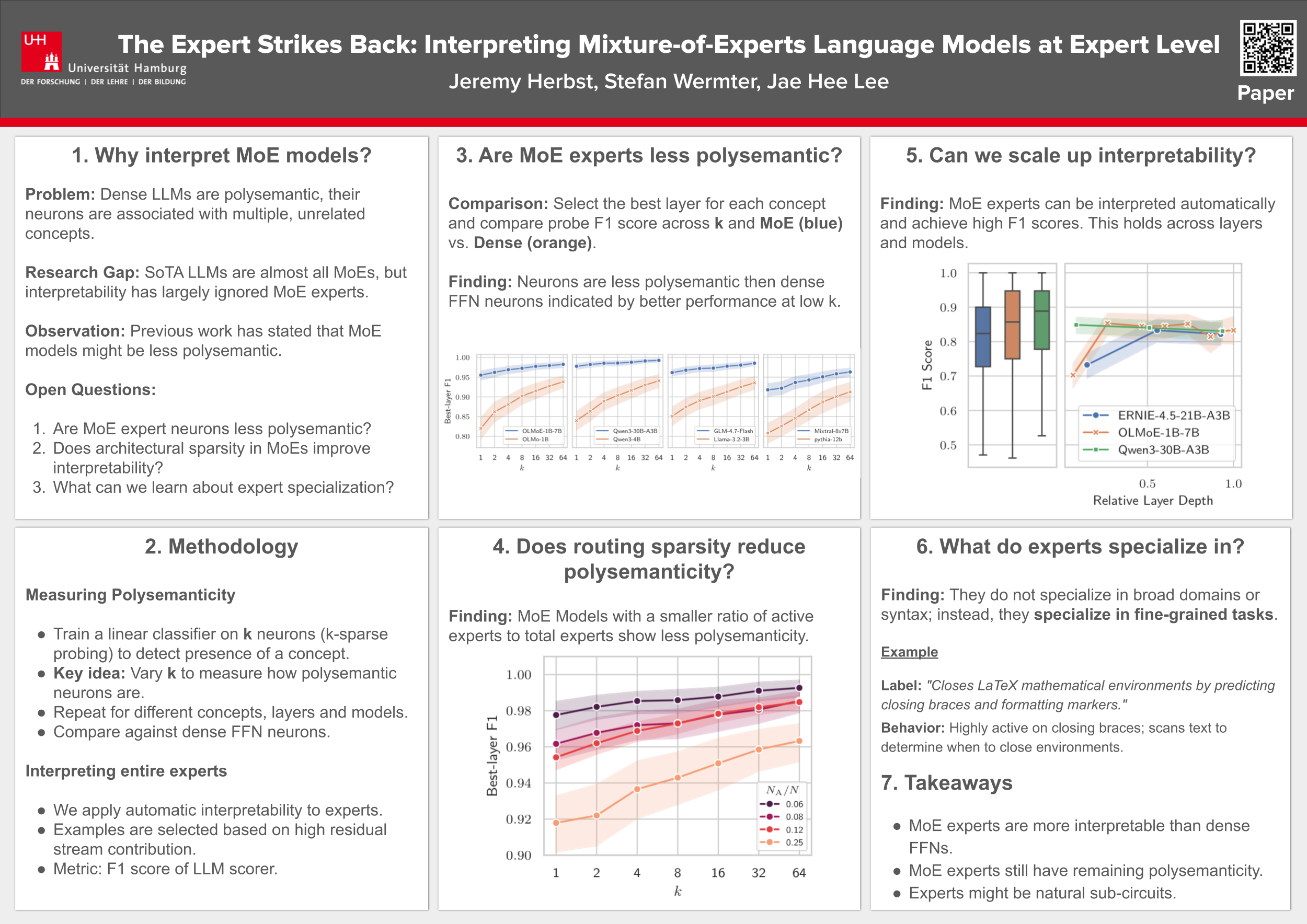
Modern AI language models are so complex that even their creators struggle to understand what is happening inside them, which is a serious obstacle to making these systems safe and trustworthy. One promising design, called Mixture-of-Experts (MoE), splits a model's work across many modules, using only a small fraction for any given input. We investigated whether this design makes models easier to understand, or whether the inner workings remain just as opaque. We tested twelve models and found that individual units inside MoE designs tend to respond to one concept at a time, rather than many jumbled concepts simultaneously. Crucially, the fewer modules used at once, the cleaner this effect becomes. Building on this, we treated each module as a single interpretable unit and automatically generated plain-language descriptions for hundreds of them, then verified those descriptions were meaningful and not just plausible. Our analysis also settles a long-running debate: these modules are neither broad topic specialists (e.g., biology) nor simple grammar processors. Instead, they perform precise tasks, like closing brackets in mathematical notation or completing role-playing game terminology. This suggests that the industry trend toward using fewer modules at once is making AI more transparent by design.