
Pushing the Limits of Block Rotations in Post-Training Quantization
Abstract
Lay Summary
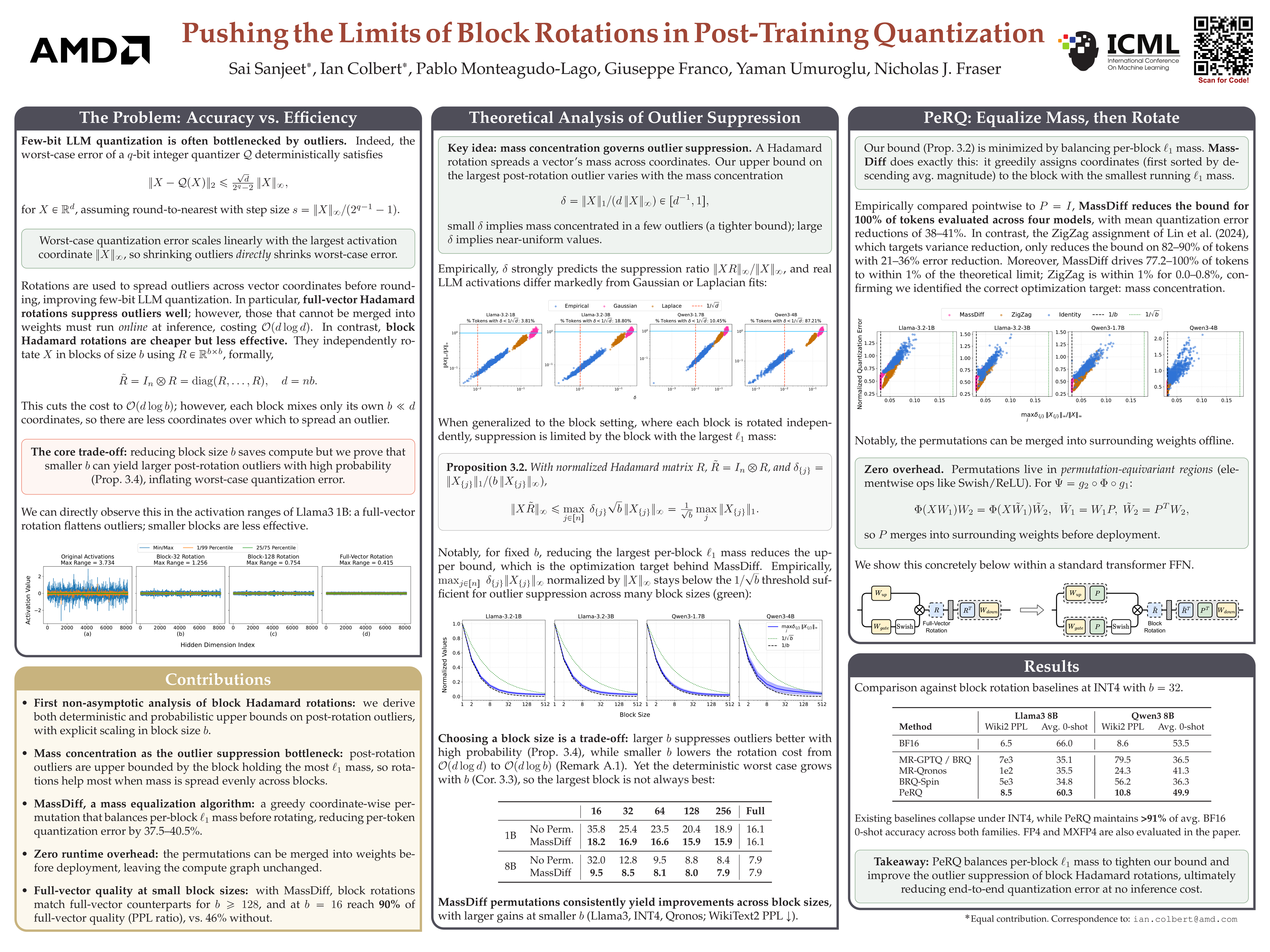
Large language models are powerful but expensive to deploy, so engineers compress their weights and activations into low-precision datatypes, a process called quantization. A handful of unusually large activation values, called outliers, dominate the numerical range and degrade accuracy at low bit widths. A popular remedy is to redistribute activation magnitudes across coordinates by rotating the tensors before rounding. Rotating the full activation vector works best but is computationally expensive at inference time, so recent methods partition activations into fixed-size blocks and rotate each block independently. Until now, it has been unclear why this block structure sometimes fails to suppress outliers. We provide the first deterministic analysis of outlier suppression under block rotations, showing that suppression is fundamentally limited by how activation magnitude is distributed across blocks before rotation, and is most effective when that the pre-rotated activation mass is evenly balanced across blocks. Guided by this insight, we introduce PeRQ (Permute, Rotation, then Quantize), which calculates a permutation that balances activation magnitudes before rotation. By exploiting equivariance properties within transformer architectures, this permutation can be absorbed into surrounding weights, recovering accuracy at no additional inference cost.