
From Parameters to Data: A Task-Parameter-Guided Fine-Tuning Pipeline for Efficient LLM Alignment
Abstract
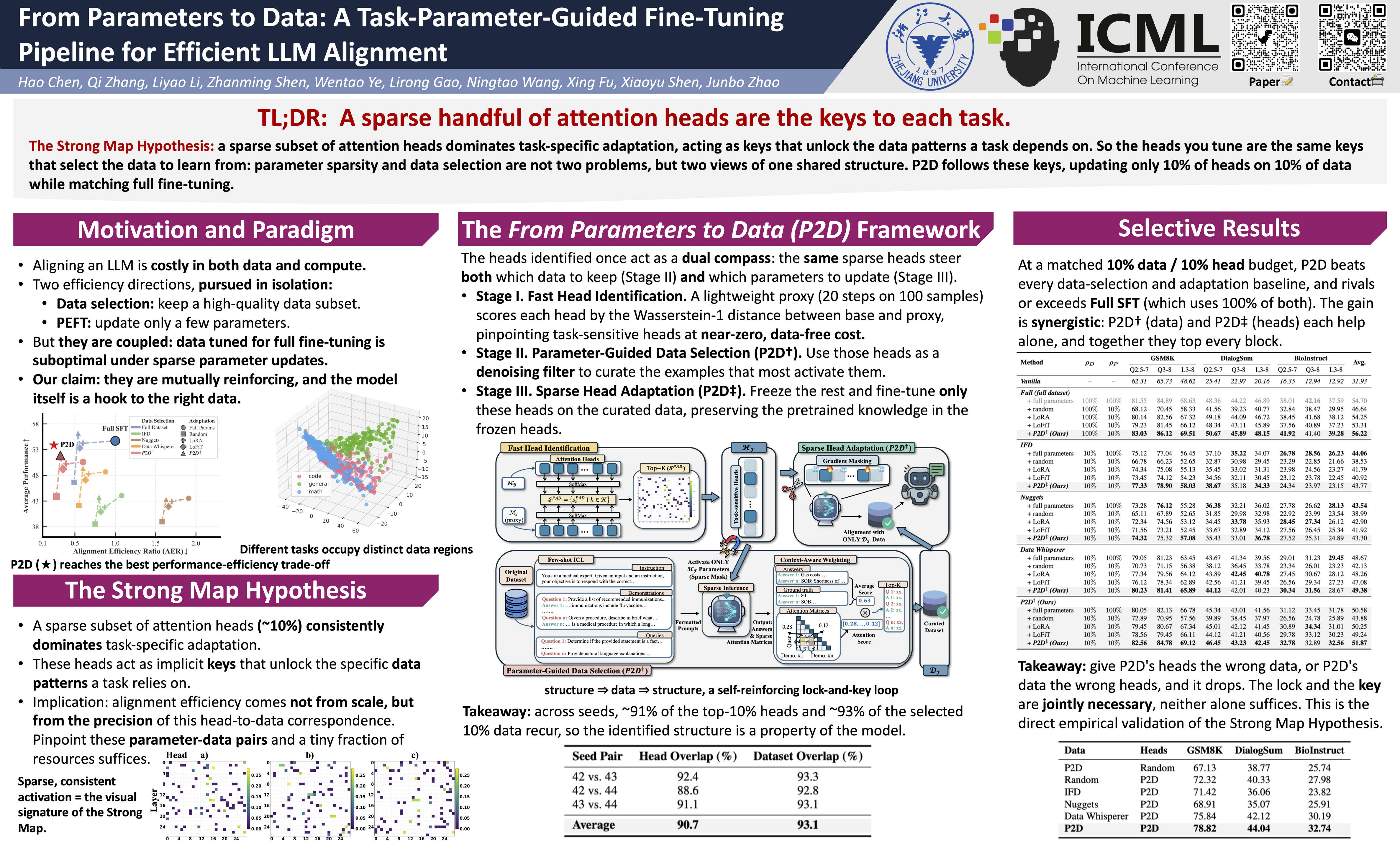
Adapting Large Language Models (LLMs) to specialized domains typically incurs high data and computational overhead. While prior efficiency efforts have largely treated data selection and parameter-efficient fine-tuning as isolated processes, our empirical analysis suggests they may be intrinsically coupled. We posit the Strong Map Hypothesis: a sparse subset of attention heads plays a dominant role in task-specific adaptation, acting as keys that unlock specific data patterns. Building on this observation, we propose From Parameters to Data (P2D), a unified framework that leverages these task-sensitive attention heads as a dual compass for both sample mining and structural pruning. To rigorously quantify the total pipeline cost, we introduce the Alignment Efficiency Ratio (AER) metric for both selection latency and training time. Mechanistically, P2D identifies critical heads via a lightweight proxy and uses them as a functional filter to curate high-affinity data, establishing a synergistic pipeline. Empirically, by updating merely 10% of attention heads on 10% of the data, P2D achieves an 8.3 pp performance gain over strong baselines and delivers a 7.0x end-to-end time speedup. These results validate that precise parameter-data synchronization eliminates redundancy, offering a new paradigm for efficient alignment.
Lay Summary
Modern large language models must be re-trained to specialize in fields such as medicine, dialogue, or math, but this re-training is expensive, consuming massive amounts of text and burning through GPU hours, which puts it out of reach for many researchers and small teams. We discovered that inside every large language model, only a small fraction of the internal wiring actually matters for any given task, much like a few specific circuits inside a giant electrical board. Our method, called P2D, first uses a tiny probe to identify these task-relevant circuits, then picks only the training examples that best activate them, and finally re-trains just those circuits on just those examples. Surprisingly, updating only 10% of the model on only 10% of the data not only matches but often exceeds the quality of training the full model on the full dataset. P2D cuts the time, cost, and energy of model specialization by roughly seven times, while also preserving the model's general knowledge so the same base model can be reused for many tasks. It also reveals a deeper principle: AI capabilities live inside sparse, task-specific subnetworks, opening new directions for understanding and steering large language models.