
Conformal Calibration Transfer
Abstract
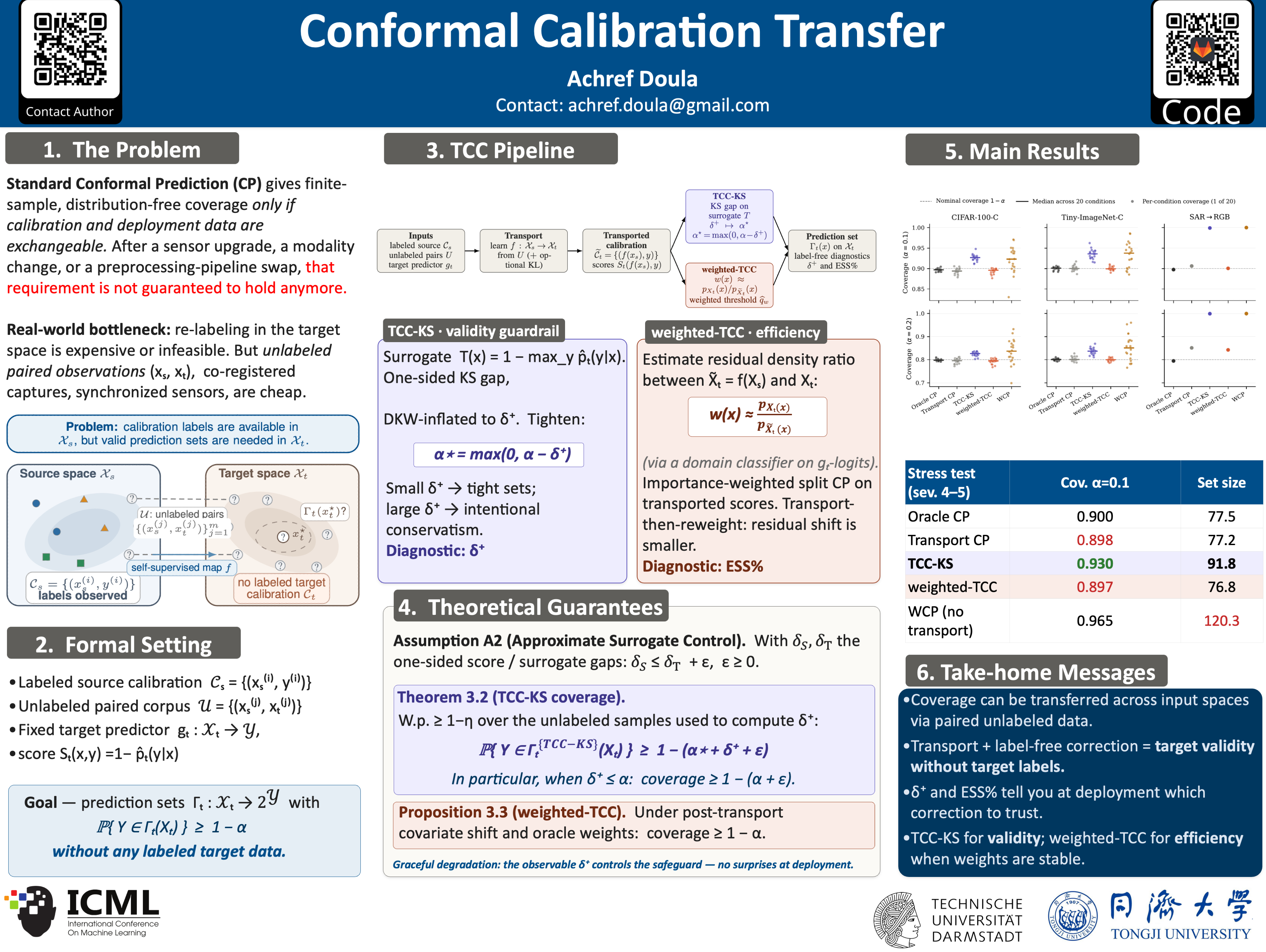
Conformal prediction converts point predictions into set-valued predictions with coverage guarantees under exchangeability between calibration and deployment data. We study conformal calibration transfer, where this requirement fails because labeled calibration is available only in a source space, while prediction sets are needed in a target space linked to the source through unlabeled paired observations (e.g., paired modalities or sensor changes). We propose Transported Conformal Calibration (TCC): we transport labeled source calibration into the target space using the paired data, and then correct residual post-transport mismatch using only unlabeled target inputs. We instantiate this correction with two complementary methods: TCC-KS, which uses a label-free uncertainty surrogate to detect mismatch and adjust calibration conservatively, and weighted-TCC, which reweights transported calibration toward the target domain for improved efficiency when weights are stable. We provide finite-sample target-domain coverage guarantees that adapt to an observable measure of mismatch. Across CIFAR-100-C, Tiny-ImageNet-C, and SEN12MS, we show reliable target-domain coverage transfer without labeled target calibration data, with label-free diagnostics that predict when correction is needed.
Lay Summary
Conformal prediction can turn a model’s output into a set of plausible answers with a formal guarantee that the correct answer is included often enough. To achieve this, it typically requires a labeled calibration set from the same kind of data on which the model will be used. In many practical settings, however, labeled calibration examples may exist only in one input space, while prediction sets are needed in another. For example, the two spaces may correspond to different data representations, modalities, sensors, or processing pipelines, and collecting new labels in the target space may be expensive, delayed, or unavailable. This paper studies how to transfer conformal calibration from a labeled source space to a target space using unlabeled paired observations. The proposed framework, Transported Conformal Calibration (TCC), first maps source calibration examples into the target input space and then corrects remaining mismatch using diagnostics that do not require target labels. It combines a conservative safeguard for reliability with a reweighting strategy that can improve efficiency when the transferred calibration data closely match the target domain. By reducing the need for labeled target calibration data, this work broadens the situations in which conformal prediction can be used. It also provides practical signals indicating when calibration transfer is reliable and when more conservative prediction sets are appropriate.