
Random Process Flow Matching: Generative Implicit Representations of Multivariate Random Fields
Abstract
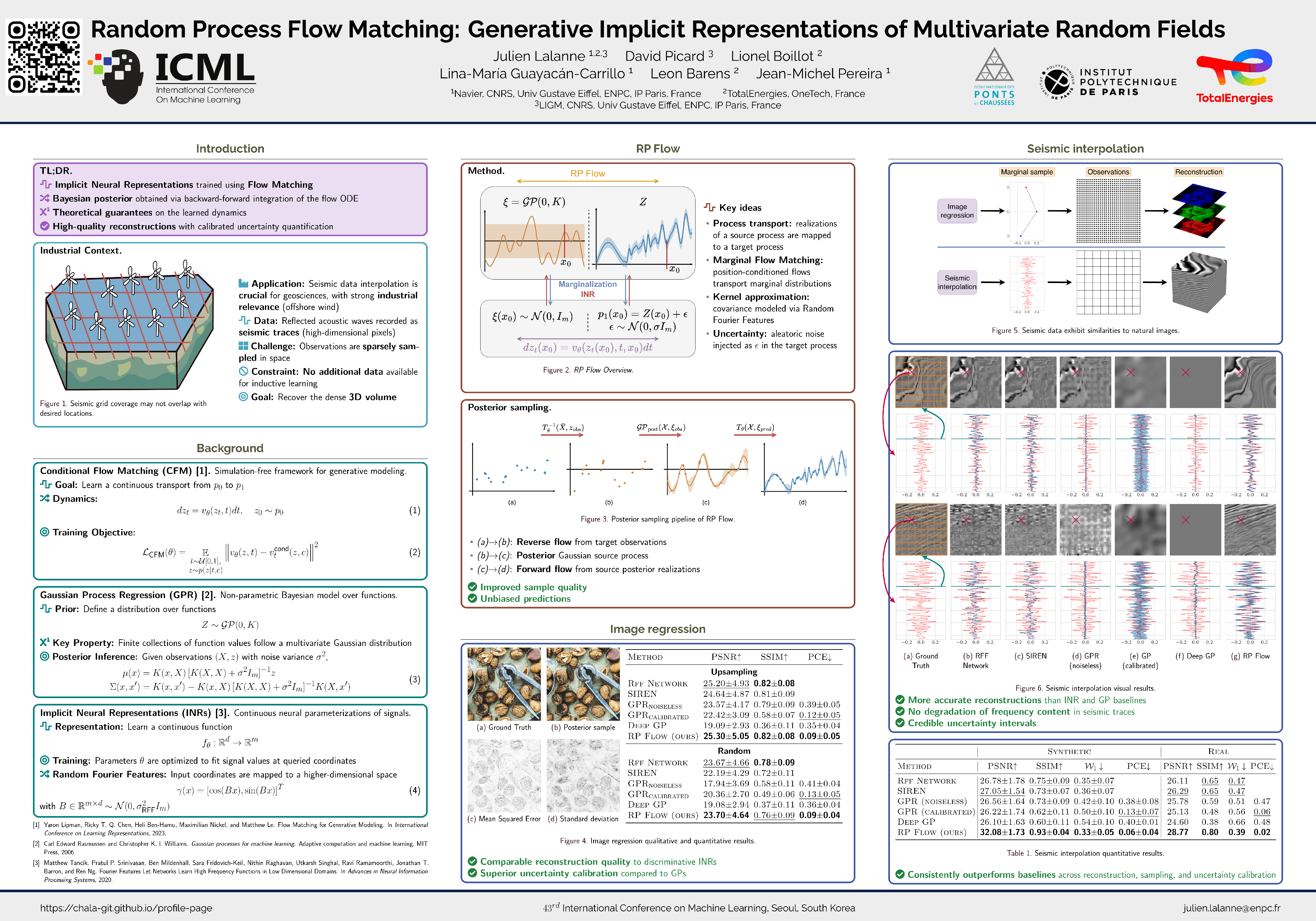
Generative modeling provides a powerful framework for learning data distributions. These models initially relied on probabilistic methods such as Gaussian Processes (GP) for uncertainty-aware predictions and shifted towards larger trainable models to learn more complex distributions. In this work, we introduce Random Process (RP) Flow, a Flow Matching-based framework that represents the vector field as a neural implicit function. Unlike modern generative methods, our setting involves a single observed field, from which only sparse measurements are available. RP Flow uses Random Fourier Features to learn an implicit signal representation that can be queried at any arbitrary location from a limited set of observations, while encoding uncertainty through ensemble sampling. We propose constructing a Bayesian posterior by GP regression in the source space to generate high-quality samples. Our empirical results demonstrate that this framework generates realistic samples along with calibrated uncertainty estimates, even under challenging conditions such as high frequency, high sparsity, or high dimensionality. These findings position RP Flow as a milestone towards generative models for reconstruction tasks where data is scarce and uncertainty must remain traceable.
Lay Summary
Many real-world problems require filling in missing information from only a few measurements. Existing methods typically need large datasets and often struggle to provide reliable uncertainty estimates, which are crucial when decisions depend on limited data. We introduce a new generative method that learns from just a single example with sparse observations. Instead of relying on large datasets, our approach models the data as a continuous process that can be queried anywhere. It combines neural networks with ideas from Bayesian statistics to both reconstruct missing values and quantify uncertainty. By working in a carefully designed latent space, our model can generate realistic reconstructions while maintaining well-calibrated uncertainty. Many scientific and engineering applications, such as medical imaging or geophysics cannot easily collect more data. This research enables better reconstruction and trustworthy uncertainty from scarce data, making generative modeling practical in data-limited settings.