
Bio-Inspired Self-Supervised Learning for Wrist-worn Accelerometer Data
Abstract
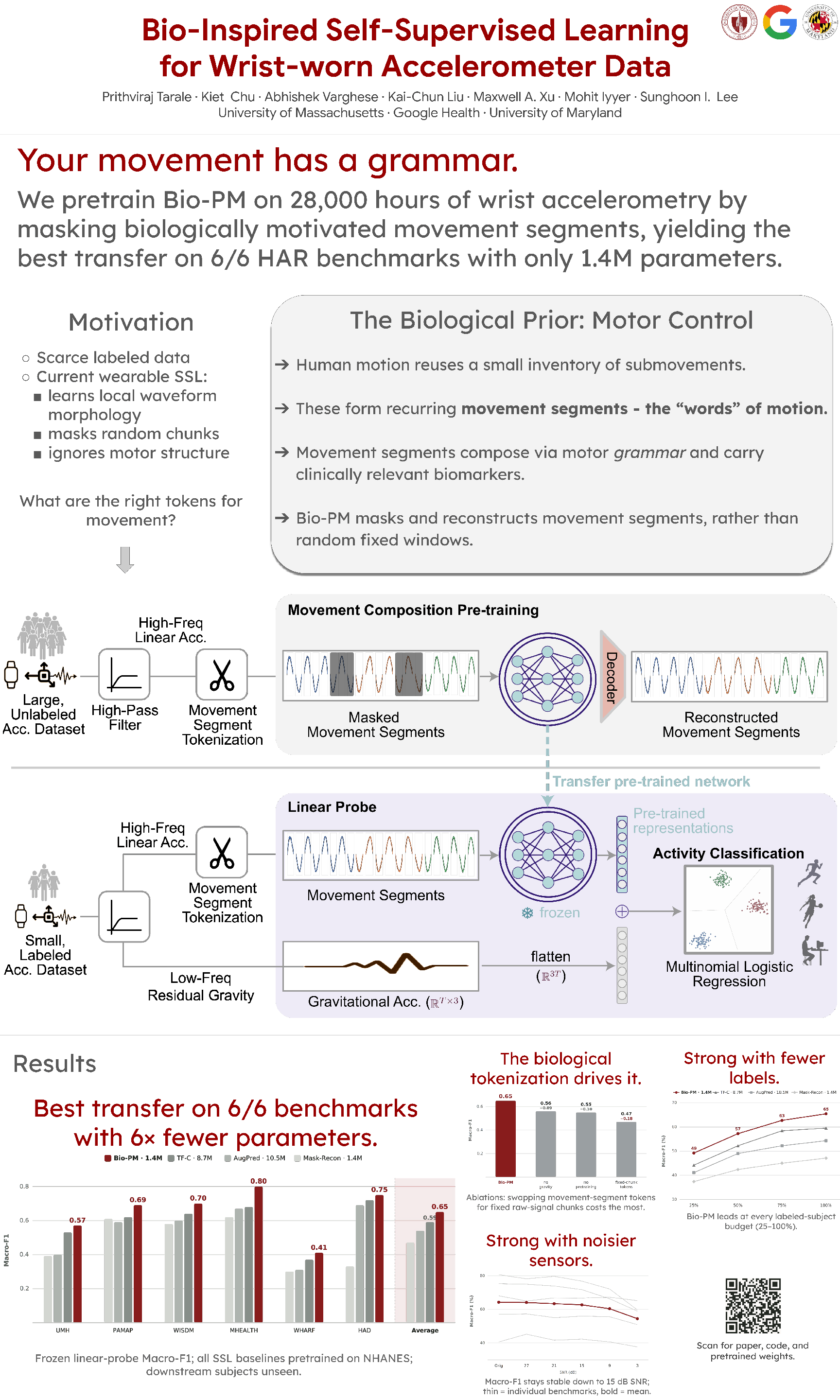
Lay Summary
Smartwatches record wrist movements throughout the day. These signals can help AI models recognize activities such as walking, eating, or climbing stairs, and may one day help track progress in motor rehabilitation or detect symptoms of conditions such as Parkinson’s disease, stroke, or ataxia. The problem is that teaching models to recognize each activity usually requires large amounts of human-labeled data, which is expensive to collect. One way around this is to let a model first learn from unlabeled movement recordings, before asking it to solve specific tasks with labels. Many current methods do this by hiding random parts of the signal and training the model to fill in the blanks. But human movement is not random: it is composed of distinct, meaningful actions, much like sentences are built from words. These actions are especially important because research has shown that their execution reveals changes linked to motor impairments. This motivated our central idea: a model may learn the language of human movement better if it learns to fill in the missing movement “words,” rather than the missing random signal fragments. Our method automatically finds these movement “words” in smartwatch sensor data, hides some of them, and trains the model to fill in the blanks using the surrounding movement context. After learning from about 28,000 hours of public wearable data, our model recognized daily activities more accurately than comparable models across six datasets. This approach could help future wearable devices better understand everyday movement, supporting applications in fitness tracking, elder care, rehabilitation, and motor health assessment.