
Breaking the Self-Confirming Loop: Diagnosing and Mitigating Systemic Reward Bias in Self-Rewarding RL
Abstract
Lay Summary
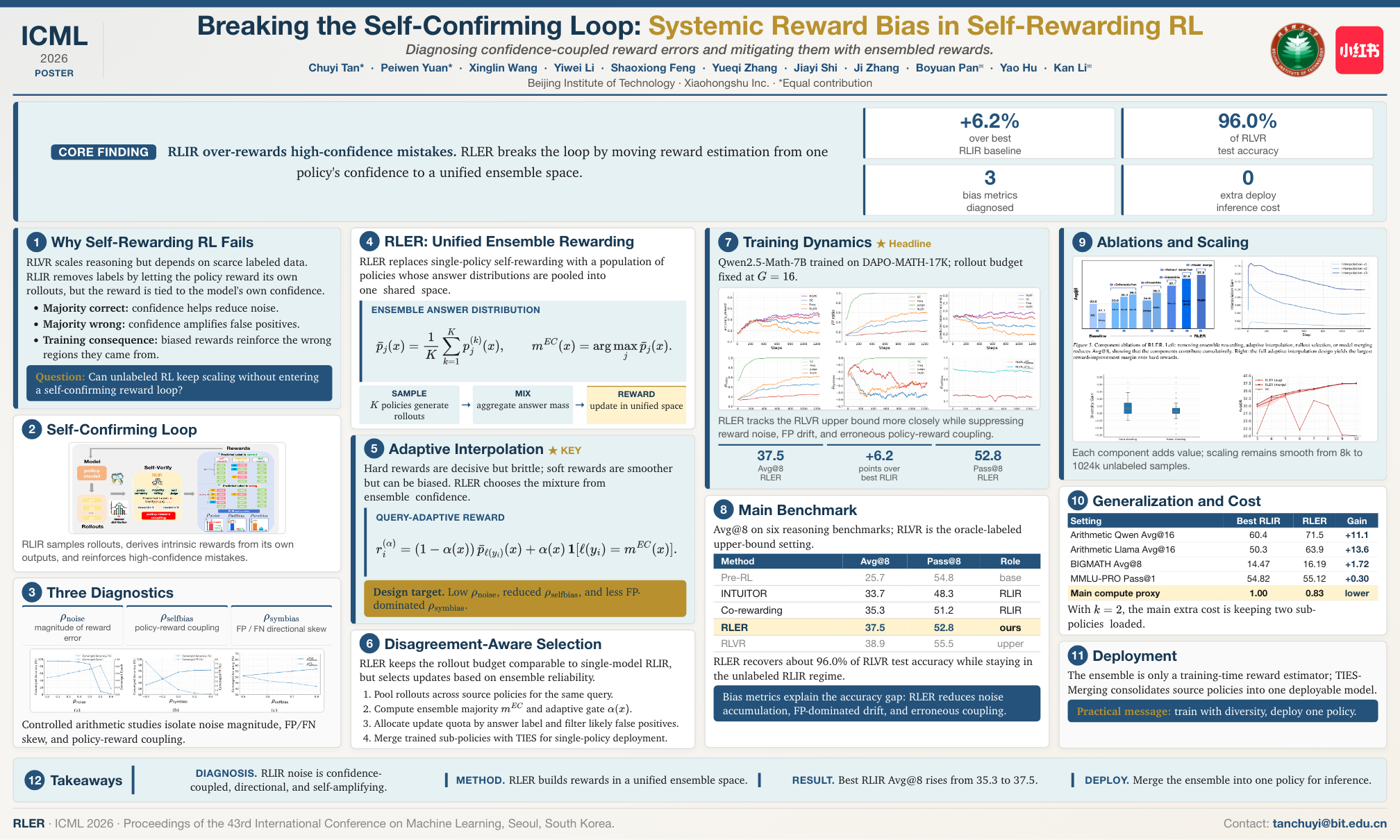
Large language models can improve their reasoning by training on problems with checkable answers, but such labeled data is often limited. A natural alternative is to let the model learn from its own generated answers. However, this can create a self-confirming loop: when the model is confidently wrong, it may assign overly positive feedback to its own mistake and reinforce it during training. This paper studies this failure mode and shows that it comes from three related issues: noisy self-generated rewards, rewards that are too tied to the model’s own predictions, and an imbalance between over-rewarding wrong answers and under-rewarding correct ones. We propose RLER, which estimates rewards using an ensemble of models, adaptively balances hard and soft reward signals, and selects training examples based on model disagreement. This makes self-rewarded training more stable and improves reasoning performance on unlabeled data.