
HSMAD: Heterophily-Driven Spectral and Manifold Learning for Graph Anomaly Detection
Abstract
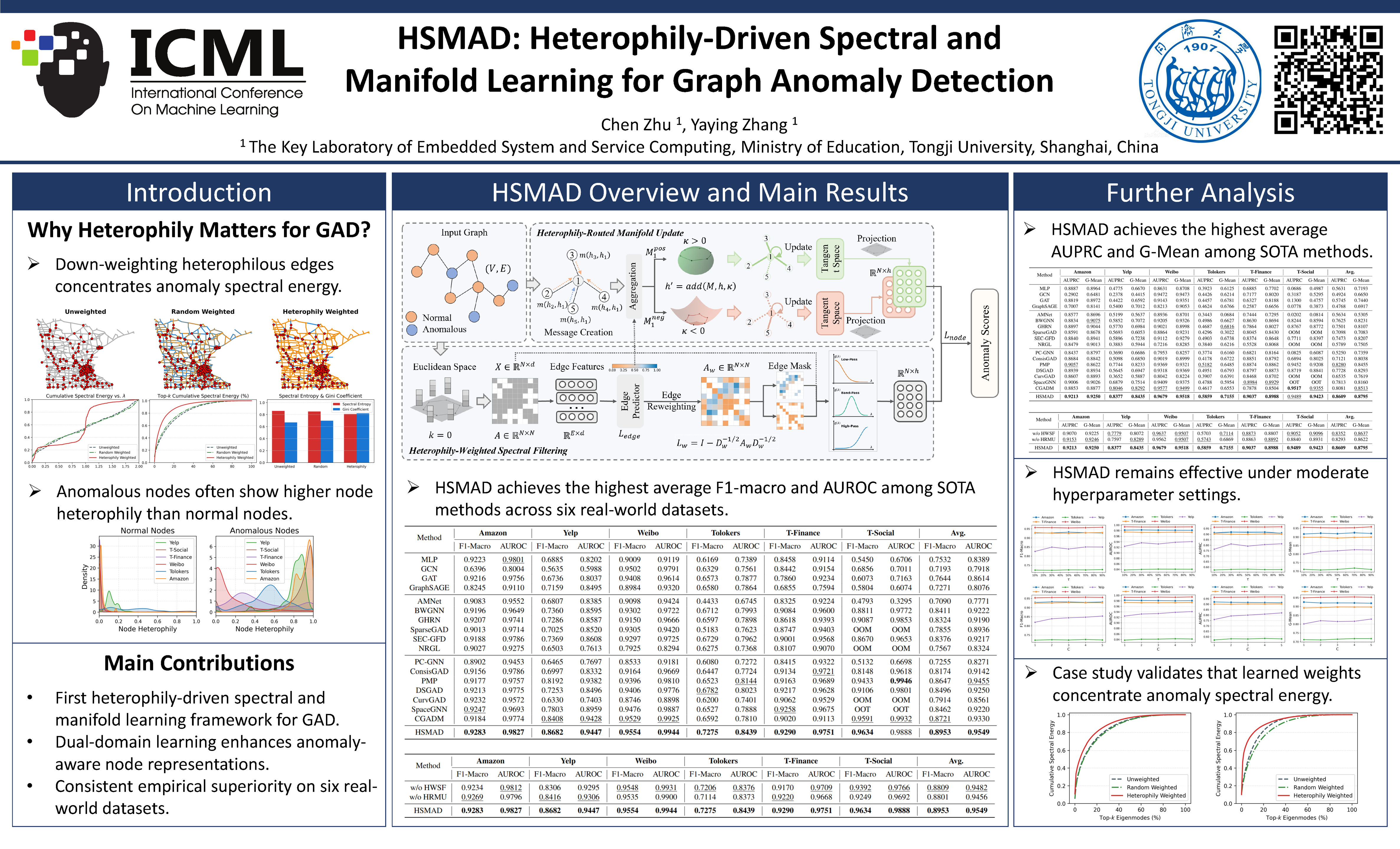
Graph anomaly detection (GAD) is a fundamental task in graph learning. However, most existing methods rely on the homophily assumption, which posits that connected nodes tend to share the same labels. This assumption often fails in the presence of edge heterophily, leading to degraded performance. We first observe that down-weighting heterophilic edges, relative to the original or randomly weighted graphs, results in a more concentrated spectral energy distribution, thereby facilitating the learning of discriminative spectral representations. Moreover, existing methods typically embed graphs in Euclidean spaces, neglecting the importance of heterophily in manifold spaces. Motivated by these observations, we propose HSMAD, a novel framework for GAD. It consists of two key components: the Heterophily-Weighted Spectral Filtering module, which reconstructs the Laplacian using heterophily-based edge weighting for spectral filtering, and the Heterophily-Routed Manifold Update module, which routes neighborhood messages to the appropriate manifold for node feature updates, enabling curvature-adaptive representation learning. These spectral and geometric representations are jointly leveraged for anomaly detection. Extensive experiments on six real-world datasets show that HSMAD achieves state-of-the-art performance across the average F1-Macro, AUROC, AUPRC, and G-Mean. Specifically, the average F1-Macro score improves by 2.66% over the best-performing method.
Lay Summary
Many important systems can be viewed as networks, such as users interacting on social media, accounts sending money, or devices communicating in a computer system. In these networks, finding unusual objects is important because they may reveal fraud, cyberattacks, faults, or other risks. Many current methods work best when connected objects are similar, but real networks often contain important connections between very different objects, such as a suspicious account interacting mostly with normal accounts. We propose HSMAD, a method that uses these differences between connected objects as useful signals. It adjusts how much information should pass through each connection and chooses a more flexible way to update each object’s representation, depending on the local pattern around it. This helps the method separate normal and abnormal objects more clearly. Across six real world datasets, HSMAD performs better than strong existing methods on several common measures of anomaly detection. These results suggest that paying attention to differences between connected objects can make anomaly detection more accurate and reliable in practical networked systems.