
Sequential Group Composition: A Window into the Mechanics of Deep Learning
Abstract
Lay Summary
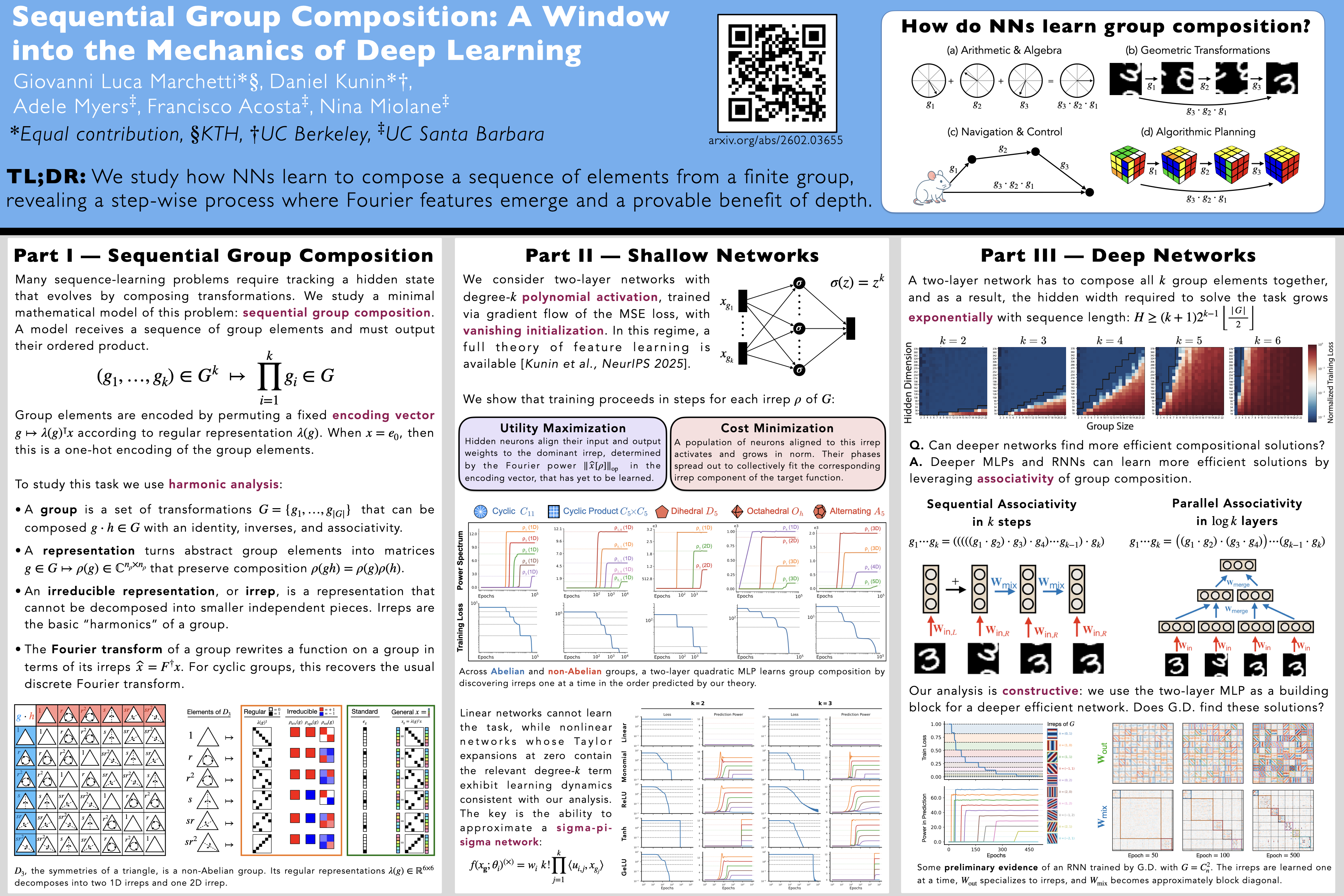
Despite the popularity of neural networks within AI, we do not understand what and how they learn. In our work, we study how neural networks learn to solve problems that involve composing a sequence of elements following prescribed algebraic rules. These tasks are simple but illustrative, since they require the model to build an internal understanding of the underlying rules, rather than just memorize examples. We show that, as training progresses, the network learns these rules step by step, forming increasingly organized internal representations. Our tools come from abstract algebra, and involve a far-reaching generalization of methods originating in signal processing (the “Fourier Transform”). The results help explain how artificial intelligence systems discover structure in data, and offer a clearer picture of how complex reasoning-like behavior can emerge from learning.