
PrivGate: Steering Contextual Integrity in LLMs via Latent Space Geometry
Abstract
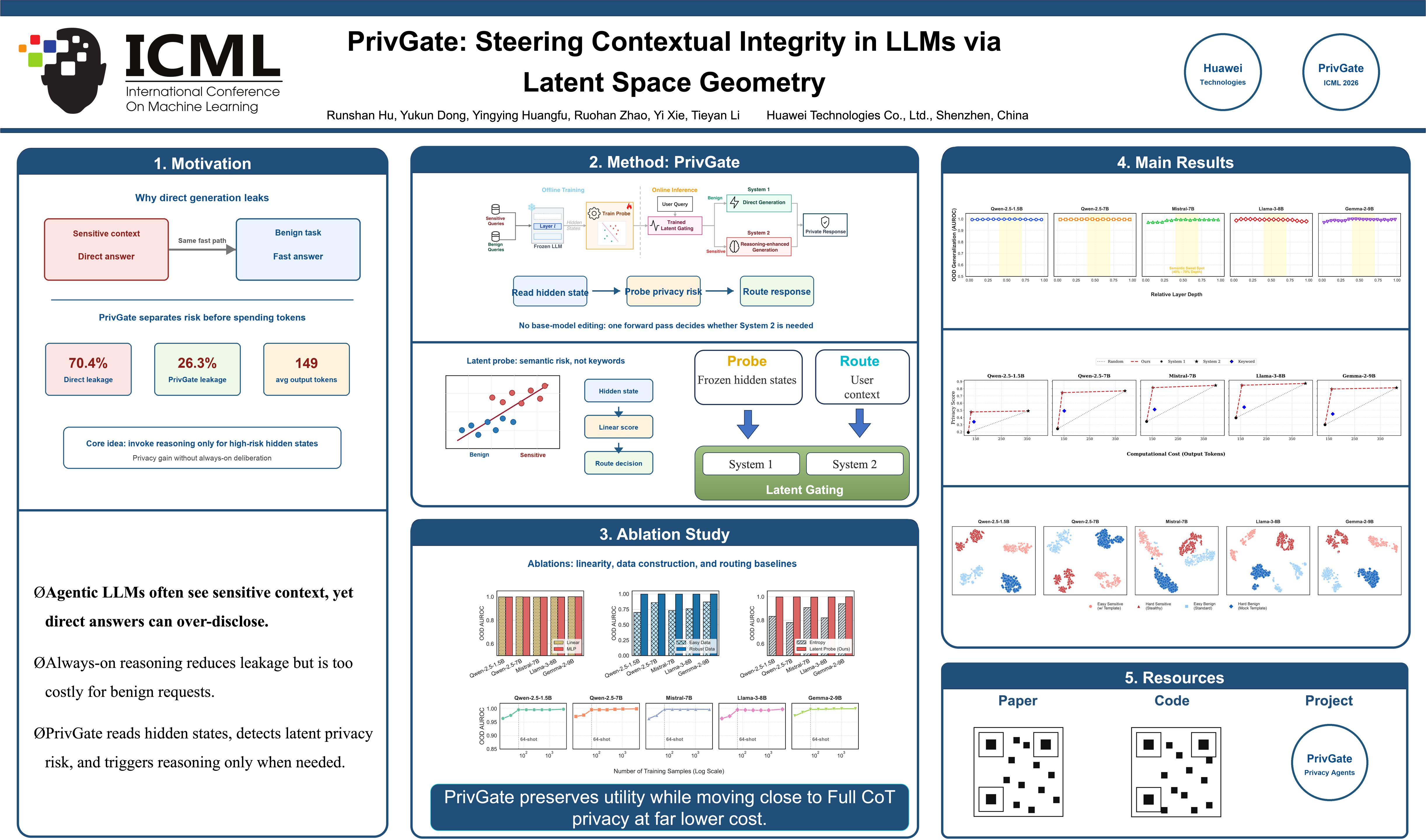
Securing Contextual Integrity (CI) is critical for privacy-preserving Large Language Model (LLM) agent execution. However, existing agents struggle to balance the agility of direct generation against the prohibitive latency of CI-constrained thinking. To address this, we propose PrivGate, a framework that selectively invokes explicit reasoning based on internal privacy signals. Our approach is grounded in the discovery of a privacy manifold, where models linearly encode privacy sensitivity within their residual streams, even during non-compliant generation. Leveraging this structure, PrivGate employs Latent Gating, a training-free mechanism that requires no fine-tuning of the base LLM and triggers explicit reasoning only when high latent risk is detected, thereby optimizing the efficiency-privacy trade-off by minimizing unnecessary compute. On the contextual PrivacyLens benchmark, PrivGate maintains consistently high performance in out-of-distribution risk identification, validating the generalizability of the discovered manifold. End-to-end evaluations show that PrivGate achieves a 62.6% average relative reduction in privacy leakage with 15.9% token overhead, offering a practical pathway to reconcile rigorous CI requirements with the performance demands of LLM agents.
Lay Summary
As AI assistants become able to use email, calendars, and other tools, they may accidentally share more private information than a task requires. For example, an assistant trying to help with a message could reveal a medical or financial detail to the wrong person. We study whether these systems can sense privacy risk before they answer. We find that several AI models show warning signs inside their own processing when a request involves sensitive information, even when their final response might still reveal too much. Based on this finding, we build PrivGate, a method that checks for these warning signs and asks the AI to slow down and think more carefully only when privacy risk is high. For ordinary low-risk requests, the assistant can still respond quickly. In our tests, PrivGate greatly reduced privacy mistakes while adding only modest extra cost. This suggests a practical way to make AI assistants safer without making every interaction slower.