
Asymmetric Contrastive Objectives for Efficient Phenotypic Screening
Abstract
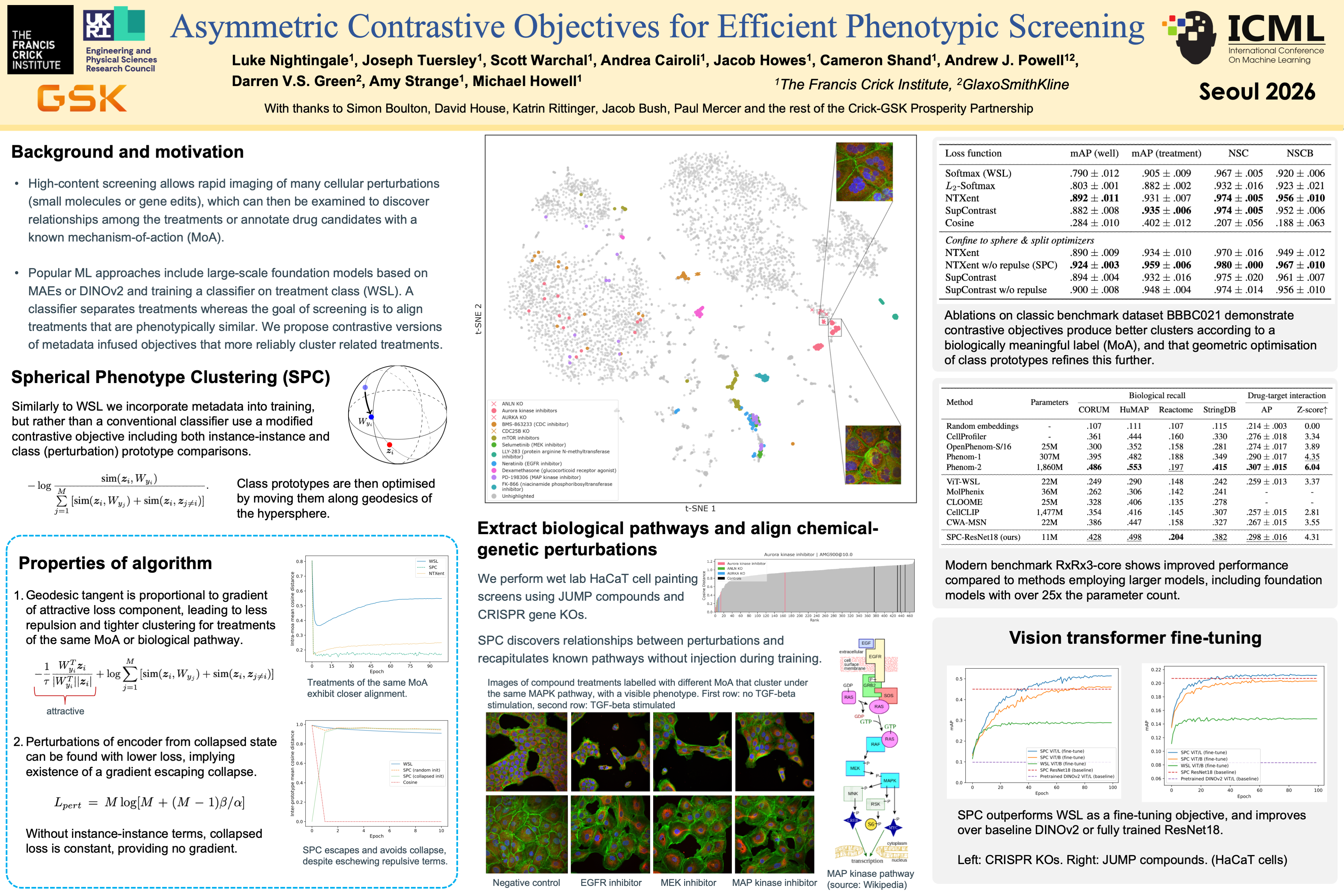
Phenotypic screening experiments produce many microscope images of cells under diverse perturbations, with biologically significant responses often subtle or difficult to identify visually. A central challenge is to extract image representations that distinguish activity from controls and group phenotypically similar perturbations. In this work we propose new adaptations of contrastive loss functions that incorporate experimental metadata as learned class vectors, and a geometrically inspired variant, called SPC, where class vectors are confined to the unit sphere and updated only by attractive terms (allowing more overlap of phenotypically similar classes). The approach is tested on two popular benchmarking datasets, BBBC021 and RxRx3-core; and we also evaluate performance on uncurated screens of HaCaT cells to gauge effectiveness in a realistic use-case scenario. We find we outperform prior methods across the three datasets and on a wide array of metrics measuring phenotype grouping, biological recall, drug-target interaction and mechanism-of-action inference. We also show we maintain this improved performance compared to models over 10x larger in parameter count, and that SPC can be used as an effective fine-tuning technique. The method is easy to implement and is well suited to settings with limited data or compute resources.
Lay Summary
Early stage drug discovery can be accelerated by imaging large collections of cells that have been exposed to drugs or CRISPR gene edits. Examining how these cells change their shape and structure — their phenotype — provides clues about the biological processes that have been altered. When testing a new small molecule drug candidate, its effects are compared with those of known treatments to look for similar patterns, helping researchers infer the molecule’s likely biological mechanism. Machine learning is particularly well suited to this process because microscopy is high-throughput, generating the quantities of images needed for data-hungry modern algorithms. Current state of the art approaches require extremely large datasets and substantial computing resources, which limits their use outside major research centres. We address this challenge with a geometrically informed algorithm, SPC, that achieves performance competitive with large scale methods while using far fewer images and much less compute. This makes advanced phenotypic analysis accessible to academic institutions and smaller teams. SPC also improves the quality of the phenotype groupings, more reliably linking drugs that act on the same biological pathway and producing clear, interpretable landscapes of cell biology.