
The Bridge-Garden Dilemma in LLM Distillation: Why Mixing Hard and Soft Labels Works
Abstract
Lay Summary
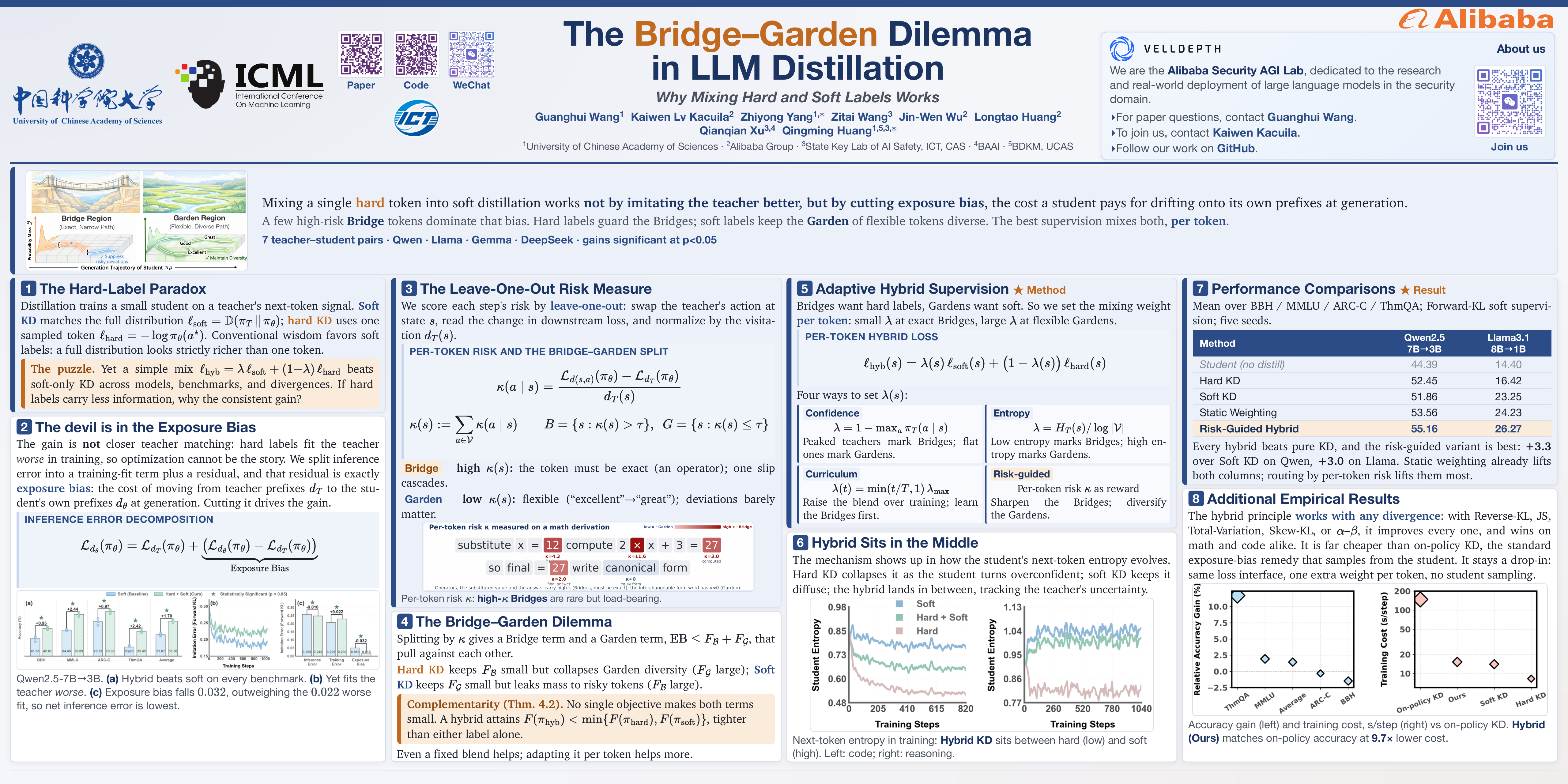
Large language models are useful, but they are expensive to run. A common way to reduce this cost is to train a smaller model to imitate a larger one. This paper studies a simple question in that process: when the larger model teaches the smaller one, should it provide only its chosen answer, or should it also provide its full range of possible answers? At first, the full range of possible answers seems strictly better, because it contains more information. We find that this is not always true. Some parts of generation are narrow: one wrong word, symbol, or code token can derail the whole answer. Other parts are flexible: several word choices can be equally acceptable. The first kind benefits from clearer, more decisive supervision, while the second benefits from preserving alternatives. Based on this observation, we propose methods that mix these two kinds of teaching signals. Across reasoning and coding tasks, this gives smaller models better performance while keeping training much cheaper than more expensive alternatives.