
Towards Effective Waste Segmentation for Automated Waste Recycling in Cluttered Background
Abstract
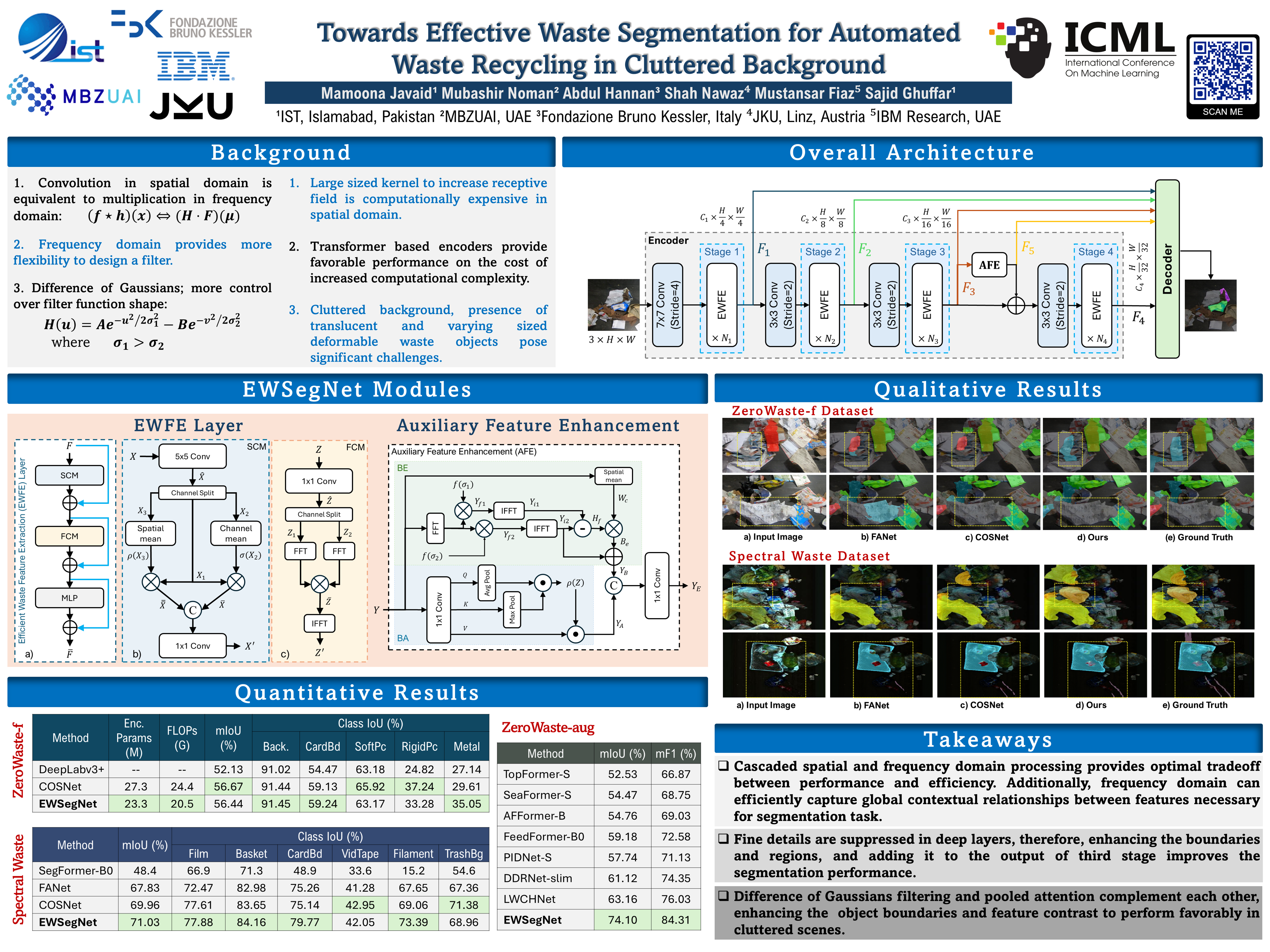
Rapid expansion of urban areas and population growth is causing an immense increase in waste production, which demands the need for efficient and automated waste management. In this scenario, automated waste recycling (AWR) using deep learning methods can assist humans in optimal waste management. Recent deep learning approaches for AWR provide promising waste segmentation performance, however, these methods rely on large backbone networks that are inefficient for AWR systems and suffer from performance deterioration in cluttered scenes. To this end, an optimal waste segmentation network is introduced which effectively utilizes the spatial domain to capture localized structural dependencies and the spectral domain to efficiently extract global contextual relationships. This cascaded design allows the network to progressively leverage both local and global representations across complementary domains to highlight the semantic information necessary for effective segmentation of various waste objects. Furthermore, auxiliary feature enhancement module (AFEM) is introduced to enhance the target objects' boundaries and blob amplification for better segmentation in cluttered scenarios. Extensive experimentation on ZeroWaste-aug, ZeroWaste-f and SpectralWaste datasets reveals the merits of the proposed method.
Lay Summary
Humans cannot imagine living in a world where waste is spread everywhere, polluting their ecosystem. To live in a healthier and less polluted environment, we wanted computers to separate recyclable waste objects from the solid waste thereby assisting humans in efficient waste management. We propose an artificial intelligent system that takes the image of the solid waste on a messy conveyor belt and identifies the recyclable objects. Our artificial intelligence system uses the advantages of frequency domain and improves the system performance and efficiency.