
Joint Navigation and Manipulation Planning with 3D Interaction Chains
Abstract
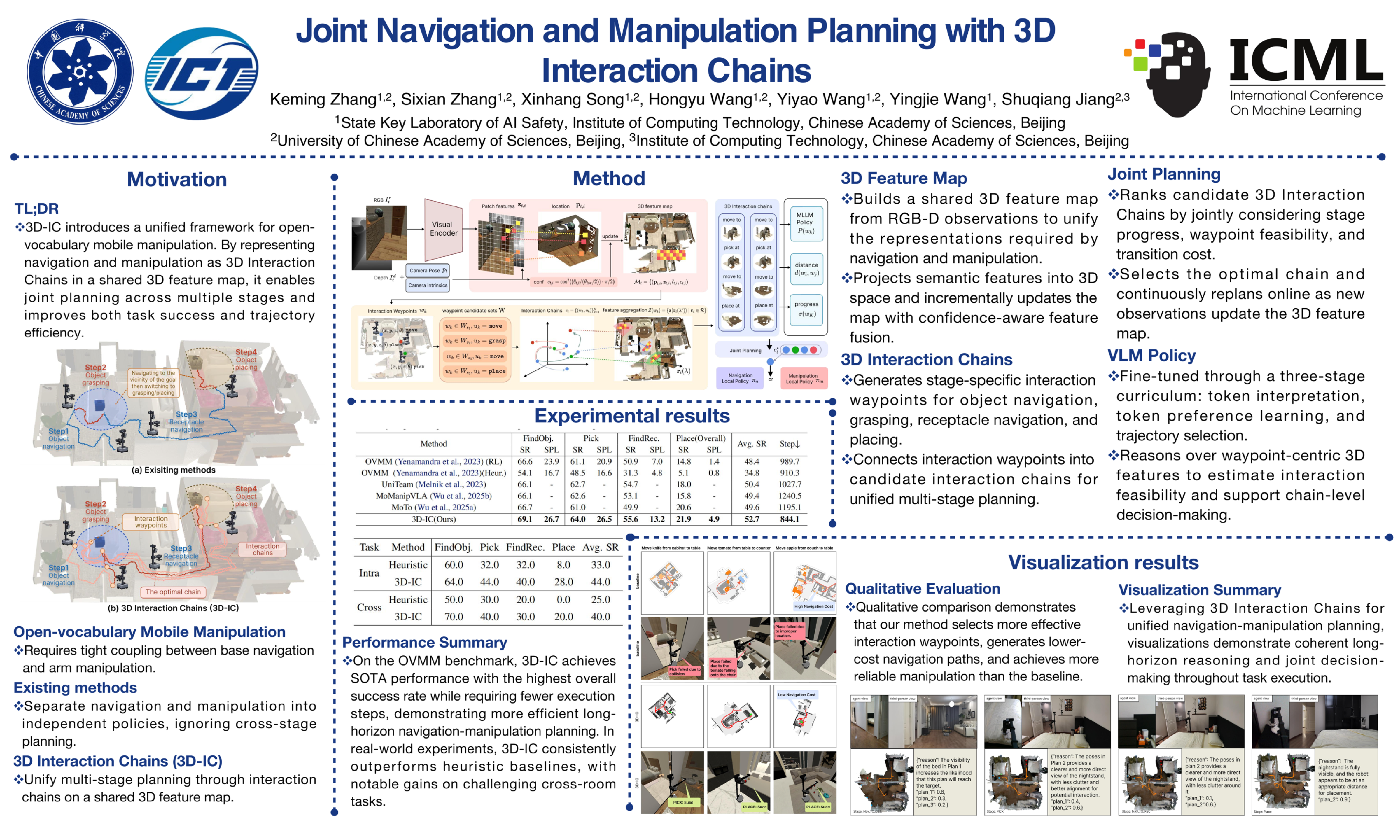
Open-vocabulary mobile manipulation (OVMM) requires long-horizon navigation in unseen environments and object-centric manipulation. Most existing methods treat navigation and manipulation as separate stages, which can yield navigation endpoints that are poor for manipulation or manipulation-friendly poses that are globally inefficient. We address this mismatch with 3D Interaction Chains (3D-IC), a unified framework that couples multi-stage navigation and manipulation planning. 3D-IC maintains a shared 3D feature map for both skills, generates stage-aligned interaction waypoints, and links them into candidate multi-stage chains. A hierarchical policy then scores these chains by jointly considering feasibility (via VLM reasoning over waypoint-centric 3D features) and transition cost, selecting the best trade-off between success and path efficiency. The robot executes the next waypoint and replans as new observations arrive. Experiments in simulation and on a real Stretch 3 robot demonstrate consistent gains in both task success and trajectory efficiency.
Lay Summary
Robots that assist people in homes need to move around unfamiliar environments and handle objects. However, many existing systems treat these abilities separately, which can lead to decisions that seem reasonable at one stage but make later actions more difficult. We introduce a new approach that allows robots to plan navigation and manipulation together rather than as isolated stages. The robot builds an understanding of its surroundings and considers how different sequences of actions may affect the success of the overall task. Experiments in simulation and on a real robot show that this approach helps robots complete tasks more successfully while also reducing unnecessary movement.