
Bioacoustic Geolocation: Species Sounds as Geographic Signals
Abstract
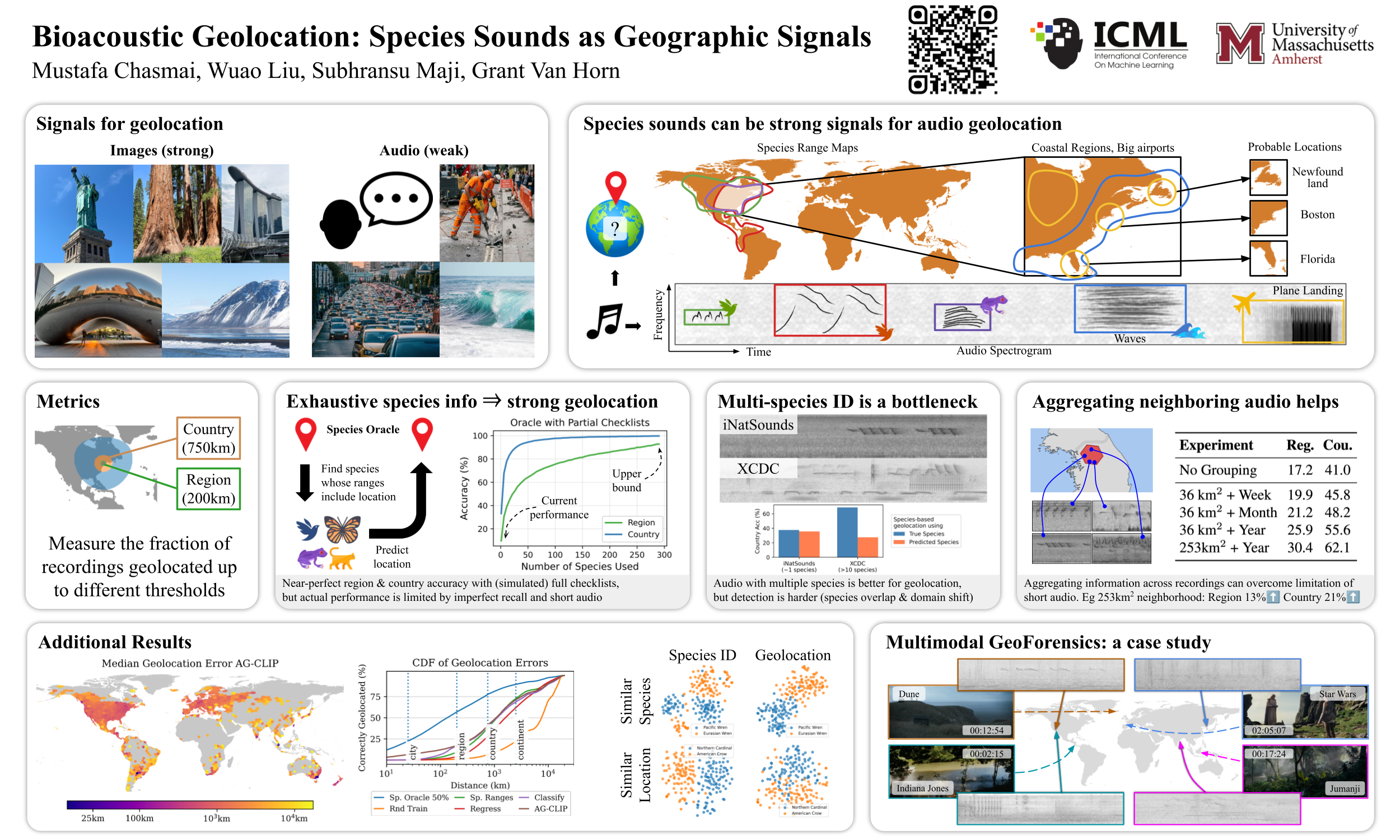
Can we determine someone’s geographic location solely from the sounds they hear? Are acoustic signals enough to localize within a country, state, or even city? In this work, we tackle the challenge of global-scale audio geolocation, with a particular focus on wildlife and natural sounds. We posit that bioacoustic signals contain informative geolocation cues because of well-defined geographic ranges of species. To test this hypothesis, we benchmark image geolocation and soundscape mapping methods, design oracles and species-centric baselines, and propose a hybrid approach that combines species range prediction with retrieval-based geolocation. We further ask whether geolocation improves with species-diverse recordings and spatiotemporal aggregation across neighboring samples. Finally, we extend our study to multimodal geolocation with case studies from movies that combine both audio and visual content. Our results highlight the potential of incorporating bioacoustic signals into geospatial tasks, motivating future work on species recognition and audio geolocation.
Lay Summary
We study the problem of determining someone’s geographic location solely from the sounds they hear. We want to understand 1) whether the problem is even feasible and 2) how precisely can location be estimated---down to the country, state, or city. We particularly focus on bioacoustic signals---sounds made by birds, animals, insects, etc---hypothesizing that the well-defined geographic ranges of species provide useful cues for the location. To first understand the state of current research, we construct simple extensions from the similar problems of image geolocation (predict location from images) and soundscape mapping (retrieve sound from location). We also design oracles that simulate perfect species information at every location, and evaluate geolocation performance with this to show that the task is feasible. Finally, we incorporate species information in a popular image-geolocation model to propose a hybrid method AG-CLIP. In our experiments, we observe that strong geolocation performance can be attained with complete species information. However, existing approaches fall short of this oracle performance, and there is a significant scope for improvement. We observe that our models tend to perform better with more species diversity, and increased difficulty of species identification becomes the bottleneck in such cases. We further show that combining information from multiple audio recordings in a neighborhod is an effective strategy to boost geolocation performance. Finally, we extend our study to the multimodal domain with case studies from movies that combine both audio and visual content. Our results highlight the potential of incorporating bioacoustic signals into geospatial tasks, motivating future work on species recognition and audio geolocation.