
Think Less, Act Early: Reinforced Latent Reasoning with Early Exit in Vision-Language-Action Models
Abstract
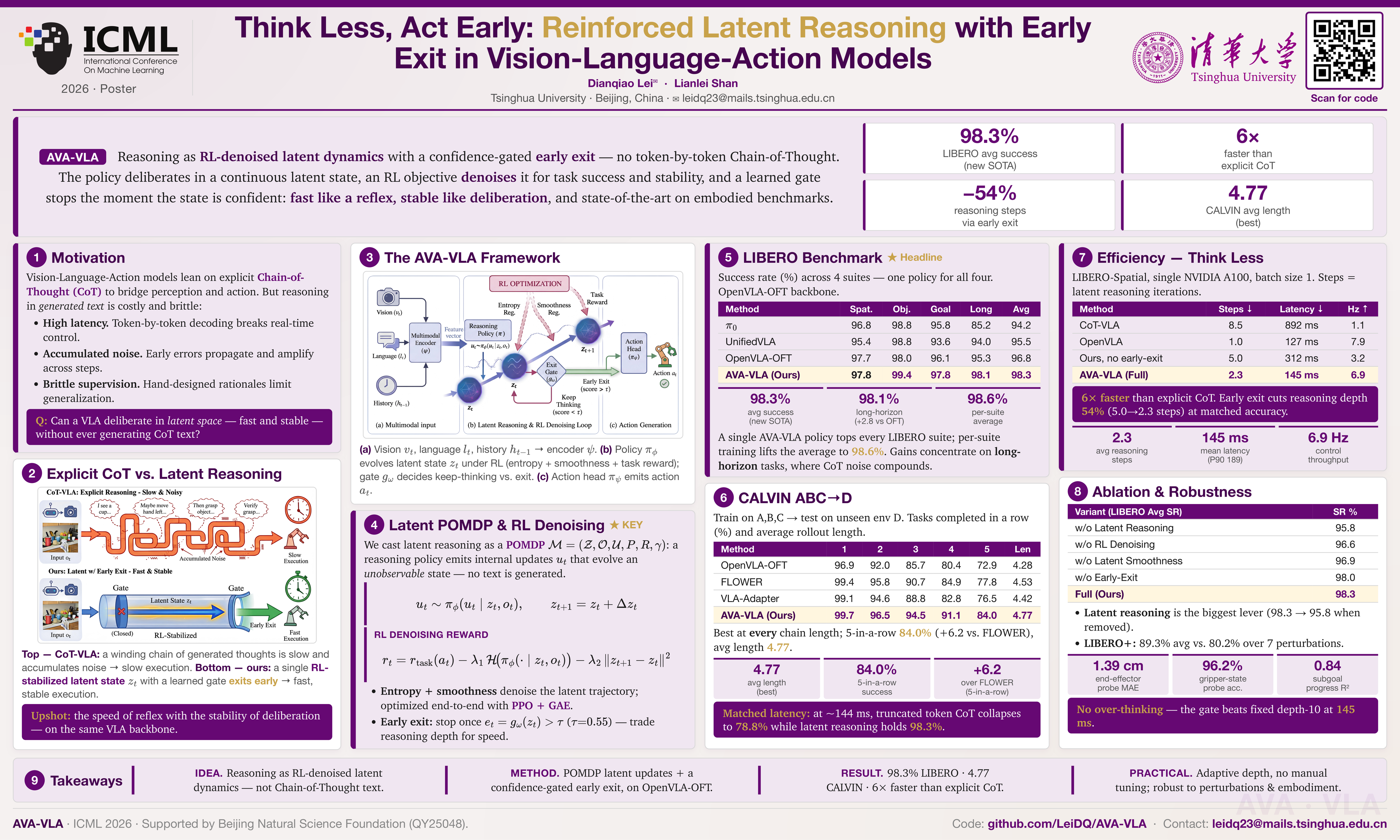
Existing Vision-Language-Action (VLA) models predominantly rely on explicit Chain-of-Thought (CoT) reasoning to bridge perception and action. While effective, this paradigm suffers from high computational costs and error propagation in multi-step tasks. In this paper, we propose Adaptive Variable Alignment VLA (AVA-VLA), a novel Latent Reasoning VLA framework that models reasoning as a sequence of unobservable latent variables, bypassing the need for explicit text generation. However, latent trajectories are inherently susceptible to noise interference and misalignment with downstream objectives. To address this, we introduce a Reinforcement Learning-based Denoising mechanism that treats latent state generation as a sequential decision process, optimizing reasoning trajectories via task-level rewards. Furthermore, we incorporate an Early-Exit Strategy that adaptively terminates reasoning based on state confidence, enabling a dynamic trade-off between depth and efficiency. Extensive experiments on embodied decision benchmarks demonstrate that AVA-VLA significantly reduces inference latency while achieving superior stability and success rates compared to full-reasoning baselines.
Lay Summary
Robots that follow human instructions often need to connect what they see, what people ask them to do, and the actions they should take. Many current systems do this by generating step-by-step text explanations before acting. This can make them slow, and mistakes in early steps may affect later decisions. In this paper, we propose a different approach: instead of writing out every reasoning step, the robot reasons internally and learns to keep this internal process stable. The system can also stop reasoning early when it is already confident enough, so it does not waste time on unnecessary computation. Experiments on robot task benchmarks show that this approach helps the robot act faster while maintaining strong task performance and stability.