
How (Not) to Hybridize Neural and Mechanistic Models for Epidemiological Forecasting
Abstract
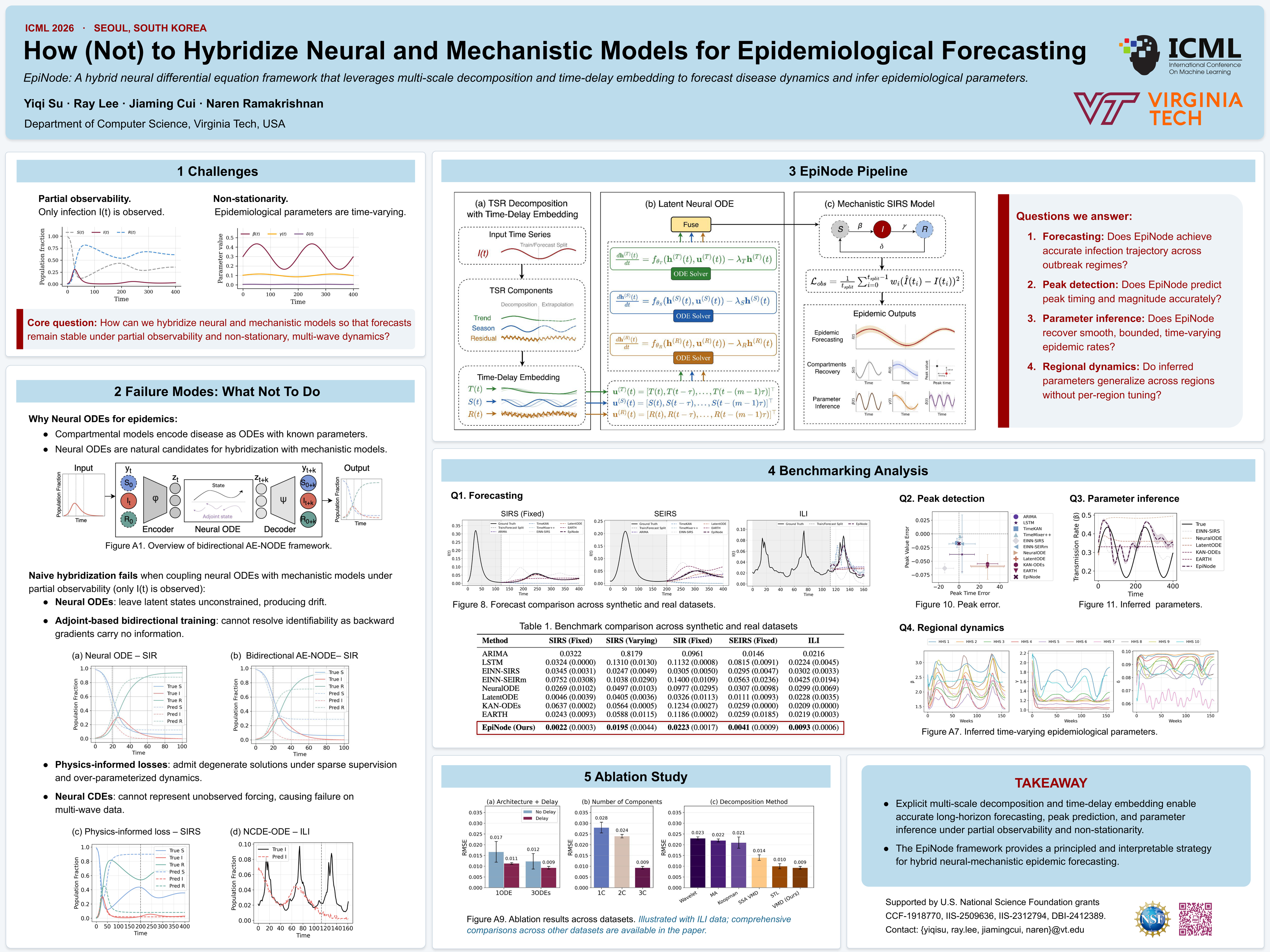
Epidemiological forecasting from surveillance data is a hard problem and hybridizing mechanistic compartmental models with neural models is a natural direction. The mechanistic structure helps keep trajectories epidemiologically plausible, while neural components can capture non-stationary, data-adaptive effects. In practice, however, many seemingly straightforward couplings fail under partial observability and continually shifting transmission dynamics driven by behavior, waning immunity, seasonality, and interventions. We catalog these failure modes and show that robust performance requires making non-stationarity explicit: we extract multi-scale structure from the observed infection series and use it as an interpretable control signal for a controlled neural ODE coupled to an epidemiological model. Concretely, we decompose infections into trend, seasonal, and residual components and use these signals to drive continuous-time latent dynamics while jointly forecasting and inferring time-varying transmission, recovery, and immunity-loss rates. Across early outbreak and multi-wave regimes, our approach attains the lowest RMSE on all five datasets (up to 57% reduction over the strongest baseline), predicts the peak within one time step on four of five, and recovers time-varying epidemiological rates within ground-truth ranges, without relying on auxiliary covariates.
Lay Summary
Forecasting how an epidemic will unfold over the coming weeks and months is hard. Public-health agencies typically only see reported case counts, not the underlying populations of people who are still susceptible, currently exposed, or already recovered. The dynamics of the disease also shift over time as people change their behavior, immunity wanes, weather changes, and new variants emerge. Classical mathematical disease models capture the textbook biology but assume fixed conditions, while modern AI models learn flexibly from data but lack the biological structure that keeps long-term predictions sensible. A natural idea is to combine the two, letting biology constrain the forecast while letting data drive the details. In practice, many of these hybrid combinations break down when only case counts are available and the disease keeps shifting. We diagnose where existing combinations fail and show what makes a hybrid actually work. Our approach, EpiNode, first separates the case time series into three patterns: a slow long-term trend, a repeating seasonal wave, and short-term fluctuations. These three signals act as a guide for a flexible model that fills in the unobserved biology and the disease parameters that change over time, while still respecting the textbook epidemic equations. On simulated outbreaks and real influenza data from the U.S. Centers for Disease Control, EpiNode produces the most accurate forecasts on every dataset we tested, reducing errors by up to about 60% over the strongest existing method. It pinpoints the timing of each epidemic peak to within roughly one week. The recovered disease rates stay within biologically plausible ranges, so the forecasts can support both projections of where cases are heading and explanations of why.