
When LLMs Develop Languages: Symbolic Communication for Efficient Multi-Agent Reasoning
Abstract
Lay Summary
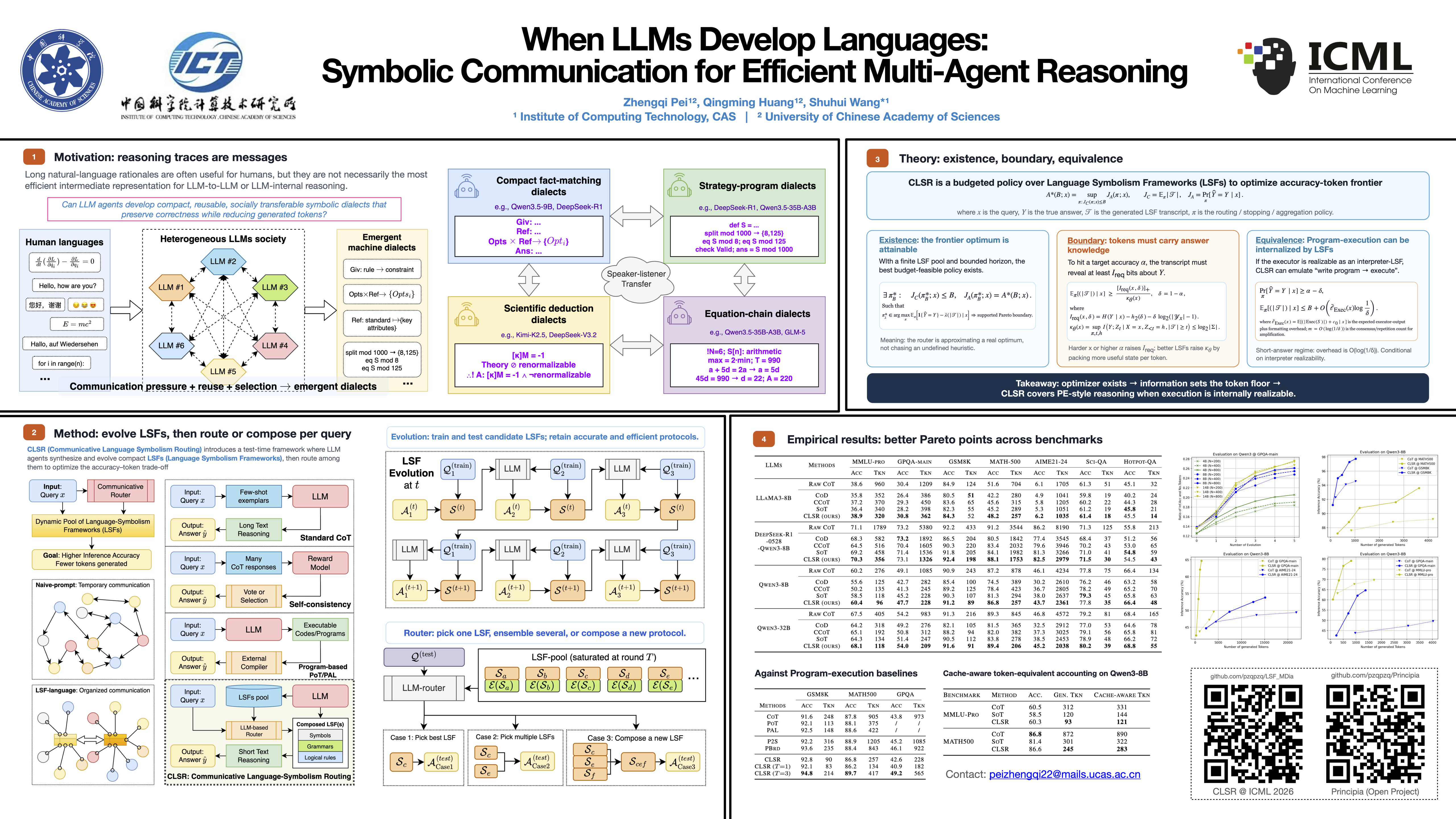
Large language models (LLMs) often solve hard problems by writing long and verbose step-by-step explanations. Practically, these long-text reasoning process can be slow and expensive to generate. In this paper, we ask whether these LLMs can instead invent shorter language symbolism frameworks (LSFs) that are readable for themselves without caring about human readability. These machine-oriented languages might help them reason more efficiently. Our method, called Communicative Language Symbolism Routing (CLSR), lets multiple LLM agents create compact reasoning LSFs, evaluate which LSFs work well, and keep the ones that answer correctly with fewer generated tokens. At inference time, an LLM-based router chooses whether to use one compact LSF, combine several LSFs, or spend more reasoning steps on harder questions. Across several reasoning benchmarks, CLSR keeps accuracy close to standard chain-of-thought reasoning while significantly reducing generated tokens by about three to six times. This results suggests that long natural-language explanations are not always necessary for machine reasoning. An LLM can sometimes use a shorter internal-style protocol instead, rather than those verbose natural languages. The work also gives a theoretical view of why such LLM-invented symbolic protocols can improve the tradeoff between accuracy and token cost. In general, CLSR provides a way to study how AI agents may develop shared communication conventions that are useful for efficient problem solving.