
Role-Level Inductive Bias for Cross-Task Generalization in Multi-Agent Reinforcement Learning
Abstract
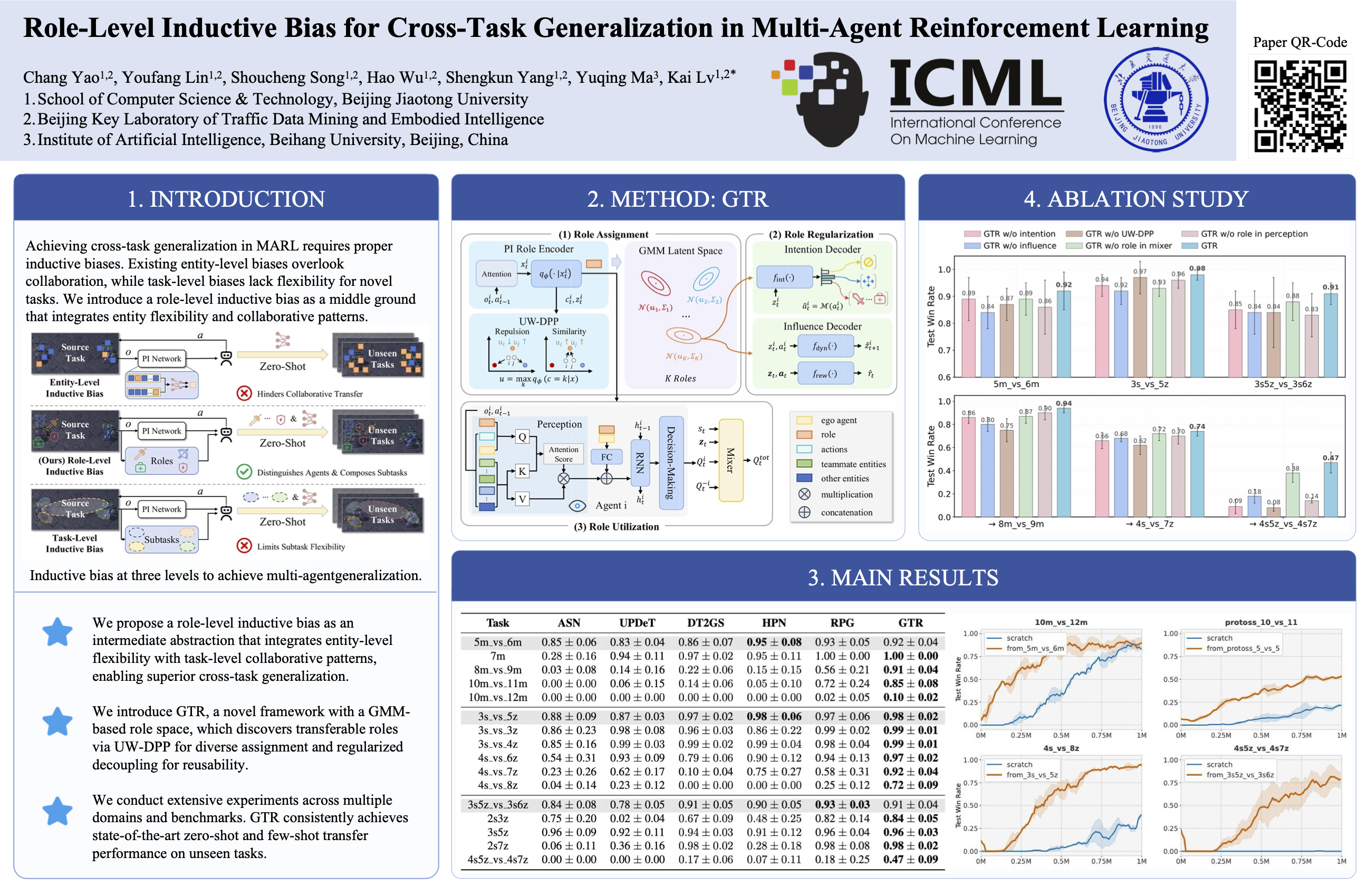
Achieving cross-task generalization remains a critical challenge in Multi-Agent Reinforcement Learning (MARL), fundamentally relying on effective inductive biases. However, existing entity-level biases often overlook collaborative patterns, whereas task-level biases lack sufficient coverage for novel scenarios. To address this, we introduce a role-level inductive bias as an intermediate abstraction that integrates entity-level flexibility with task-level inter-agent collaboration. To instantiate this, we propose Gaussian-mixture-model-based Transferable Role discovery (GTR). Specifically, GTR constructs a structured role space to ensure diverse role assignment, further achieves role decoupling via regularization, and ultimately utilizes these roles for efficient generalization. Empirical results demonstrate that GTR achieves superior zero-shot and few-shot transfer performance on unseen tasks compared to state-of-the-art methods.
Lay Summary
Teams of intelligent systems that work together struggle to apply the experience they have learned from previous tasks to new ones. Existing approaches either are built only to work with varying team sizes while neglecting to preserve collaboration knowledge, or are designed exclusively for specific, well-defined subtasks and become completely useless once the task composition changes. We wondered if there was a better solution. We found that introducing the concept of "roles"—just like the clear division of labor in human teams where there are organizers, movers, and inspectors—works extremely well. We developed a method called GTR that automatically discovers these general, reusable roles for robot teams. Surprisingly, these roles can transfer to unfamiliar new tasks within the same domain. Our method significantly outperforms existing approaches both when no new training data is available and when only a small amount is provided. This will greatly reduce the training costs and allow the team to adapt more quickly to different scenarios.