
MOD-SR: Unifying Multimodal Learning and Direct Optimization with Gradient-Guided Diffusion Model for Symbolic Regression
Abstract
Lay Summary
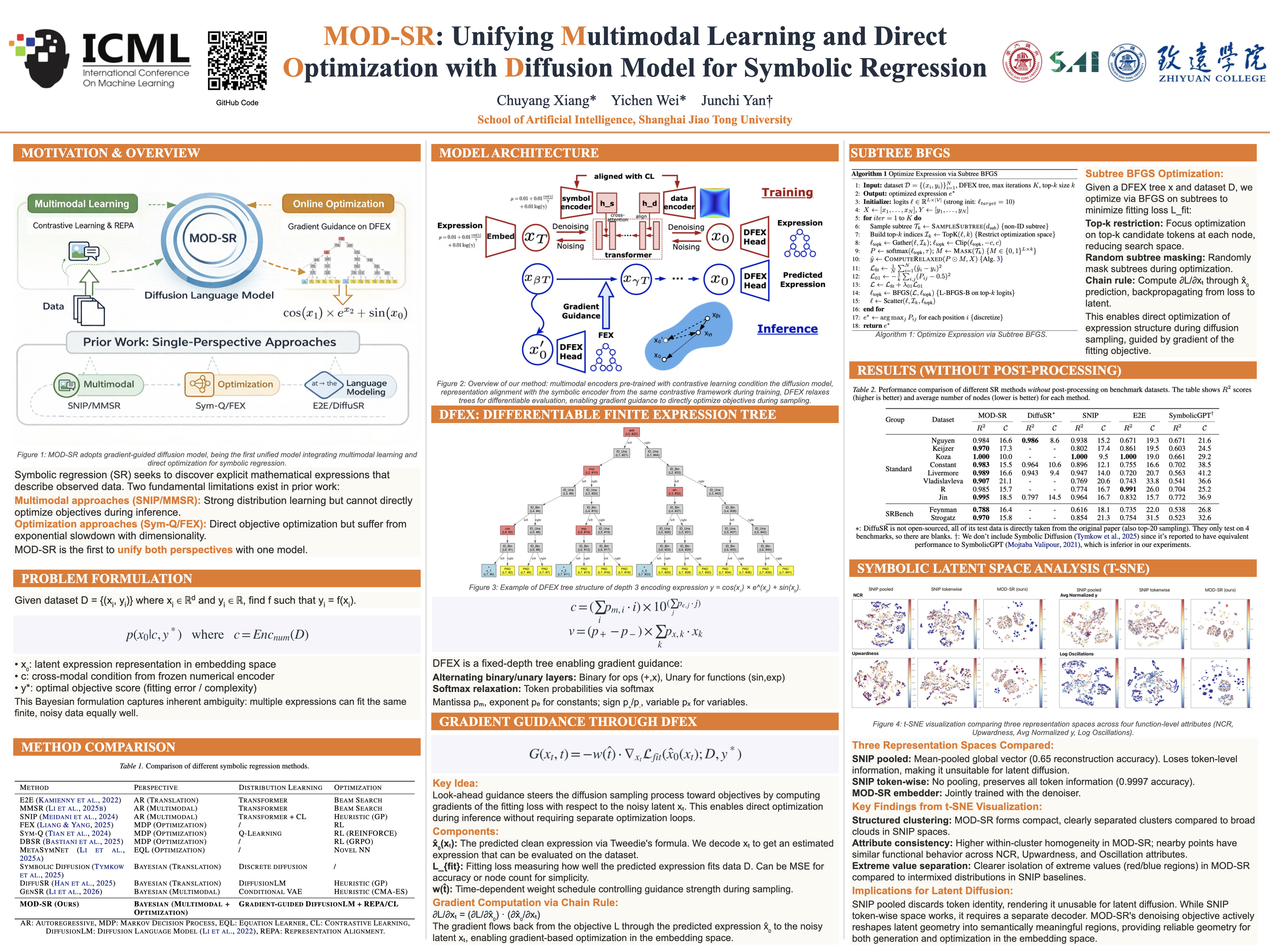
Symbolic regression is the task of finding the most accurate and simple mathematical formula that explains a given dataset—much like a scientist discovering physical laws from experimental observations. Recently, artificial intelligence has been used to "translate" data directly into equations. However, these AI models often struggle because their training goals don't perfectly align with what we actually care about: discovering highly accurate and concise formulas for specific new problems. Conversely, traditional search methods that actively try to build and test formulas step-by-step become excessively slow and get stuck when dealing with complex data with many variables. In this paper, we propose a new AI system called MOD-SR that combines the best of both worlds. During its initial training stage, it broadly learns the general patterns and "language" of mathematical equations. Then, when faced with a new dataset, it uses a guided refinement process—similar to how AI generates high-quality images—to continuously tweak and directly optimize the formula until it fits the data perfectly. To make this possible, we treat the rigid structure of mathematical trees as a smooth, continuous space, allowing the AI to effectively "slide" towards the best equation instead of resorting to trial-and-error. Our experiments show that MOD-SR is significantly more successful at discovering the true mathematical laws across various challenging benchmarks.