
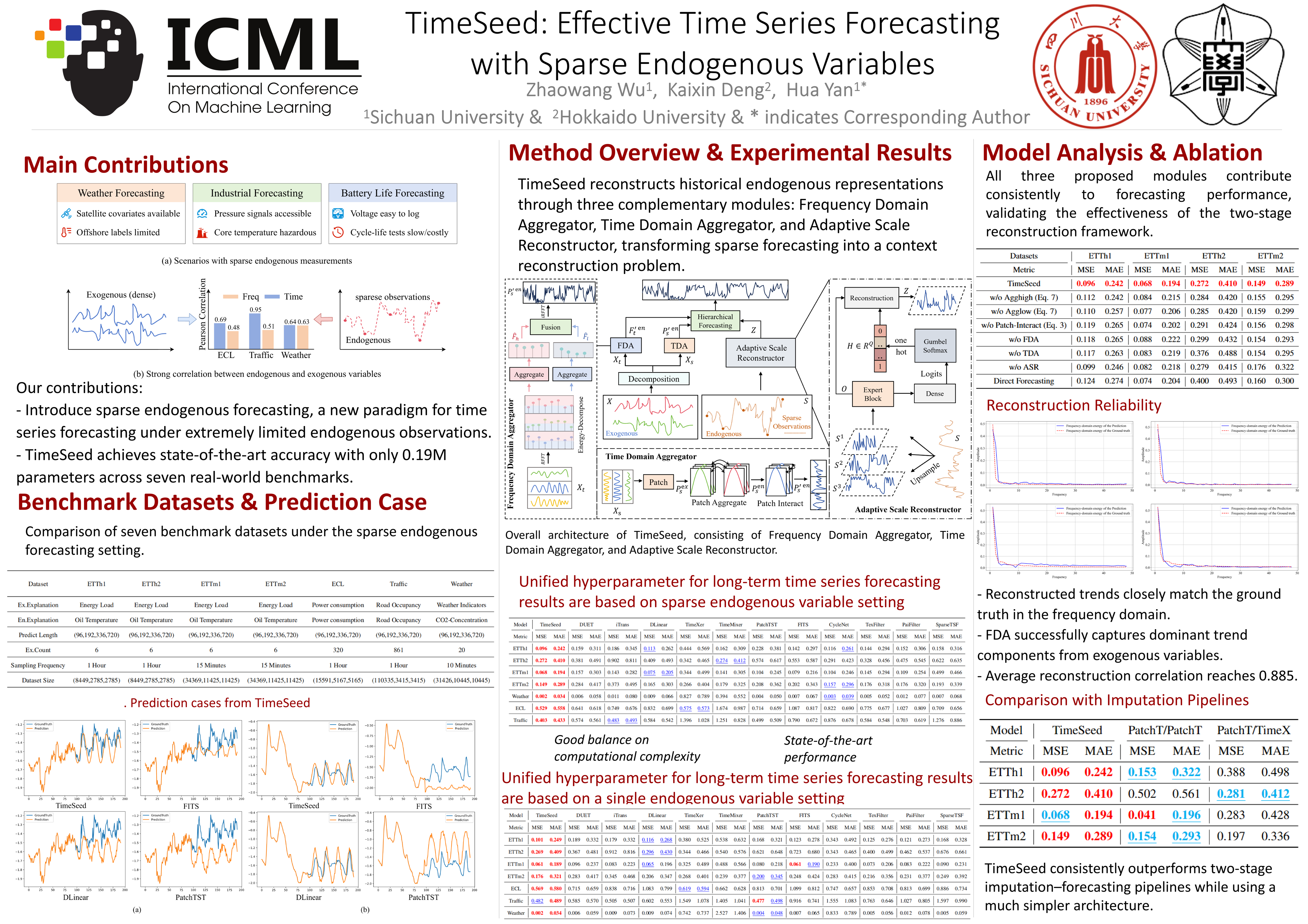
TimeSeed: Effective Time Series Forecasting with Sparse Endogenous Variables
Abstract
Time series forecasting has long relied on dense endogenous observations, yet in many real-world scenarios, such data is scarce or even absent. Existing approaches attempt to compensate with exogenous variables, but their reliance on incomplete endogenous histories makes them brittle under data scarcity. In this work, we introduce sparse endogenous forecasting as a new setting, where exogenous sequences and only sparse endogenous observations are available. To tackle this problem, we propose TimeSeed, a lightweight architecture that redefines sparse forecasting as a context reconstruction task. By jointly exploiting the stability of exogenous sequences and the limited but informative endogenous signals, TimeSeed reconstructs robust historical representations and transforms forecasting into a tractable sequence-based prediction problem. Remarkably, TimeSeed achieves this with a purely linear architecture using only 0.19M parameters, consistently outperforming state-of-the-art deep models on seven real-world benchmarks, with an average improvement of 13.01\% in MSE and 7.54\% in MAE. These results establish sparse endogenous forecasting as a practical and promising paradigm, opening a new direction for time series analysis under extreme data scarcity. Code is available at this repository: \url{https://anonymous.4open.science/r/Alistair-7}.
Lay Summary
Many real-world forecasting systems must make predictions even when historical target data is missing or only rarely recorded. For example, in healthcare, energy systems, and industrial monitoring, the variable we want to predict may only be observed occasionally, while related external signals are continuously available. Existing forecasting methods usually depend on complete historical records, making them unreliable in these sparse-data settings. We propose TimeSeed, a lightweight forecasting method designed specifically for situations where only a few observations of the target variable are available. Instead of directly predicting the future from incomplete data, TimeSeed first reconstructs the missing historical context by learning relationships between sparse target observations and richer external signals. It captures both long-term trends and repeating patterns, then combines them to make future predictions. Despite using only simple linear components and a very small number of parameters, the model remains highly effective. Across seven real-world benchmarks, TimeSeed consistently outperforms existing state-of-the-art forecasting methods.