
NeuroCLUS: A Foundation Model with Functional Clustering for Intracranial Neural Decoding
Abstract
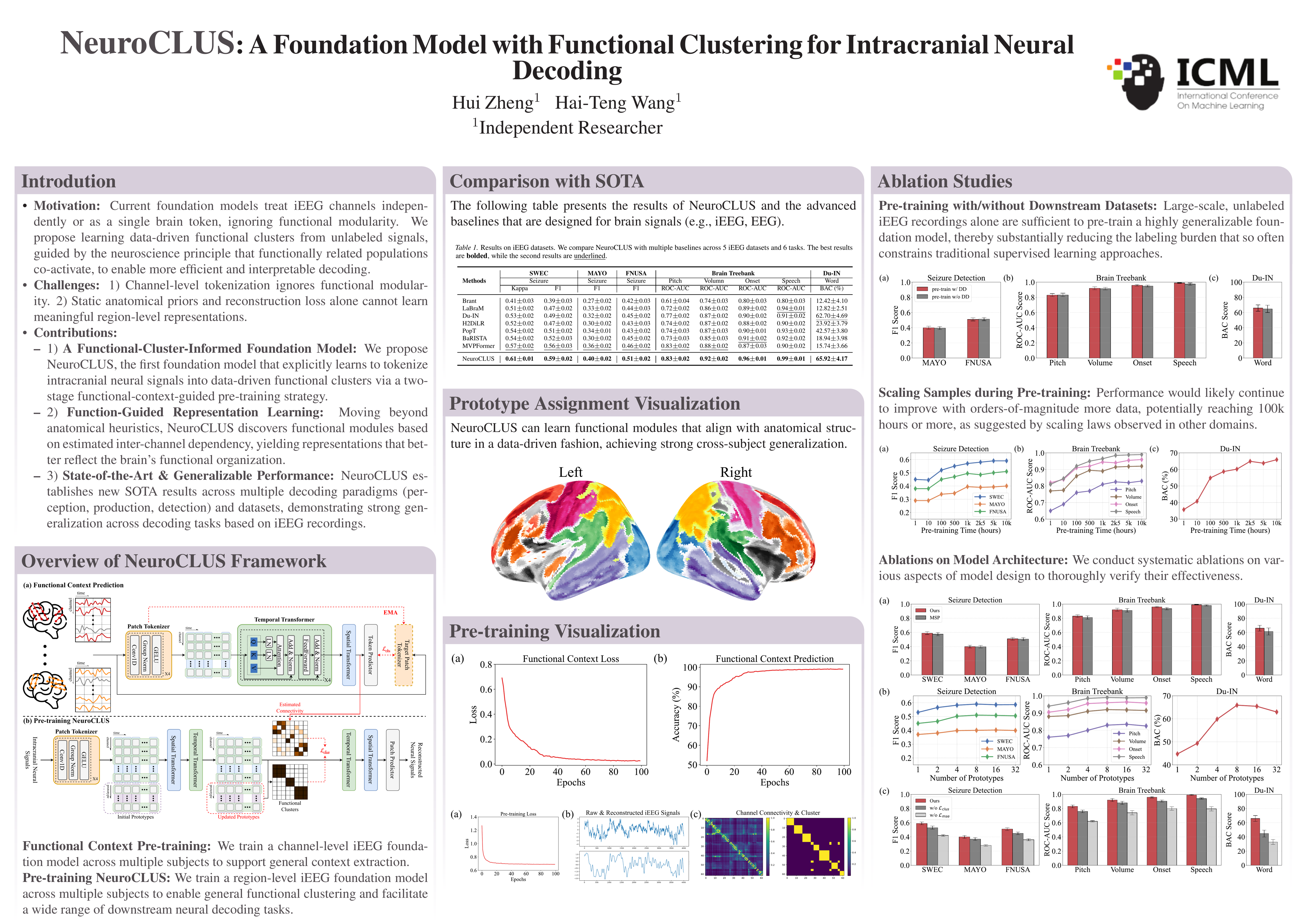
Foundation models for intracranial neural recordings aim to learn generalizable representations from large-scale unlabeled data. However, existing approaches rely on suboptimal tokenization schemes -- treating individual electrode channels as independent tokens or aggregating them into a single brain-wide representation -- which fail to capture the brain’s inherent functional modularity. We introduce NeuroCLUS, a foundation model that learns to represent neural activity through data-driven functional clusters. NeuroCLUS is built on a novel two-stage pre-training framework. First, a spatial-temporal model learns a functional context graph between channels via a functional context prediction task. Second, this graph guides a soft clustering of channels into a set of learnable prototype tokens, enabling the transformer backbone to process coherent functional units rather than raw channels. Evaluated across a diverse range of decoding paradigms -- including speech perception, speech production, and seizure detection -- NeuroCLUS consistently achieves state-of-the-art performance. The discovered functional clusters align with established neurophysiology and offer enhanced interpretability. Our work demonstrates that explicitly modeling functional neural groupings significantly improves the efficiency, generalization, and interpretability of foundation models for intracranial decoding.
Lay Summary
When doctors place electrodes inside the skull to record brain activity, they get a wealth of data—but making sense of it is challenging. Existing AI models either look at each electrode in isolation or treat the whole brain as one lump, missing the fact that different brain regions naturally work together in teams. This limits their ability to decode speech or detect seizures. We developed NeuroCLUS, a new AI model that first learns which electrodes tend to fire together—forming “functional teams”—and then uses those teams to interpret brain signals. Think of it like recognizing that a basketball team’s players coordinate their movements, rather than watching each player alone or just the whole court. Our model discovers these teams automatically from the data, without needing a pre‑defined map of brain areas. When tested on real patient recordings, NeuroCLUS outperformed all previous methods on three challenging tasks: perceiving speech, producing spoken words, and detecting epileptic seizures. Notably, it succeeded where others failed on the complex task of decoding actual word production. By helping AI understand the brain’s natural teamwork, NeuroCLUS brings us closer to more reliable brain‑computer interfaces for restoring communication in people with severe paralysis and to better tools for monitoring epilepsy.