
Dispersion Loss Counteracts Embedding Condensation and Improves Generalization in Small Language Models
Abstract
Lay Summary
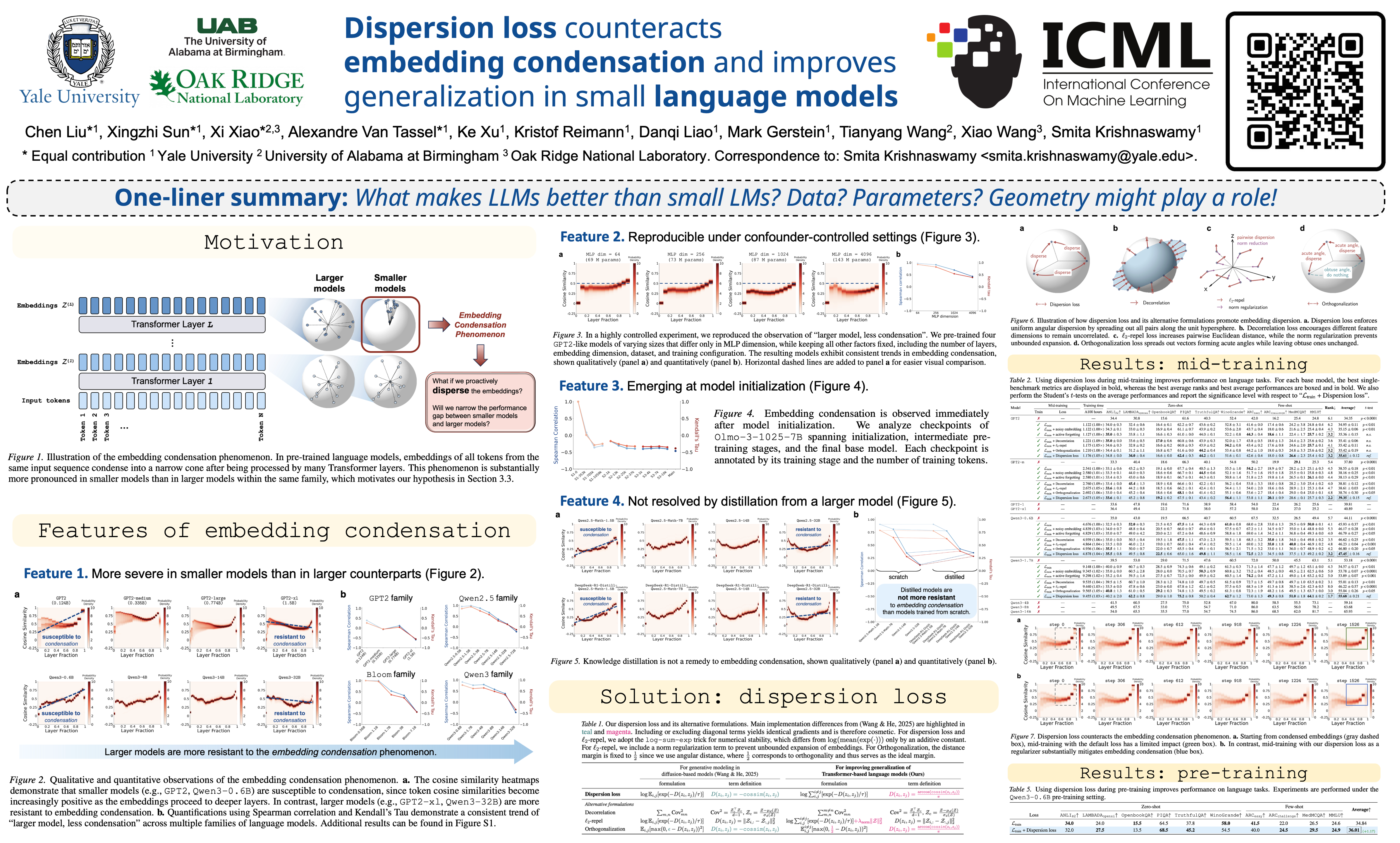
Language models represent each word or token as a point in a high dimensional space. We found that in many language models, these points gradually collapse into a narrow cone as they pass through the model's layers, leaving much of the representation space unused. We call this phenomenon embedding condensation. This collapse is much stronger in smaller models than in larger models from the same family, and it appears consistently across different model families, datasets, and under confounder-controlled settings. Surprisingly, embedding condensation is already present at initialization, and is not reliably solved by distilling knowledge from a larger model. These findings suggest that smaller language models are not only limited by having fewer parameters, but also by how their internal representations are geometrically organized. To test whether this geometry can be improved, we introduce a simple training objective that encourages token representations to spread out more evenly. This reduces embedding condensation and modestly improves generalization, pointing to representation geometry as a useful direction for making language models more capable.