
No More K-means: Single-Stage Sparse Coding for Efficient Multi-Vector Retrieval
Abstract
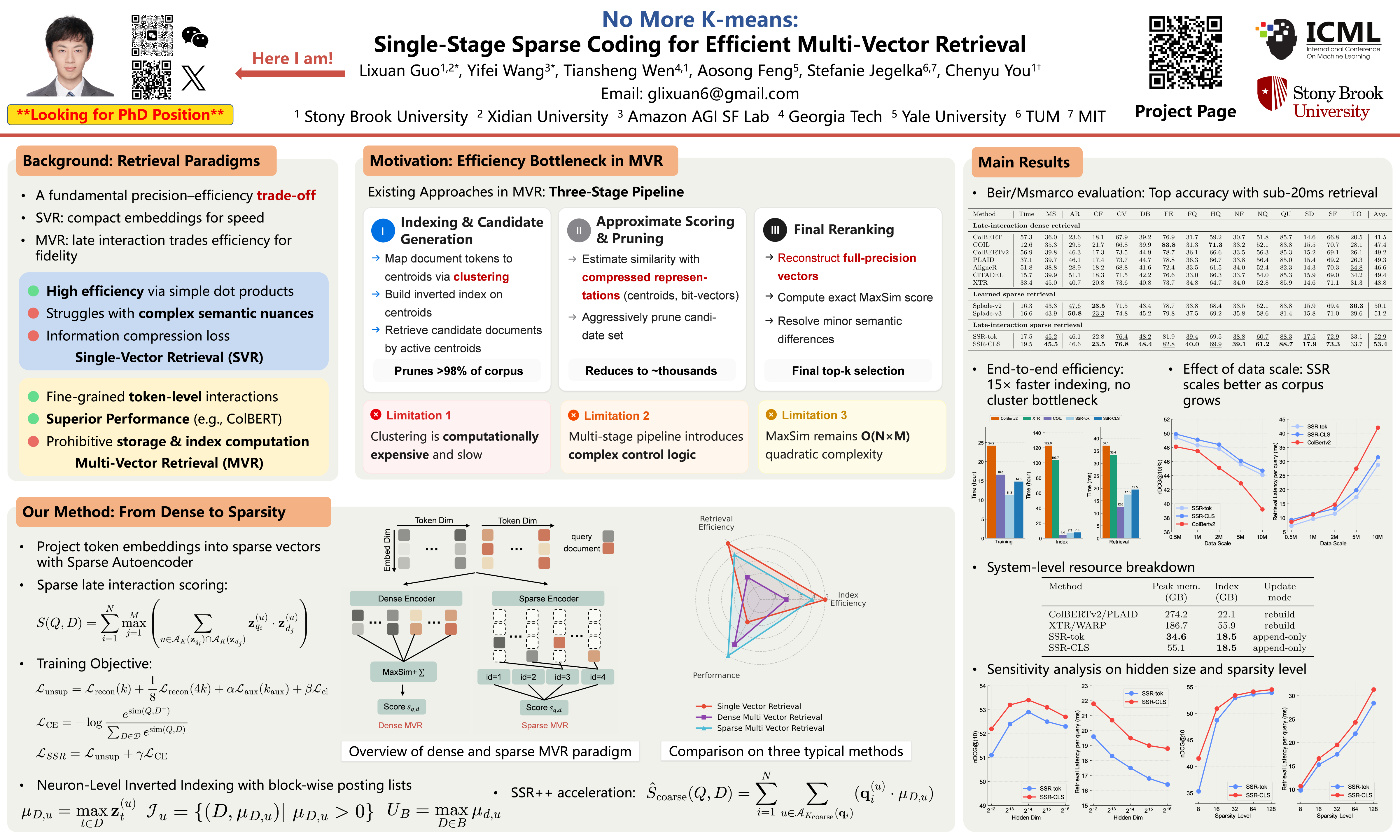
Multi-vector retrieval (MVR) models, exemplified by ColBERT, have established new benchmarks in retrieval accuracy by preserving fine-grained token-level interactions. However, this granularity imposes prohibitive storage and retrieval efficiency bottlenecks: to manage the immense memory footprint and computational overhead of billion-scale token vectors, state-of-the-art systems are forced to rely on aggressive dimension reduction and complex clustering (e.g., K-means). This compromise introduces two critical limitations: excessive indexing latency of clustering large-scale corpora and semantic information loss inherent to compression. In this paper, we propose Single-stage Sparse Retrieval (SSR}, a paradigm shift that replaces expensive clustering with efficient sparse coding. Instead of compressing features into low-dimensional dense vectors, we utilize Sparse Autoencoder (SAE) to project token embeddings into a high-dimensional but highly sparse representation. This transformation enables us to bypass vector clustering entirely and leverage inverted indexing for precise, high-throughput retrieval. Extensive experiments on the BEIR benchmark demonstrate that SSR achieves a "trifecta" of improvements: it reduces indexing time by 15x compared to ColBERTv2, halves retrieval latency, and simultaneously improves retrieval performance over leading baselines.
Lay Summary
Modern AI search systems can find highly relevant documents by comparing a user’s question with many small pieces of each document, but this usually makes them slow, costly, and difficult to update. This paper introduces a simpler and more efficient search method that keeps the benefits of detailed document matching while avoiding expensive clustering steps. By organizing document information in a sparse way, the method can search large collections faster and build indexes much more quickly. Experiments show that it improves search quality while roughly halving retrieval time and greatly reducing indexing time, making accurate AI search more practical for large-scale real-world applications.